

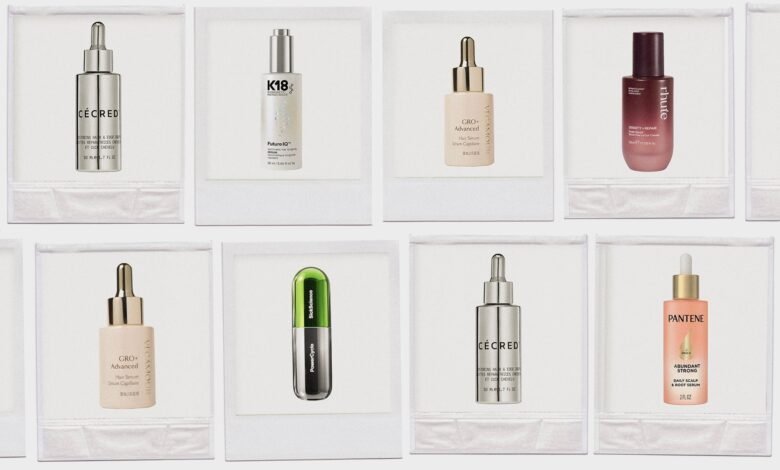
Whether you’re trying to regrow hair after a heavy shed or simply hoping to achieve longer lengths, navigating a hair growth journey comes with plenty of information to digest. There’s also no shortage of products to choose from—particularly the burgeoning scalp serums category. But does what you reach for depend on whether your goal is to encourage growth or slow shedding as much as possible? In short, yes, but the answer is nuanced.
“The primary goal of a hair growth serum is to stimulate new hair growth and increase overall density, whereas an anti-shed serum is designed to reduce shedding and help you retain the hair you already have for longer,” board-certified dermatologist Sejal Shah, MD, tells Vogue. “While the two can overlap, reducing shedding may help improve the appearance of fullness, and some hair growth products may also help minimize shedding, they are not necessarily interchangeable.”
Best with Peptides: K18 FutureIQ Biomimetic Hair Longevity Serum, $120
Best with Exosomes: SickScience PowerCycle Exosome Hair Growth Serum, $64
Best with Bioactive Keratin: Cécred EdgeEdge Hair & EdgeRestoring Drops, $56
Best with Clover Extract: Vegamour GRO+ Advanced Hair Serum, $78
Best Affordable: Pantene Abundant & Strong Daily Scalp Serum, $24
To sort out what’s what, Dr. Shah advises taking a close look at a product’s ingredients and their mechanisms rather than relying on the claims printed on the label alone. And if you’re less concerned with achieving Rapunzel-esque lengths and more focused on addressing excessive thinning, the experts strongly recommend identifying the underlying cause alongside maintaining a supportive hair care routine. “I like to think of these serums as adjuncts to an overall healthy hair-care routine,” says Dr. Sejal. “The goals of a good hair routine are to maintain a healthy scalp environment, support the hair follicles, preserve the hair you have, minimize breakage, and, when a hair-loss disorder is present, address the underlying condition appropriately.”
Still, board-certified plastic surgeon Paul Chasan, MD, reminds us to stay realistic about what topical products can actually achieve—and he speaks from experience, having both undergone and performed multiple hair transplants. As Dr. Chasan explains, “Topical serums generally stimulate hair follicles and increase blood supply through various types of natural remedies. Most of these have very subtle growth profiles.”
That said, adding a hair growth and anti-shedding serum to my routine has made a noticeable difference in my own stress-related hair loss journey—especially by reducing shedding in the shower and during styling (though I’m still waiting to see new hair growth!). Scroll on to discover more.
“A hair growth serum works by prolonging the anagen, or growth, phase of the hair follicle by activating and promoting hair growth via growth factors (such as exosomes) or increasing blood flow (like minoxidil),” board-certified plastic surgeon Kaveh Alizadeh, MD, tells Vogue. There are plenty of other powerhouse ingredients worth looking for in a formulation, too.
“L-arginine may help support a healthy scalp environment, including by promoting circulation, while peptides act as targeted signaling ingredients designed to support stronger, healthier-looking hair,” adds Dr. Shah. “Together, these ingredients may help create a supportive environment for maintaining healthy-looking hair and supporting the natural hair-growth cycle.” She also points to caffeine, rosemary oil, peppermint oil, and ginseng as ingredients that may help promote blood flow. A good example here is Cécred’s edge drops which blend peptides, keratin, and biotin to boost hair growth. Meanwhile, SickScience’s formula relies on exosomes, while Rhute implements a blend of peptides, caffeine, and more.
Anti-shed serums work by stopping the bleeding, so to speak: By slowing hair shedding, they can help hair maintain a sense of fullness and improved density. “Anti-shed serums work on limiting the telogen, or resting phase of the hair follicle, acting as a natural inhibitor of 5-alpha reductase, the enzyme responsible for converting testosterone into DHT,” says Dr. Alizadeh. But before going any further, it’s worth understanding what DHT actually is. “Dihydrotestosterone (DHT) alters follicular signaling—over successive hair cycles, these susceptible follicles can become progressively miniaturized, producing thinner and shorter hairs,” explains Dr. Shah, adding that the hormone can also shorten the active growth phase of the hair cycle.
With that in mind, she continues, ingredients like aminexil can support both the hair follicle and root environment, potentially reducing processes associated with hair anchoring and shedding. Then there are finasteride and dutasteride, which inhibit DHT-converting enzymes—though these are often prescribed as medical treatments and should be used under the guidance of a health care professional. K18’s serum relies on peptides for anchoring hair into the scalp at the root, while Vegamour uses plant-derived actives. Plus, Pantene offers an affordable option, that helps balance the scalp’s natural biome.
Source: www.vogue.com