

Zeraati, who is thirty-eight, had arrived in England in 2007 to study mechanical engineering. After graduating, he was hired as a reporter for Manoto, a Persian-language television channel based in London that, at the time, was one of the most-watched in Iran. He quickly rose to prominence with an opinionated style that he modelled after anchors he admired on Fox News and CNN. In 2022, Zeraati started hosting a Friday-night program called “The Last Word” at Iran International, a satellite channel that was attracting attention among Iranians for its scathing coverage of the regime.
Zeraati and I first met over dinner in late 2022. He was polished and charismatic, with dark-brown hair slicked into something approaching a quiff. He told me that his program was reaching peoplehip had nearly eliminated independent media. Iran International was launched in 2017 with funds from Saudi-British investors
The channel, which is banned inside Iran, refuses to disclose its private donors. And that refusal has given rise to suspicions that the network is part of a media campaign to bolster the Iranian government’s opposition. When I met Zeraati, the “Women, Life, Freedom” protest movement had erupted across the country after the death in custody of Mahsa Jina Amini, a twenty-two-year-old woman who had been detained and beaten by the police for reportedly exposing her hair.
Zeraati and his colleagues’ broadcasts featured interviews
Zeraati and his colleagues’ broadcasts featured interviews with anti-regime activists and Israeli officials, and a steady stream of videos from street demonstrations: women burning their hijabs, police beating university students, and crowds shouting “Death to the mullahs’ regime!” In a post on Twitter, Zeraati called for “the destruction of a murderous regime that kills worshippers and children.” He later told me, of Iranian officials, “I don’t bother to hide what I really think of them.”
The Iranian government saw Iran International’s coverage as evidence that the channel and its anchors were weapons in an information war.
The country’s intelligence minister, Esmail Khatib, accused the station of being a “terrorist organization.” He said it was operating as an extension of a coördinated “influence operation,” backed by the regime’s regional enemies, to erode confidence in Iran’s government and incite violence at home. Fars News Agency, which is affiliated with Iran’s Islamic Revolutionary Guard Corps, created a poster that said “WANTED: DEAD OR ALIVE,” beneath head shots of Zeraati and four other anchors.
U.K. police deployed armored vehicles to Iran International’s office in Chiswick after they discovered threats against its staff. Photos of Zeraati’s residence were posted on social media. His wife was followed to her gym by two men on a motorbike who told her, in Farsi, that she and her husband would be killed. Police installed alarms in the couple’s home and moved them temporarily to a safe house.
Zeraati and his wife stopped doing many
Zeraati and his wife stopped doing many of their usual activities, such as trips to the grocery store and dinners out with friends. But he didn’t tone down his messaging. In early January, 2023, Zeraati called the regime “the Islamic Republic of filth” after it executed two protesters. His posts about Reza Pahlavi, the son of the deposed Shah of Iran, veered toward adulation.
Zeraati endorsed Pahlavi as “a mature political leader whom Iran needs today,” and his social-media accounts featured photos and videos of crowds greeting the former Crown Prince in Oxford, Brussels, and Jerusalem. Zeraati also flew to Israel and filmed an interview with Prime Minister Benjamin Netanyahu. In the segment, Netanyahu spoke directly to the Iranian people, praising the ongoing protest movement, and he challenged the country’s leaders to “let your people go.” Viewership of Zeraati’s program soared; so did the number of threats.
Soon after, a pair of men wearing medical masks arrived outside Zeraati’s home in Wimbledon. They carried a bat and scissors. His wife filmed the men from their balcony. A neighbor, who spotted the men lingering in a garden behind Zeraati’s building, notified the police, who arrived and arrested them. Investigators later discovered that the intruders were Romanian nationals.
One of them, a twenty-two-year-old named George Stana,
One of them, a twenty-two-year-old named George Stana, had travelled to England weeks earlier. Messages recovered from his phone showed that an anonymous handler, nicknamed Em, had directed him to the address. “His flat is number 5,” Em wrote. “Make sure he is alone. Hope you do it today.”
Shortly after the police disrupted the plot, they released Stana, who flew back to Bucharest.
But he returned to London a year later, to finish the operation. He stayed in a hotel room with two other Romanian men who had also been enlisted for the job. During the next few weeks, Stana’s sister, Florina, wired the group money to pay for SIM cards, clothing, lodging, and a blue Mazda. The team made a series of short trips to Zeraati’s home to scope out his neighborhood and study his movements.
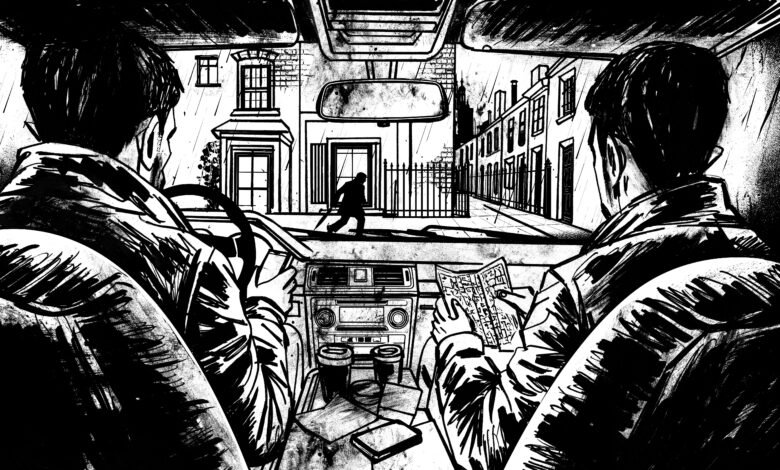
On a Friday in March, 2024, at around 3 P.M., Zeraati was leaving home for his weekly commute to Iran International’s studios. As he walked to his car, a nineteen-year-old Romanian man, Nandito Badea, came up to him and asked him for “three pounds.” At the same time, another Romanian, David Andrei, approached Zeraati from behind. One of them grabbed Zeraati while the other plunged a knife into his right leg three times.
The two men ran, laughing, to the blue
The two men ran, laughing, to the blue Mazda that was waiting for them, and Stana, who was driving, sped away. Zeraati lay collapsed in the street. Neighbors who overheard the scuffle arrived to help. A construction worker fashioned a tourniquet out of a tool belt to stanch Zeraati’s bleeding. Meanwhile, the three Romanians ditched the van, chucked their clothing into a garbage bin, and ordered a taxi to Heathrow Airport.
They boarded a flight to Geneva and then another to Bucharest. The Iranian regime has been killing troublesome exiles since the Islamic Revolution, in 1979. Its agents have been accused of murdering dozens of people living abroad. One of the most dramatic attacks took place in Berlin in 1992, when Iranian agents gunned down a group of Kurdish opposition leaders while they were dining at a Greek restaurant.
Police arrested the murder suspects. German prosecutors said that the men were sent by senior members of the Iranian regime, including the Supreme Leader. Later, an international arrest warrant was issued for Iran’s intelligence minister, Ali Fallahian. The German prosecution ushered in a period of relative quiet. The pace of plots picked up in 2009, following nationwide protests against the regime.
Authoritarian governments fear their own people, Ray Takeyh,
Authoritarian governments “fear their own people,” Ray Takeyh, an expert on Iran at the Council on Foreign Relations, told me, and that fear “becomes much more acute during periods of vulnerability.” Iran has increasingly relied on hybrid threats as it has confronted a series of of humiliations: a U.S. drone strike, in 2020, that killed Qassem Suleimani, the leader of Quds Force, I.R.G.C.’s élite special-forces-and-intelligence unit; another wave of nationwide protests in 2022; the near-destruction of Iran’s overseas proxies; and an almost uninterrupted cycle of attacks from Israel and the United States since last June.
“The more setbacks Iran experiences at home and in the region, the more attractive these fairly cost-free operations become,” Matthew Levitt, a senior fellow at the Washington Institute for Near East Policy, told me. Levitt maintains a digital map that tracks Iranian-backed plots abroad since the country’s revolution. Over the past five years, he has recorded more than two hundred—nearly double the number documented from 1979 to 2021.
Many have targeted dissidents or journalists whom the regime accuses of aiding its enemies and fomenting unrest in Iran. “Unless Western governments find a real way to increase the costs, the regime will continue to get away with kidnapping, conducting surveillance, and ultimately trying to murder people on their soil,” Levitt told me. One such operation was foiled in 2021, when a team of gunmen, including a member of the Hells Angels, used an encrypted-messaging service called Sky E.C.C.
To orchestrate the assassination of two Iranians living
to orchestrate the assassination of two Iranians living in Maryland. Federal prosecutors said that, at the behest of the Iranian government, the attempted murder was coördinated by a serial criminal named Naji Sharifi Zindashti, who lives in Tehran. The U.S. Treasury Department and British officials imposed sanctions on Zindashti and his associates for directing “heinous operations” against Iranian dissidents.
The hits, which were never carried out, were consistent with a growing trend of Iran-hired “groups trying to murder U.S. residents on U.S. soil,” Suzanne Turner, the assistant director of the F.B.I.’s Counterintelligence Division, said. In 2022, an Azerbaijani man armed with an AK-47 arrived at the Brooklyn home of an Iranian American activist, Masih Alinejad, with orders to kill her.
The would-be assassin was arrested by police and led investigators to two members of a Russian mob network who had enlisted him on behalf of Iran. Law-enforcement agents in Europe began to notice a similar pattern: a court in Germany convicted a man of trying to burn down a synagogue in the city of Bochum in 2022. He was sent by a former Hells Angels member who lived in Iran. In 2023, a Chechen-born man flew to London and filmed the exterior of Iran International’s newsroom headquarters.
He was arrested by the police and convicted
He was arrested by the police and convicted of spying for a terror plot against the network. “Criminals can obtain false documents, cross borders, rent safe houses, arrange cars, move money, and disappear,” Phillip Smyth, a researcher who tracks Iran’s proxies, told me. The use of local criminals, who don’t have any affiliation with Iran, forces European governments to “invest more in domestic security,” and demonstrates that “any crook can wreak havoc” in diaspora communities, Smyth said.
The tactic also makes it difficult for investigators to link the plots to the Iranian regime. According to Western governments, the operations are coördinated by agents in Iran’s Islamic Revolutionary Guard Corps and its Ministry of Intelligence. The United States, the United Kingdom, and the European Union have sanctioned members of a specific I.R.G.C. unit, known as 840, that has a long history of ordering covert operations in Europe.
One of the more elaborate assassination-for-hire schemes unfolded in 2024, when the regime allegedly tried to target an Iranian dissident who was living in Haarlem, in the Netherlands. The dissident, Siamak Tadayon Tahmasbi, had been accused by Iran’s Ministry of Intelligence of directing terrorist plots tied to Israeli intelligence. That March, Tahmasbi noticed strangers loitering around his apartment building.
He notified Dutch police, who gave him
He notified Dutch police, who gave him a personal alarm that he could use to call them. He also installed a hidden camera near his back door. For weeks, he barricaded himself inside his apartment, smoking cigarettes and drinking black tea to stay awake. “I could not take my eyes away from the surveillance screen,” he told me. “My life depended on it.” Finally, in June, a pair of men broke into Tahmasbi’s yard wielding guns and a large hammer.
He pressed his panic button to summon the police, who arrived within minutes and arrested the intruders. Dutch intelligence later said that the two men were likely hired by the Iranian government to kill Tahmasbi. One of the suspects was a Tunisian French man who was already wanted for an attempted murder in Spain. According to the police, he had shot a former politician—an outspoken critic of Iran’s regime—in the jaw, months earlier, on the streets of Madrid.
(Spain’s high court has since charged eight people, including the Tunisian French man, with terrorism.) The Dutch police assigned round-the-clock bodyguards to protect Tahmasbi and began shuttling him through a series of safe houses. “It’s an unofficial prison,” Tahmasbi told me from one of his locations. “But a happy one.” He was content knowing he had helped to unravel a multiyear, international operation designed to kill him and others.
Today, such plots appear to be proliferating
Today, such plots appear to be proliferating. Since 2022, counterintelligence officials have identified more than twenty Iran-backed operations that targeted U.K. residents, including Iranian reporters working for Persian-language outlets in London. “There are hundreds of journalists here doing a job that the Iranian authorities hate,” Fiona O’Brien, the regional director for Europe and Central Asia at the Committee to Protect Journalists, told me.
Dozens of exiled Iranians have described to me how violence and harassment have upended their lives and the lives of their families in Iran. “They have been coming after our relatives and our elderly parents, and putting pressure on them to stop us from doing our work,” Behrang Tajdin, a journalist at BBC Persian, told me. “It is becoming more and more aggressive.”
Sima Sabet, an independent journalist, told me that she had moved more than six times since 2022, when she learned that police had foiled a plot by Iranian agents to kill her using a car bomb.
“I feel like a fugitive in a town I have called home for more than two decades,” she said. Even now, she avoids public transport and covers her face when walking through her neighborhood or a local park. “It is an alienating existence. This is what my enemies wanted for me,” she said. “Anyone who is against them is against God. We are infidels. It is acceptable to eliminate us.” But she continues to publish programs, on YouTube and her social-media accounts, which include more than one million followers.
Inside the office, producers toggled dials
Inside the office, producers toggled dials in a control room that looked out onto a vast studio. Tall monitors, stationed in hallways and kitchens, reminded staff members to report suspicious activity to the company’s security team. Two adjoining spaces on the ground floor served as a newsroom filled with desks. A wall of muted screens flashed headlines in Farsi about ongoing peace negotiations between the U.S.
and Iran. Iran International employs about seven hundred people who work in bureaus around the world. In the past decade, it has emerged as one of the most influential and popular media channels in Iran. It is beamed into living rooms via satellite dishes, which millions of Iranians use to skirt the government’s media censorship. The channel’s sources of funding are opaque. Iran International’s parent company, Volant Media, is controlled by a wealthy Saudi businessman, Adel Abdulkarim Alabdulkarim.
In December, Volant Media received about eight hundred and seventy million dollars in a “debt-for-equity” swap with its anonymous shareholders so it could reduce debt the channel had accrued since it started broadcasting. In response to questions from The New Yorker, Iran International declined to disclose its donors. In a written statement, the channel dismissed the suggestion that “hidden hands” were directing its newsroom as “mere speculation.” “The claims that we are funded or directed by state actors (from anywhere) are false.
Such claims echo a long-running disinformation campaign aimed
Such claims echo a long-running disinformation campaign aimed at discrediting the network and increasing the security risks faced by our journalists and staff,” the statement said. The Financial Times reported this year that Volant Media is owned by an offshore company whose owner has alleged ties to the Saudi government, which has advocated for regime change in Iran and sanctions against the country.
The financial affiliations have prompted speculation, especially through strands of the Iranian diaspora, who accuse some of its journalists of exaggerating the level of support for figures in the opposition and of advocating for war. In 2023, Iran’s government reportedly demanded that the Saudi Kingdom tone down the station’s reporting during negotiations aimed at reducing tension between the two countries.
The channel’s support for Iran’s opposition turned more brazen in December, when the Islamic Republic faced another wave of demonstrations across the country. As the unrest spread, Iran International’s anchors amplified the messaging of Reza Pahlavi, the son of the deposed Shah, urging protesters to “plan for the revolution” and stay in the streets “until Israel attacks.” Soon after, in January, security forces massacred thousands of Iranian protesters with military-style weapons.
In the days that followed, Iran International broadcast
In the days that followed, Iran International broadcast harrowing testimony from survivors who spoke about the violence. Its anchors argued passionately for a foreign intervention that would allow protesters to oust the regime under Pahlavi’s leadership. “After all the blood we have shed,” one newscaster said, “we cannot possibly settle for anything short of a complete overthrow.” The programming featured appearances from American senators, including Lindsey Graham, who promised “help is on the way” and called the end of the Islamic Republic “a godsend to America.” One commentator suggested on Twitter that the United States should use atomic weapons: “Trump or Truman Plus?” the post said.
“Maybe this is the ultimate solution to defeat the devil.”
Iran’s military called the coverage “psychological warfare” designed to brainwash ordinary Iranians and “help the goals” of the U.S. and Israel. “If support for this vile and satanic media continues, those who collaborate with it will be added to the Islamic Republic of Iran’s target list,” the military said in a statement.
Iran’s state media, in turn, has waged a sophisticated propaganda campaign, publishing a barrage of content and misinformation meant to sway public opinion of the wider war and diminish its government’s losses. The regime’s charges that Iran International functions as a tool of its rivals may be legitimate, but that doesn’t justify eliminating its correspondents abroad. This year, the Iranian government froze the bank accounts and seized assets belonging to more than a hundred Iranians who are living overseas, including dozens of staff members and associates of Iran International.
In the past year, the channel’s legal team
In the past year, the channel’s legal team has documented an “alarming and unprecedented escalation” in threats against hundreds of the staff’s family members in Iran, many of whom government authorities have threatened to imprison or kill unless their relatives stop working. “Essentially, everyone working at Iran International has been designated as a Mossad agent, which makes them terrorists who are killable on sight,” Mark Stephens, a British lawyer who represents the channel, told me.
In April, two men and a sixteen-year-old boy in an S.U.V. hurled a burning container toward the newsroom’s entrance. They were chased by police, who were stationed nearby. The assailants have been charged with arson and the “intent to endanger life.”
To protect against terror attacks, the newsroom’s director, Aliasghar Ramezanpour, reorganizes his staff’s schedule every week.
He varies the times at which shows are taped. Journalists rarely gather outside office hours, aside from an annual holiday, which has been attended by armed guards. Such security precautions are not conducive to an active social life. One forty-year-old anchor told me that it was too risky to meet anyone she didn’t already know. “I’ve accepted that romantic relationships are not for this lifetime,” she said.
I’ll find someone special in the next one.
“I’ll find someone special in the next one.”
Iran International’s staff are trained to avoid hacking attempts and cyberattacks, which have recently become more frequent and more sophisticated. During my visit, Ramezanpour showed me a fake account on WhatsApp that had used his name and photograph to send an impersonation of his voice to colleagues and sources, asking them to join an “important meeting.” One recipient, Darya Safai, was an Iranian-born politician in Belgium whom the regime tried to kidnap in 2025.
When I called her to confirm the hacking attempt, Safai told me that she, too, was recently impersonated on WhatsApp by a fake account, which sent a message to the former Prime Minister of Belgium, Sophie Wilmès. Ramezanpour has worked with security advisers and European intelligence agencies to relocate staff members across Europe. In the past year, I met with several journalists who had been forced to leave their homes or move to new cities or countries.
The morning I visited Iran International, Ramezanpour had discovered that another reporter had been added to a purported hit list. “He is working from home this week,” he told me. “For the time being, we control every aspect of his life.” I told him that, a few days before my visit, I had attended a hearing for a Greek man who was charged with spying on a journalist from Iran International using a camera hidden in a sock.
The threat is always there, Ramezanpour told me
“The threat is always there,” Ramezanpour told me. “This regime will not stop trying as long as our lights are on.” He was reassured, at least, that nearly every plot to harm his staff had been disrupted by police. The Islamic Republic’s campaign in Europe poses a challenge to Western governments. Experts say that the attacks are intended not to be too bloody or sensational, lest they provoke an aggressive response.
“Torching Jewish ambulances, or even stabbing a journalist in London—these incidents don’t quite rise to the same level as blowing up a bus or an embassy,” John Jenkins, a former U.K. Ambassador to Saudi Arabia, told me. But each case demands attention from European and British police and intelligence agencies, which are already dealing with a range of similar threats from other autocracies such as China and Russia.
Even as Europe uncovers more instances of Iran directing foreign criminal networks, the cases remain difficult to spot and tedious to litigate. “Investigating a single case in Europe or Britain’s legal system can take months or even years in courts,” Jenkins told me. “In the meantime, Iranian operatives have evolved their playbook into something else.”
In 2024, Western intelligence officials started gathering evidence that gangs in Scandinavia were subcontracting local teen-agers to carry out Iranian directives.
That year, a fourteen-year-old boy was arrested
That year, a fourteen-year-old boy was arrested in connection with a shooting at the Israeli Embassy in Stockholm. Months later, a pair of Swedish teens travelled to Denmark and threw hand grenades near the Israeli Embassy in Copenhagen. The two teen-agers were sentenced to more than a decade in prison for terrorism and attempted murder. According to Swedish intelligence, the plot was ordered by a gang called the Foxtrot Network, which has been behind a wave of violent crime in the country.
The network is led by Rawa Majid, known as the Kurdish Fox, who is believed to be residing in Iran and taking orders from the Iranian government. The U.S. Treasury and British officials froze the assets of Majid and his gang last year. Swedish intelligence officers told me that Iran’s new reliance on local teen-agers helps create additional layers of separation between its operatives and the criminals they hire.
One officer described the tactic as a “cutout of a cutout.” Young recruits “raise their hands for easy money without any knowledge of what they are involved with,” he said. Many of the teen-agers were recruited via messaging apps such as Telegram and Snapchat. Magnus Ranstorp, who oversees terrorism research at the Swedish Defence University, in Stockholm, told me that Iran’s covert campaign had turned Sweden into “a theatre for hybrid threats,” as operatives in the country use “social media to trawl for anyone who might be up for doing” their dirty work.
The Iranians have a lot of assets
“The Iranians have a lot of assets in Sweden, which can operate relatively freely and at low cost,” he said. The pattern has extended across Europe over the past year amid the ongoing war with the United States and Israel, which eliminated most of Iran’s senior leadership, including Ayatollah Ali Khamenei. Its stores of ballistic missiles and attack drones have been degraded.
In response, the regime appears to have orchestrated a string of attacks against dissidents and Jewish and American targets in Europe Many of the suspects are young, under the age of eighteen, Adrian Shtuni, an associate fellow with the International Centre for Counter-Terrorism, told me. Shtuni said that the regime’s message to Western countries was hard to miss
“Iran is clearly stating ‘We are still here. And we can hit you wherever we want, whenever we want. And we can use your own hands to do it.’ ”
Smyth, the researcher, told me that with young people recruited online “handlers do not need to explain the ideology behind an operation, or even the identity of its intended victim. The pitch can be remarkably simple: ‘I’m offering you cash.
Here is the lie as the cover.’ He
Here is the lie as the cover.’ ” He pointed to a recent case in France, where police arrested three teen-agers for attempting to bomb a Bank of America office in Paris. Police told French media that one of the boys, aged sixteen, was hired over Snapchat by an anonymous figure, who had offered him several hundred euros to place a package outside the bank. The Snapchat recruiter claimed that the parcel contained “fireworks” that were intended to frighten a girlfriend who had cheated on him.
French investigators said that the package contained a homemade bomb. “These kids are often disaffected loners,” Smyth said. “They don’t ask a lot of questions before they agree to something.” The plot was allegedly directed by the leader of an Iranian-backed militia, which has claimed a string of terror attacks in Europe as part of the Islamic Republic’s retaliation for the war with the U.S.
and Israel. “I won’t take any more chances,” Zeraati told me on a video call from the terrace of his new home, where he has continued to broadcast his disdain for the regime. His Instagram profile recently featured a series of A.I.-generated videos in support of the U.S. and Israeli bombardment. One clip shows President Donald Trump playing poker while Netanyahu plays pool in the domed shrine of the former Ayatollah Ruhollah Khomeini, which is rebranded as “Tehran Casino.”
Nine months after his attackers escaped to Romania, two of the men, George Stana and Nandito Badea, were extradited back to Britain.
(Andrei was held in Romania for proceedings there.)
(Andrei was held in Romania for proceedings there.) Details of the operation, which emerged during the trial, including cellphone data and CCTV videos, revealed more than a year of coördination in the lead-up to the attack. A binder of charts illustrated dozens of text exchanges and money transfers that funded eight missions to Zeraati’s house. According to investigators, the plot was linked to Edgar Hakkopian, an Iranian businessman living in London, who was granted citizenship by the British government years before.
Police connected Hakkopian to Hemroc Ltd., a company that transferred the equivalent of more than a hundred thousand dollars to Stana’s sister, to finance the operation. Both Stana and Badea denied any knowledge that Iran had ordered the attack. Stana told the court that he had travelled to Britain to make money doing odd jobs, like construction and painting houses, and then was enlisted to spy on Zeraati.
He was unfamiliar with Zeraati’s work, and unaware that the Iranian government was targeting him. The handlers who hired him told him to slap Zeraati “across the face because he had slept with somebody else’s wife,” Stana said in court. His lawyer argued that he was “used as a disposable tool” by criminals. “Mr. Stana was useful to others for the conduct that they had intended, but he himself did not know the use to which he was being put,” his lawyer said.
He is functionally illiterate
“He is functionally illiterate. He is not aware of current affairs, let alone current affairs involving foreign actors.” After deliberating, the jury returned guilty verdicts against both men. On a recent afternoon, I made my way through central London to the Old Bailey, the central criminal court. I walked through the building’s marble halls to courtroom No. 1, where the judge in the men’s case, Bobbie Cheema-Grubb, was scheduled to deliver her sentence.
The sword of justice was affixed, in a jewel-studded scabbard, over the judge’s bench. A smattering of reporters had assembled in the pews. Three officers escorted Stana and Badea into the courtroom. Stana wore a white T-shirt with a cross pendant that matched a tattoo under his left ear. Badea sported a button-up shirt, wire-rimmed glasses, and cropped hair. Both men bowed their heads toward a Romanian-speaking interpreter who stood between them and translated the proceedings.
Cheema-Grubb called the operation to stab Zeraati “a targeted, organized, and funded act of serious violence carried out for reward.” She acknowledged that both Romanians came from disadvantaged backgrounds, which may have made them more susceptible to recruitment. But she was certain that Stana was aware that the plot against Zeraati “was not conventional criminality but an operation being conducted on behalf of a foreign power.” She sentenced him to twelve years in prison, and Badea to eight.
Zeraati watched the sentencing, which was live-streamed,
Zeraati watched the sentencing, which was live-streamed, from his home in Israel. He told me that he was encouraged by the outcome of the trial. “I am not concerned with how many years these guys get locked away—they were disposable agents,” he told me. It was more important to him that the judge had made clear that Iran was behind the attack. The trial had reignited his fury at the regime and at the British police who had failed to prevent the operation.
He was still recovering from the harm it had caused him and his family. But he held on to some hope that he would return to his life in London. Ten days after the Romanians were sentenced, the British government announced that it would include the Revolutionary Guard on a list of organizations that threaten its national security. Maybe now Zeraati would consider moving back to the city he had called home for almost two decades.
“This might change things,” he said. ♦
Source: www.newyorker.com