
It was just a few seconds of hard-nosed, wheel-to-wheel battle on an overcast but pleasant Saturday in May at the Circuit Gilles-Villeneuve in Montreal. But from the outside looking in, it certainly seemed as if Kimi Antonelli had declared war.
Early on in Saturday’s sprint race at the Canadian Grand Prix, Antonelli, vibrating with restless energy, chased teammate George Russell for the lead. As the boy wonder stalked Russell down a straight, the grandstand leapt to its feet, the potential for on-track chaos high. Coming into Turn 1, Antonelli did that thing great F1 racers can do, spotting a glimmer of an opportunity and charging in, pulling his wheels side by side with Russell. “This is the most ambitious move, I think, for a race lead in Montreal,” one on-track TV announcer declared.
But Russell, Mercedes’ elder statesman, wasn’t going to surrender his spot—not in this race, and not in the team’s pecking order—without a fight. As they rounded the corner, Antonelli on the outside, Russell did the thing any driver in his position would do: run a little wide, close the door, take up the asphalt Antonelli desperately wanted to occupy. Their cars touched. Accounts would differ here: Russell would say he held his line, Antonelli would claim he was forced off track. Whoever you’d believe, it ended with Antonelli having to take a detour through a patch of grass.
That was very naughty, Antonelli announced
“That was very naughty,” Antonelli announced from the car, exasperated and breathing heavily over the team radio, clearly agitated by Russell’s unyielding defense.
For most drivers, let alone a teenager in his second season at Mercedes, the most elite operation in modern F1 history, this brush with catastrophe would be a shot across the bow from God. A signal to ease off a bit. Not least because, in the course of the season, this particular race was somewhat trivial: Sprint races, run a few times a year on Saturdays, are shorter than Sundays’ Grand Prix races, and worth less as a result. Finishing ahead of Russell would have netted Antonelli exactly one additional championship point in a season where the eventual winner will rack up hundreds…but crashing would have cost both drivers—and most important, the team—dearly.
And yet, just a few corners later, the young Italian took another shot at passing Russell, lunging down the inside as they entered another back-and-forth chicane. Again it resulted in Antonelli’s car veering onto the grass, this time bucking violently. McLaren’s Lando Norris, watching the messiness unfold ahead, swept by for second. For all his gutsiness and determination, Antonelli now sat in third place.
In a span of just a few seconds,
In a span of just a few seconds, the energy seemed to shift at Mercedes. Last year, when Antonelli was a rookie, the team dynamic was perfectly straightforward. He and Russell had appeared cordial and sometimes chummy, their roles fitting into an easily solvable math equation: Veteran driver plus rookie driver plus not-quite-fast-enough car equals harmony. This year, though, Mercedes has a car capable of winning a championship, and Antonelli has shaken his first-year jitters. And now his mask was off.
“We’ve just witnessed it,” said Martin Brundle, Sky Sports commentator, memorializing the shift on live TV. “We’ve all witnessed the beginning of a whole new phase at Mercedes.” In that moment, Antonelli let the world—and more importantly, the team—know he was no longer the happy-to-be-here prodigy wowing everyone with raw talent and cheerful smiles. He would pull no punches in trying to become the youngest Formula 1 world champion in history.
First, though, he’d have to endure a talking-to from his boss.
In life and in racing, many people will swear that it’s easier to chase than to be chased, easier to hunt than be hunted. Having a competitor on the horizon fuels adrenaline and clarifies one’s purpose; leading the pack comes with the pressure of having everything to lose. Andrea Kimi Antonelli is in the midst of transforming from the hunter to the hunted, and learning to understand the distinction. Lovingly called Andy by his family—and simply Kimi by everyone else, including adoring Mercedes fans and a homeland smitten by seeing a countryman dominating F1—the driver has ascended the pecking order of his sport in a breakneck, almost divinely appointed fashion.
When he joined Formula 1 last year, having
When he joined Formula 1 last year, having already leapfrogged one of the stepping–stone racing series below, he became the third-youngest driver in the sport’s history. And he didn’t just take any seat—he was chosen to take the seat vacated by Lewis Hamilton at Mercedes after the seven-time world champion announced he was heading to Ferrari. Now, in Antonelli’s second year, he’s in the fastest car on the grid, with an opportunity to fulfill the hype lavished on him.
In March, he won his first Formula 1 race at the Chinese Grand Prix (the season’s second race) and then proceeded to win the next four—Japan, Miami, Canada, and Monaco. In July, Antonelli was leading the drivers’ championship, while having become the only driver in F1 history to take his first five career wins consecutively. Suddenly, he was no longer the wunderkind rookie learning the ropes. He was out front, with Lewis Hamilton and Russell immediately trailing him in the standings. As Antonelli says about Hamilton, laughing, “Just another driver. Just the driver who made the history of the sport. Easy.”
“I have to be honest,” he says, mulling the real-time transformation of his career. “Hunting, at times, feels very nice and exciting. But if you’re always chasing, it can be more stressful, especially if the chase is tough.”
Hunting is fun, but winning is better
Hunting is fun, but winning is better. And now Antonelli is qualified to comment on both. “I feel like leading is actually a very good position,” he continues. “You can just focus on what you have to do and execute in the best way possible.”

Shirt and jacket by Prada.
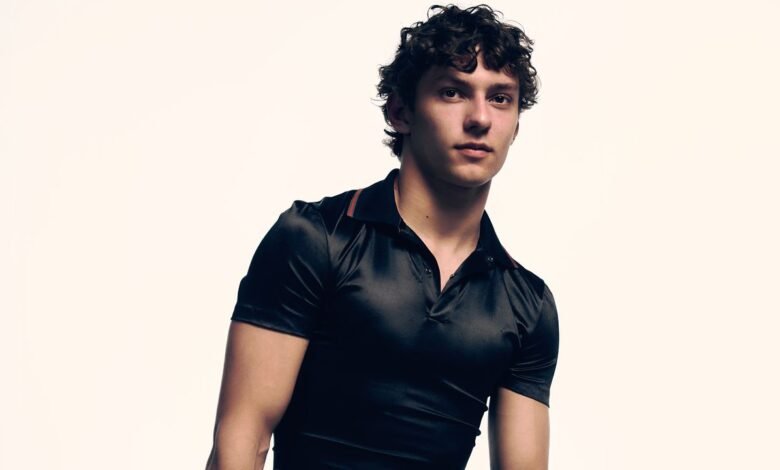
Talking to Antonelli, outside of the race car and the helmet, it is almost impossible to perceive him as anything but a teenager (which he is when we speak; he’ll later turn 20 in late August). He’s a compact five feet eight and 155 pounds, which only underlines his youth. No amount of media training or globe-trotting can smooth out the boyishness—the slightly unruly flop of hair, the toothy grin, or the sweet, unspoiled gleam of someone barely old enough to vote. Antonelli’s most visible signature is a corded choker with a whale-tail charm, a souvenir purchased by his mother in Sardinia on a family vacation when he was 12 or so. Dupes of the whale-tail necklace are all over Etsy. It’s an Italian symbol of good luck, worn by a kid who passed his high school graduation exams just last year.
Of course, he’s also a kid who won the Monaco Grand Prix, where it’s customary to enjoy in a bacchanalian celebration after taking the checkered flag. When Antonelli triumphed in June, he went to the celebratory dinner gala, then went to his hotel to sleep. No drinking. Mercedes leader Toto Wolff called him around noon the next day and asked what he was doing, and remembers Antonelli saying, “I don’t know yet. What are you doing?” Wolff, a little taken aback, invited his employee to join him and his family on a boat excursion. And so Antonelli spent the afternoon after his Monaco win fishing with his boss’s nine-year-old kid. “[Kimi’s] an Italian son. A 19-year-old that is almost like a 16-year-old, because he’s an Italian boy. He just wanted to be in a family environment,” Wolff says. “It was for me, almost surreal.”
This everyday boyishness makes Antonelli’s on-track attack mode
This everyday boyishness makes Antonelli’s on-track attack mode even more jarring to those closest to him in the paddock. Wolff has noticed Antonelli’s uncanny ability to live in two different worlds: “He goes into race mode, and he goes into a zone. Sometimes you talk to him on the radio, and he doesn’t even hear you because he’s so in his zone.” Occasionally, when Antonelli gets out of the car after a session or a race, he seems spaced out. “It’s almost like…he needs to recalibrate himself: Kimi’s back on planet Earth,” adds Wolff.
While Antonelli, like any driver, had flashed his inner wolf before, that on-track joust with Russell changed things. After calling Russell’s move “very naughty,” he radioed that his teammate deserved a penalty. Antonelli’s race engineer, the voice in his ear, tried to calm him, to get him refocused. And yet, as the checkered flag dropped, he kept fuming. On the radio. Which is broadcast on TV, complete with a little beep-beep alert. Clearly still pissed off, Antonelli offered a reappraisal of the team dynamics: “If we need to race like this, then good to know.”

All clothing by Adidas.
Until then Wolff had largely been Antonelli’s cheerleader in public, doing everything he could to cultivate the young driver’s confidence and ease, both of which are needed for driving at 200 mph and for navigating a relentless spotlight. Wolff suddenly became the disciplinarian. “Kimi, concentrate on the driving, please, and not on the radio, moaning,” he responded at one point. At the end of the race, with Antonelli still complaining, Wolff shut him down. “Now is the fourth time to talk about this,” he said. “We talk about this internally and not on the radio, okay?”
After the sprint race, Antonelli debriefed
After the sprint race, Antonelli debriefed with the team and hashed out the situation with his friends and family. He watched a movie in his hotel room. “When I woke up the next morning, I was feeling good,” he says. “Mentally, I was in a good place, and I was ready to go.”
When Antonelli fully emerged from the race haze after the Canadian GP sprint, Wolff gave him and Russell a spiel about the nature of a team, and the weight of working for a brand like Mercedes. Wolff—the only team principal with a significant ownership stake, both head coach and CEO in one—warned Antonelli and Russell about what was on the line: the reputation of one of the biggest brands in the world, and the livelihood of all of its employees. He outlined the expectations.
“The rules are, you can’t expect the other car to give you gifts. Don’t expect the other car to be a gentleman, because he’s fighting against you in a world championship. Expect the car to race you like any other team. You two have to figure out how to race each other,” Wolff recalled explaining to them, before landing on the most critical takeaway: “But you’re not colliding.”
We’re speaking in June, a month after
We’re speaking in June, a month after the Canadian fireworks. Antonelli is in Austria, and it’s clear that he’s absorbed the team’s messaging. He’s quick to point out how damaging a Mercedes-on-Mercedes battle can be to the team’s delicate ecosystem and how uninterested he is in making things personal. As someone both hunting and hunted, he is energized by the prospect of tangling with Russell. “We both have a great car and we’re both in a position to fight,” he says. “So we know we’ll clash, and we’ll have to fight for position on track.”
There are 1,696 active players in the NFL; 450 or so in the NBA; 500-plus in the Premier League. Only 22 drivers get to sit behind the wheel of an eight-figure rocket ship covered in stickers that cost millions of dollars, and getting there necessitates access to a rarefied world of equipment, karting tracks, and mechanics, plus the ability to travel—and, crucially, the money to fund it all—from a young age. These things advantage those with racing in their DNA and, accordingly, a family willing to put everything else aside for the long shot chance of a child becoming one of those 22 drivers. No surprise then, that each race features an army of racing dads in the paddock who have molded their sons into future Sennas and Schumachers and Hamiltons.
Antonelli, too, has a racing dad, but their story is different from most. Marco drove touring cars. (They broadly resemble a BMW or an Audi you could buy at the dealership, with a much rowdier approach to speed.) He was talented but struggled to sell himself in a way that attracted sponsors, so in the early ’90s he launched Antonelli Motorsport in San Marino—an independent microstate inside Italy’s borders, about an hour from his hometown of Bologna—to help other drivers get into the sport. By the time Kimi arrived in 2006, Marco had seen the ultracompetitive, money-warped world of motorsport from every angle. “My dad didn’t want me to race,” Antonelli tells me, “because motorsport is a beautiful sport, but at times it can be very cruel. He experienced it himself, and he was afraid I would suffer from disappointment.”
Still: At the age of five, Antonelli piloted
And still: At the age of five, Antonelli piloted a go-kart for the first time. “I remember just loving the feeling of speed, and the adrenaline,” he says. “And after that, it just took off.”
As a boy and then a teenager, Kimi was breaking records in the karting universe. He was fast, but the adults around him noticed something more crucial. “They would say my style was natural,” he remembers. “And I had a style that was based a lot on instinct—trust in the instinct.”
Formula 1, like any major sport, now scouts younger talent than it ever has, in the hopes of discovering—and signing, and developing—the next great driver. In addition to Antonelli, today’s F1 grid features the 19-year-old Arvid Lindblad, plus a trio of 21-year-olds (Oliver Bearman, Isack Hadjar, and Gabriel Bortoleto) who were rookies alongside Antonelli last year. A former Ferrari principal recently said that the team noticed Antonelli when he was 10 or 11, but couldn’t have supported a driver so young. Mercedes, though, had no such concerns, and brought a 12-year-old Antonelli into its drivers academy in 2019.
In 2024, Lewis Hamilton made a decision
Then, in 2024, Lewis Hamilton made a decision that launched a million ESPN app alerts: He would be leaving Mercedes at the end of the year to join Ferrari. Antonelli’s name started flying around. It was almost unthinkable at first: He had skipped Formula 3, and at the time had only just started in Formula 2 (a.k.a., the minor leagues of Formula 1). But Hamilton’s seat had a mythological pull. A baton passing from one generational talent to another? Impossible to resist. Antonelli was announced as Mercedes’ next driver that summer.

Overshirt and pants by Brioni.
“If you run with Mercedes, and you take Lewis Hamilton’s seat and you’re 18 years old, the first year of Formula 1 is very difficult,” says Marco. Antonelli’s early days in an F1 car were patchy: He had a confidence-crushing crash during a practice session before even starting as a rookie. In his first full season, he had nine races where he didn’t score a single point—but also three podiums to celebrate. Then the 2026 season arrived, with a new F1 car—smaller, more nimble, with aerodynamics designed to make passing easier and a funky hybrid power system that some veteran drivers griped about loudly. But Mercedes had dealt with the regulation shift masterfully, and it was immediately clear that they had the best car on the grid. Russell was tabbed as the preseason favorite to take the title. Antonelli, unfazed, shot out of the gate. At the Chinese Grand Prix in March, he took his first Formula 1 win with ease.
Since then, he’s also easily won the hearts of both Mercedes fans and his fellow Italians—two groups that normally go together like (motor) oil and (holy) water. A few months ago, Marco Antonelli found himself at a bar in Maranello, the town in northern Italy that houses Ferrari’s factory. He noticed three Formula 1 drivers’ photos hanging on the wall. “Kimi is in the middle, like Jesus, with [Ferrari drivers] Hamilton and [Charles] Leclerc beside him,” he says. “A lot of people who, before, were for Ferrari, are now for Kimi. And this is very crazy.”
Not to jinx things, but if Antonelli stays
Not to jinx things, but if Antonelli stays the course (and the season is long, with about half yet to go), he will be the youngest ever, by a full three years, to win the drivers’ title. He would be the first Italian to do so since 1953 (which was only four years into F1’s existence). So yes, he’s the one being hunted—but as his father points out, the kid with the toothy smile and whale-tail necklace needs to keep a tight grip on that hunter mentality he showed back in Montreal, in May.
“It’s good that you have friends outside of the track, but when you are in competition, it’s not possible to have friends,” explains Marco Antonelli. “This is the mentality I’ve tried to transmit to Kimi since karting: You have to transform, like a killer.”
PRODUCTION CREDITS:
Photographs by Tereza Mundilová
Styling by Luca Paolantonio
Grooming by Angelo Rosa Uliana
Source: www.gq.com