
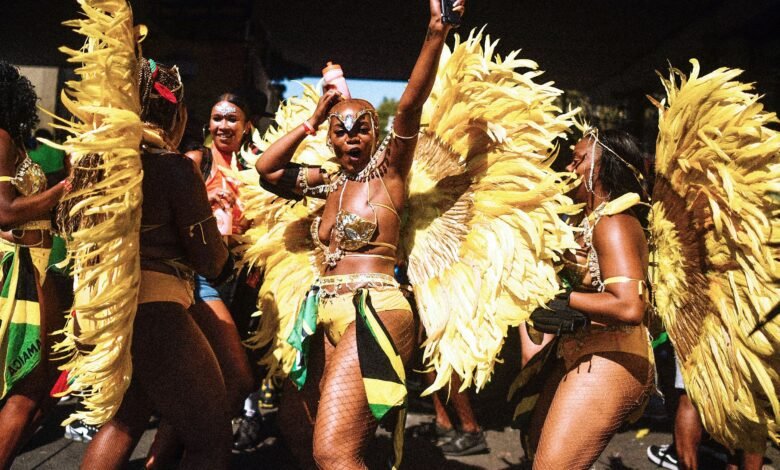
In a matter of days, the streets of West London will be thronged with families, ravers, and historic sound systems for the Notting Hill Carnival (running August 30-31). Amongst them, a host of brand logos will appear at intervals, emblazoned across banners and freebies. It poses a perennial conundrum: what, if anything, makes a fitting Carnival collaboration? A similar set of questions accompanies other public, open-air street parties across the globe, including June’s annual Fête de La Musique — which began in Paris in 1982, but now occurs across France — and Rio de Janeiro’s carnival in February.
All these festivals have foundations in or close links to the Black diaspora, and so players wanting to enter the space should tread with sensitivity and humility, priming themselves with knowledge and context to develop brand-second — rather than brand-first — activations. The numbers attest to the potential for brand visibility, but also brand scrutiny. According to research from JN Bank economist James Williams — commissioned by The Voice in 2024 — Notting Hill Carnival has a total direct or net economic impact of more than £396 million per year.
In March this year, the Mayor of London announced £4.66 million in additional funding for the carnival to help the event with potential crowding. In recent years, Carnival visitor estimates have ranged between one and two million people, and, per London’s Royal Borough of Kensington and Chelsea, 2025’s iteration saw 36 sound systems, 48 mas bands (traditional, costumed dancing groups), and 250 street traders.
Not surprisingly, brands including Adidas, Stüssy, Puma, Diesel,
Not surprisingly, brands including Adidas, Stüssy, Puma, Diesel, and Converse have all shown up over the years, enticed by the event’s potential for online and IRL reach. Fête de La Musique’s event in Paris this summer attracted an estimated two million attendees from across the globe, and — like last year’s Notting Hill — featured no shortage of activations. Chloé Parfums took over cult coffee spot Merlo Caffè, providing DJ sets, fragrance-inspired drinks, and a product-sampling space for an intimate crowd of 100-something people.
Byredo took a more democratic approach, calling on local DJ Broodoo Ramses and Iranian-Dutch singer Sevdaliza to perform outside its Le Marais store, releasing content across TikTok and Instagram, such as vox-pop interviews and on-the-ground footage, each format implicitly weaving fragrance storytelling into the narrative. For Notting Hill Carnival 2026, plans are already underway.
Caymanian-Jamaican designer Jawara Alleyne will drop a playlist and capsule collection based around the ease and party-apt sensibilities people adopt when dressing and styling themselves for the event. “It’s less about how I’m taking inspiration from Carnival and more about the fact that Carnival has defined my point of view,” he affirms. For other brands — not least corporate giants with less direct connections to the cultural event — the task ahead is trickier.
Cultural credibility Done right, showing up at annual
Cultural credibility
“Done right, showing up at annual cultural hotspots like Fête de La Musique and Notting Hill Carnival is a no-brainer for brands that have a role to play,” says Hari Blanch Bennett, a creative strategy expert at Kantar. “Brands earn their place by adding to the culture, not borrowing from it,” she says, citing Puma’s sponsorship in 2025 as a success story.
The sportswear label worked directly with historic sound systems, King Tubby’s and Rampage, devising a line-up of performances and — ahead of the event — hosting a pop-up customization workshop with British-Caribbean designer Sharkkana and sneaker artist Latya. While Puma certainly leaned into visible branding — reliant on seeding and logo placement on stage — experts agree that best practice is subtlety.
“The key storytelling challenge for brands in these spaces is to get themselves out of the way,” says Sophie Borelly, managing director at research and creative agency On Road. “If brands want to be seen as credible, they need to think about tangible impact, showing how [they’re] broadening access to soundsystem culture for young people or creating chill-out spaces for community elders.”
Borelly recognizes the draw for brands: being associated with “the coolest parties on the planet” is a big win for cultural relevance and audience connection.
She argues, brands must look closely at how
However, she argues, brands must look closely at how they can benefit the cultures, too, supporting and stewarding people directly involved in the grassroots. If brands are taking more from the events than they’re bringing, the over-commercialization undermines the very scenes’ cultural capital, she notes. “You risk not only making your brand look superficial and out of touch, but making things worse for culture as well,” says Borelly.
Empower the community
Here, it’s important brands don’t just platform the community, but consult them directly on the programming. This can be tricky for brands used to total marketing control, but it’s crucial for a strong partnership. “I think Carnival is a really hard space to crack because it’s so contained in what it is, and by its nature, it’s not really something that brands can easily integrate themselves into,” says Alleyne.
“When I’m working with Converse, they are pretty open to whatever I am doing, particularly as it relates to Carnival, because this is my community and my space.”
Last year, the designer worked on a line of deconstructed garments to gift to a mas band. Converse contributed by supplying the shoes for his brand to customize. The result, he explains, was a seamless integration.
It shouldn’t feel like the brand is trying
“It shouldn’t feel like the brand is trying to get their name out there,” says Alleyne. “It’s more, ‘What are you guys already doing, and how can we help you to kind of pull it off and get it done?’”
This matters, especially when the threshold for co-option is low. “Nowadays, people can smell bullshit easily — specifically Gen Z,” says Angelo Baque, founder of Awake NY and former brand director at Supreme.
“You can’t fool them. They’re the ones that are going to do the deep dive on you. They’re the WikiLeaks of today.”
Awake NY will be present at Carnival in collaboration with Jordan, soft launching the new Jordan collab, but the rollout model has been astutely considered. Through Jordan, funding will go to the esteemed Killerwatt sound system to host Benji B and Judah Afriyie’s club outfit, De
As for the one-off T-shirts (art directed by London graffiti artist Fatzoo), these will be given away free. With the sneakers, Baque’s priority is getting them on the kids in the mas band. “They might not know what Awake is. They might not own a pair of Jordans. And their first pair of Jordans [will be] a pair of Awake Jordans, which I think is really cool,” says Baque. In the same vein, Awake’s activation during Fête de La Musique leant into its own cultural integration, teaming up with Black-owned streetwear label Patta, Ghanaian radio station Oroko, and speaker brand Marshall.
Was it a good party? When it comes
Was it a good party? When it comes to the metrics brands should be tracking, IRL engagement should come above everything else, argues William Dickson, NTS Radio’s head of marketing and communications. “I think that’s the most important thing, before we look at how we’ve amplified what happened on the ground digitally,” he says, explaining how NTS appraised the success of its Fête de La Musique activation in partnership with Brazilian flip-flop brand, Havaianas.
For this party programming — an “editorially sensitive” mix of Brazilian music genres — NTS was able to integrate Havaianas into a cultural moment that made sense to its own USP. Rather than honing in on audience demographics, NTS instead looked at sub-communities, scenes, and behaviors. “We don’t want programming to feel like it’s engineered back from a specific target market,” explains Dickson, noting the diversity of the crowd in attendance.
On the other side of the collaboration, Havaianas had a similar outlook. “The KPIs we wanted were people showing up organically and queueing, and not leaving the event,” says Laure Martinez, Havaianas’s brand marketing director for Europe. “It’s not about us showing a product as a promotion, but really showcasing a pure experience for people to remember — to remember having a good time.” Martinez said that the original target attendance count was 1,000 people, but over 6,000 came down, many staying for more than six hours.
Critically, Havaianas wasn’t even offering customization services
Critically, Havaianas wasn’t even offering customization services or drinks, just a roofless kombi van tightly programmed with Brazilian-genre sets. “Us being such a democratic, accessible brand, we were looking for activations that actually mimic that, and Fête De La Musique was a great example of that,” says Harm van de Camp, CEO and president of Havaianas parent company Alpargatas.
“It’s free, it’s public, and it has this free spirit we wanted to engage and thought could bring the culture of Havaianas to life.”
That focus on the experience is integral. As soon as a carnival-adjacent brand moment feels like a stuffy excuse to highlight a new product development, the activation falls flat, and the motives appear cynical. “These are historically free, non-commercial spaces, so any whiff of extraction gets called out instantly, and criticism tends to travel faster than praise,” says Bennett.
The same holds for digital amplification. People want an honest, unpolished portrayal of the fun shared. “We tell brands to treat social amplification not as a highlight reel but as an extension of the same spirit: credit the artists, capture real participants, and let the content feel lived-in,” Bennett concludes.
Source: www.vogue.com