
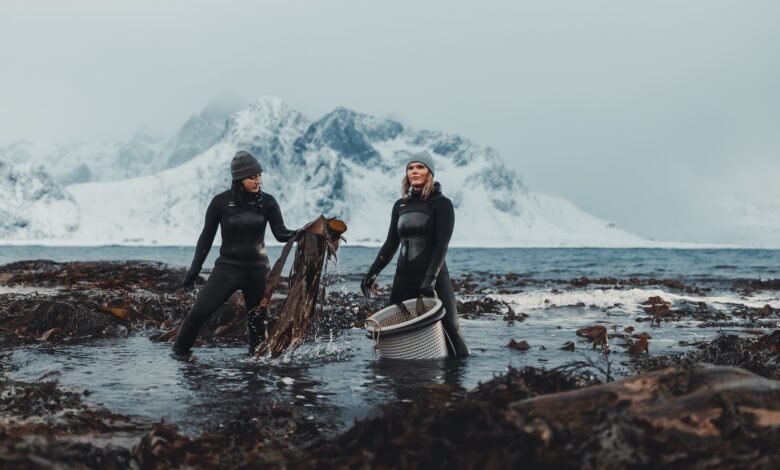
It’s still dark as I pick my way down a rocky path toward the sea. The air is as cold as you’d expect from a Norwegian winter, but the wind is still—a small mercy as I peel off my robe and slide into my wetsuit. I’m preparing to dive. Not for fish, but for seaweed, a natural rethe story of these wind-whipped northern shores has been told through the lens of the male-dominated fishing industry
But today, a seaweed-based movement led primarily by women is rapidly reshaping what it means to eat, farm and live sustainably. “It’s like a tropical rainforest of seaweed that grows around just this tiny island,” explains Antje de Vries, emerging from the water with a handful of ribbon-like sugar kelp. Antje—a chef and ecotrophologist—runs the plant-based kitchen at Lilløy Lindenberg, a private island retreat off the coast of Bergen where I’ve been spending the weekend.
I zip up my wetsuit and join her, gliding past colourful starfish and sea urchins in search of those tendrilling fronds. Two nights earlier, I’d joined Antje for ‘Kelp Club’, a roaming, nine-course supper where each dish has been made or infused with hand-harvested seaweed from this very fjord. “Fermenting, dehydrating, caramelising, searing,” she raves, “what you can do with it is endless.”
Her enthusiasm is far from an isolated culinary quirk.
As the UN warns we must cultivate
As the UN warns we must cultivate the oceans to prevent food insecurity by 2050, these northern coasts are fast becoming a testing ground for a new ecological framework. Seaweed has a unique potential to scale sustainable, nutrient-dense food supplies, requiring no arable land, fresh water or synthetic fertilisers. It produces up to sixty percent of the world’s oxygen, absorbs dissolved nitrogen and captures carbon at rates that rival rainforests.
Little wonder, then, that the global seaweed market has more than tripled over the last two decades. And that’s to say nothing of the plant’s mind-boggling health benefits. Packed with iodine, essential minerals, and gut-stabilising compounds, research shows that ocean-grown plants act as natural antibacterial agents and help regulate blood sugar—a primary reason why seaweed-rich diets in coastal Asian nations are consistently linked to longevity and lower rates of chronic disease.
But long before global institutions began hailing seaweed as a future food, Angelita Eriksen knew it only as a nuisance; a weed that tangled her father’s boat propellers in the Arctic waters of the Lofoten Islands. It wasn’t until she returned home after many years abroad that her perspective started to shift. “I became blown away by its nutritional benefits, the taste, and its environmental impact.
I called everyone that had ever mentioned it.
I called everyone that had ever mentioned it.” In doing so, she reached out to Tamara Singer, who was familiar with seaweed by way of her Japanese heritage. Together, they founded Lofoten Seaweed, a business that creates seaweed-based products from salts and sprinkles to seaweed-enhanced beauty products. Initially, local fishermen laughed at the sight of two women gathering weeds in their baskets.
“It’s a tough, male-dominated environment,” says Angelita. “Many people didn’t understand what we were doing.” But as the company grew—eventually earning a spot on the menu at Copenhagen’s famed Noma and representing Norway at the prestigious Bocuse d’Or in Lyon—that skepticism turned to respect. Though seemingly novel, their work is part of a much older, global tradition of women working with seaweed.
For 3,000 years, Japan’s legendary Ama ‘sea women’ have freedived to harvest kelp. Centuries later, in Victorian England, women—banned from scientific institutions—took up beachcombing, where their work formed the backbone of modern seaweed classification. Today, across coastal Zanzibar and Tanzania, the seaweed sector is roughly 80% female-led, and has transformed local communities by placing financial independence and civic leadership directly in women’s hands.
Here in Lofoten it goes way back
“Here in Lofoten it goes way back to the Viking ages,” Angelita explains, “when women would stay back to run the farms while the men were gone. Seaweed harvesting was something they could do while staying at home with their children. It’s a tradition we have forgotten in modern society, but sometimes the older generations approach us and say ‘you know, I also picked seaweed as a child.’” This return to ancient ways of working signals a wider cultural shift, as policymakers begin transitioning from dominance over nature to stewardship.
“From a female perspective, it makes sense to work with the ocean in a more sustainable, harmonic way,” explains Tamara. “It’s kinder, not so brutal. Success for us means helping to make things better—people’s health, the environment.” Unlike fishing, which begins and ends with the catch, seaweed cultivation demands continuous care. You cannot over-harvest a reef without destroying your own livelihood; to gather from the ocean, you have to nurture it.
“That feels like a uniquely female strength,” Antje reflects. And this more nourishing way of relating to the natural world extends to how these women physically encounter the ocean, too. While male commercial divers often layer up in thick, insulated drysuits, Norway’s female harvesters almost always wear wetsuits. It’s an intentional choice to forgo total protection in favour of tactile intimacy.
We’re feeling the water, Antje says, her gloves
“We’re feeling the water,” Antje says, her gloves deliberately worn thin at the fingertips. “I think that’s really important, that synchronisation with nature. Feeling the elements is something we’re all missing.”
Last year, the EU endorsed algae as a key reorway is leading the charge, piloting large offshore farms along its coastlines while investing in R&D initiatives like Arctic Seaweed and Seaweed Solutions
Advocates like Antje and founders like Angelita and Tamara are ensuring that gender parity is woven into the movement’s DNA from day one. But even as these projects begin to scale, their purpose remains the same: a conscious move away from extractive practices and toward a more restorative approach to our oceans. “It’s the birthplace of all on Earth, right?” Antje offers with a smile.
For these women, seaweed isn’t just a superfood, but a way to reshape our relationship with the wild. And in tending to the ocean, we may just find our way back.
Source: www.vogue.com