

–:– / –:–
This voice experience is generated by AI. Learn more.
This voice experience is generated by AI. Learn more.
Summary
Major League Baseball has offered a new proposal as part of collective bargaining to the MLB Players Association, featuring a significant change to the free agent signing period. The plan would limit signings to specific windows: from the Monday of the Winter Meetings through December 21st, and then resuming after the first Monday in February. Crucially, this latest proposal is now tied to the implementation of a salary cap, a new condition not present in previous discussions. MLB argues it’s essential for competitive balance. However, the MLBPA, through interim Executive Director Bruce Meyer, vehemently opposes the plan. Meyer calls it “propaganda,” stating it would drastically reduce player compensation, eliminate guaranteed contracts, and severely diminish player leverage by creating an artificial signing window under a salary cap. Player agents like Scott Boras also criticize it as restricting competition. The current CBA expires December 1st, with a lockout anticipated if no deal is reached, potentially halting all transactions.
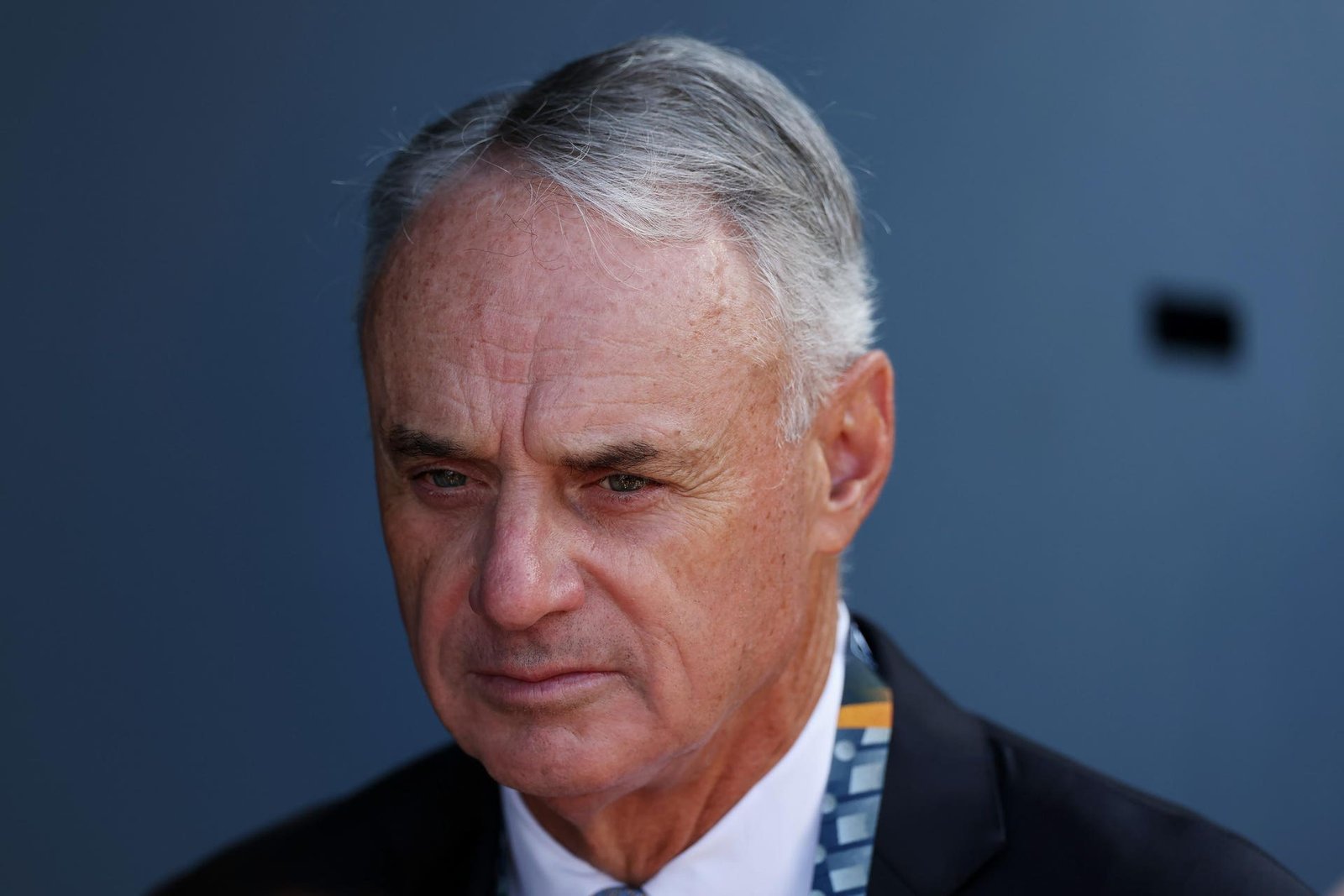
MLB commissioner Rob Manfred, along with the league’s owners, offered a new proposal as part of the latest collective bargaining sessions that would create a limited free agent signing period. (Photo by Patrick Smith/Getty Images)
On Thursday, Major League Baseball made its latest proposal to the MLB Players Association for the next collective bargaining agreement. It would create an extreme shift in the free agent signing period, looking to mirror other sports by placing a strict limit on the window in which signings could take place, creating a frenzied period designed to increase fan interest.
As first reported by MLB.com, the five days
As first reported by MLB.com, the five days after the World Series would still allow players and clubs to trigger or decline options. After that, free agents would be allowed to negotiate deals, but signings would only be allowed after 12 p.m. on the Monday of the first day of the Winter Meetings through December 21st. From Dec. 21st through the first Monday in February, no free agent signings or trades would be allowed. After the first Monday in February, free agent signings would then be allowed to resume.
It is not the first time that the league has sought to have a limited free agent signing period. The league proposed it as part of the negotiations of the current labor deal in place since 2021, and as recently as January, MLB Commissioner Rob Manfred discussed it on WFAN, touting it as a way to promote excitement.
“I think there’s going to be some more conversation about it, because I do believe that there’s a marketing opportunity,” Manfred said. “Let’s face it, we operate in a really competitive environment. Just put entertainment, generally, to one side — just sports, right? It’s really competitive. And I think that you make a mistake, particularly during the offseason, when you don’t take every advantage to push your sport out in front of your fans during that down period.”
An important change in direction with the latest
An important change in direction with the latest proposal is that the league has suddenly shifted and is tying it to implementing a salary cap. That was not the case in negotiations for the current labor deal, nor did Manfred mention it on WFAN in January.
When asked why the proposal on Thursday could not be offered separately from MLB’s push for a cap system, MLB spokesperson Glen Caplin said, “In our current economic system, these changes would be too harmful to competitive balance and would not be practical.”
As The Athletic reported in January, player agents see the limited signing period differently.
Scott Boras, who has notoriously used the start of Spring Training to leverage deals for his players, sees the proposal negatively.
The sole purpose of deadlines (is to) simply
“The sole purpose of deadlines (is to) simply restrict competition and deny players the true market,” Boras said. “Our current rules allow for ultimate roster construction and the best possible team for a season. (A deadline is) not for competition reasons. Every owner wants the opportunity for time to allow him to respond to changes by his competitors. That’s why there’s been many significant signings more in late January, February and March, because owners have responded.”
Other agents, notably Joel Wolfe, head of the Wasserman’s baseball division, have seen limited signing windows work with international players from Japan.
“If there was a way to re-create the exceptional efficiency of the posting system for all the free agents, I would certainly be interested in that,” said Wolfe, who represents Los Angeles Dodgers pitchers Roki Sasaki and Yoshinobu Yamamoto to The Athletic. “But I have yet to see a good answer as to what happens to the FA’s if they go unsigned that doesn’t unfairly prejudice them. MLB teams always seem to find a way to game the system and crush a large part of the class. I think it’s worth exploring.
“I just haven’t seen any great idea yet that benefits all the players.”
The proposal on Thursday to limit the free
The proposal on Thursday to limit the free agent signing period and tie it to the cap system garnered a pointed response from MLBPA interim Executive Director, Bruce Meyer.
“The league, through their propaganda arm, is promoting their latest set of roster and transaction proposals as player-friendly,” said Meyer. “MLB expressly conditioned these proposals on the players’ agreement to a salary cap system, which would drastically reduce overall player compensation, eliminate fully guaranteed contracts through escrow, and turn back the clock on fundamental player rights.”
“Their latest proposals regarding free agency would eliminate Player rights by establishing an artificial free agency window, subject to a salary cap, which would reduce player leverage and create a game of musical chairs pitting player vs. player.”
The suggestion that the only way to limit
“The suggestion that the only way to limit roster churn, or incentivize earlier Free Agent signings is with a salary cap is entirely unserious. Players have proposed changes that would address these priorities, but the league is not interested in any changes that don’t directly reduce the rights of all players and shift leverage to the owners.”
The current labor deal between MLB and the players is set to expire at 11:59 pm ET on December 1st. If the owners and players do not agree on a new deal by then, the owners are expected to lock out the players. If so, the Baseball Winter Meetings would be canceled, and all player transactions – either trades or free agent signings – would stop until a new labor deal is reached.
The 2027 MLB regular season is scheduled to start on the night of Wednesday, March 24th.
Editorial StandardsReprints & Permissions
Source: www.forbes.com