
The Story Behind Edith Head’s Very First Collaboration With Alfred Hitchcock

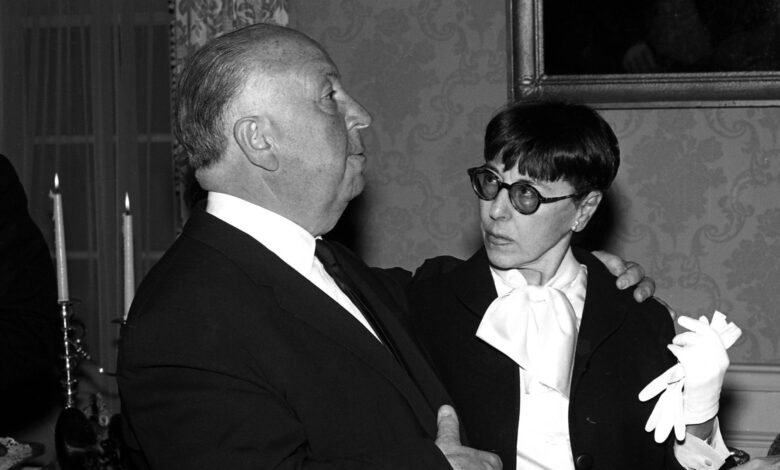
There’s a very sensuous moment in Alfred Hitchcock’s 1946 postwar classic Notorious. Cary Grant and Ingrid Bergman step out onto the porch of a Miami bungalow and into the late-night breeze. He’s in a cool dark suit, she’s in a shimmering zebra-print top that reveals a slash of bare midriff—code for “bad girl” in the 1940s. “Don’t you need a coat?” Grant’s T.R.
Devlin asks her. “You’ll do,” Bergman’s hedonistic Alicia Huberman shoots back. Then, to protect her from the cold, he wraps his handkerchief around her waist and leans in closely. Hitchcock’s films are full of little costume touches, where scarves and handbags, glasses and ties, are used as narrative tools for romance, disguise, and even murder. Throughout the film, Grant and Bergman bring the heat to their secret love affair, but it’s this scene that sets the simmering tension.
For Alicia, the handkerchief will become a symbol of their first meeting, before she realizes he is a government agent sent to recruit her to seduce a Nazi collaborator in Rio de Janeiro. It’s been 80 years since Notorious was released in the United States, and it’s still as impactful as ever. Ingrid Bergman’s Alicia haunted Jonathan Anderson’s pre-show trailer for his debut Dior cruise 2027 show, with actress Alison Oliver as stylish and reckless as Bergman behind the wheel of her convertible, laughing manically as the wind whipped through her hair.
There’s a reason Notorious is on the moodboard
There’s a reason Notorious is on the moodboard for designers like Anderson. Not only was it the film that confirmed Hitchcock’s position as the “master of suspense”—with its Nazi spy rings and uranium hidden in wine bottles—but it also has an important place in Hitchcock lore, and indeed in cinematic history. Notorious was the director’s first collaboration with legendary costume designer Edith Head, she of the eight Oscar wins and 35 nominations over her nearly 60-year career, and who as head costume designer at Paramount Pictures created such classics as Bette Davis’s chocolate-brown, shoulder-slipping cocktail dress in All About Eve, Audrey Hepburn’s blouse and skirt for nipping around the Colosseum on a scooter in Roman Holiday, and Elizabeth Taylor’s light-as-air strapless white gown in A Place in the Sun.
But most famous of all is her collaboration with Hitchcock. She designed for 11 Hitchcock films, including Rear Window, To Catch a Thief, The Man Who Knew Too Much, Vertigo, The Birds, and Marnie, and she created Vera Miles’s wardrobe in Psycho. Think of a classic Hitchcock scene, and there’s a good chance Edith Head was involved. Head’s costumes in Notorious are not only exquisite, but also a masterclass in revealing a person’s interior through their wardrobe.
We see exactly Alicia’s trajectory, from hedonistic party girl to redemptive figure, as she puts herself on the line for her country. This first collaboration between Hitchcock and Head can actually be credited to Bergman. Notorious was originally to be produced by David O. Selznick (he sold it to RKO due to his dissatisfaction with the script), and I discovered in the research for my book Fashioning Hitchcock that he was considering either Travis Banton, who had once been Head’s boss at Paramount, or couturier Mainbocher to design Bergman’s costumes.
Selznick had signed Bergman to a contract
Selznick had signed Bergman to a contract in the late 1930s, bringing her to Hollywood from Sweden with a plan to create a star. But Bergman was not one for being made over, refusing to change her eyebrows, her teeth, or her name. She was also very serious about acting, and her screen wardrobe had to be true to her character. Bergman put forward Head’s name to do the costumes in Notorious, and Selznick listened.
The two had been friendly since Head designed functional wardrobes for Bergman’s films For Whom the Bell Tolls and The Bells of St Mary’s. Head would later tell her biographer Paddy Calistro in Edith Head’s Hollywood that while designing the almost two dozen costumes in Notorious, she had to make sure “what I did pleased Hitch,” and that “he repeated many times that the clothes must not be a focal point, that Bergman was to be a believable secret agent.”
She found Hitchcock to be more opinionated about costumes than any other director she’d worked with, and his clear vision was set out in the pages of his script: heels clicked on a marble floor and a skirt was to swirl around her as she collapsed to the ground.
As Alicia hosts a party in her Miami bungalow, moving around the room pouring drinks, the arresting zebra print top makes her the most important person in the room. “In a black and white film the eye is immediately attracted to the stark contrast of black and white, since other colors become various shades of gray,” Head also told Calistro. The stripes are animalistic, to show—according to Head—that she’s a “party girl with a notorious reputation.” They are also symbolic of Alicia’s entrapment, after being recruited to romance Claude Rains’s Alex Sebastian and uncover a Nazi plot.
The Nazis of the film liked their women
The Nazis of the film liked their women to dress according to the rules of femininity, while also adhering to traditional morals. Alicia arrives for dinner at the Sebastian home in a dazzling white gown and fur wrap, a diamond necklace imprisoning her neck, as if she’s been reborn as Snow White. One of the most striking costumes in the film is a long black gown with medieval-style sleeves.
Its plunging neckline brings drama to Notorious’s most suspenseful scene, in which Alicia risks her true identity being uncovered by venturing into the wine cellar with Devlin. Once Sebastian and his mother (one in a long line of repressive matriarchal figures in Hitchcock films) realize that Alicia is a spy, they slowly poison her. That revealing neckline is, in turn, replaced by a procession of restrictive collars, buttoned-up coats, and bar-like necklaces.
Bergman’s Notorious costumes were promoted in the fashion press, but audiences would have to wait another eight years before they could see more Edith Head magic in a Hitchcock film. When Hitchcock signed a multi-picture deal with Paramount Pictures in 1953, it reunited him with Head, who ruled the studio’s wardrobe department. From then on, Head would shape the midcentury look of Hitchcock’s heroines, women who continue to haunt the fashion imagination to this day.
Source: www.vogue.com