

I was warned that the light change right before totality would feel the strangest. As I looked up at the cloud-strewn Icelandic sky, the crowd pulsing around me, it was as if the world had transformed into a film noir—our upturned faces suddenly cast in washed-out shades of grey. Then, for a minute, everything slipped into pitch-black darkness. In those few moments, strangers hugged; I cried and laughed simultaneously; and one person yelled “You’re doing great, moon!”
When the moon crossed between the Earth and the sun on August 12, we couldn’t see the total solar eclipse—but we could feel it.
We were standing in the moon’s shadow. There were no groans, complaints, or frowns, in part because our anticipation was two-fold. The dark green weather forecast (indicating the heaviest level of cloud coverage) had sent many of the more devoted eclipse chasers north, chasing clear skies. But thousands of us chose to remain in Víðistaðatún, a sculpture park strewn with massive lava rocks in Hafnarfjörður about six miles from Downtown Reykjavik, for Echolalia, a one-day rave headlined by Björk, arguably Iceland’s most famous musician.
Yes, the party was, in part, organized to mark the 2026 total solar eclipse, which drew thousands of travelers from all over the world to remote corners of Iceland, Greenland, and Spain. But whether attendees knew it or not, there was something else to celebrate, too: Echolalia was organized by Reykjavik-based record label Smekkleysa to commemorate its 40th anniversary. Smekkleysa, which translates to “Bad Taste,” was founded in 1986 by members of Icelandic alternative rock band The Sugarcubes (Björk, Bragi Ólafsson, Einar Örn Benediktsson, and Sigtryggur “Siggi” Baldursson), along with Ásmundur Jónsson, the host of the underground radio show Áfangar and co-founder of Gramm Records.
It’s a name that feels fitting
It’s a name that feels fitting for a label that has spent decades being an incubator for the experimental and the offbeat. As Smekkleysa’s original 1986 manifesto declares: “good taste and financial restraint are the main enemies of creativity and well-being.”
Echolalia promised to live up to the name. In addition to the rave itself, Björk was presenting a multi-sensory exhibition at The National Gallery of Iceland—also called Echolalia—featuring three of her songs played in immersive, theatrical soundscapes.
To better understand how Smekkleysa’s anti-establishment spirit still resonates today, I sat down with Bragi, Siggi, and Ásmundur at the record label’s Reykjavík headquarters, where we took over a picnic table alongside dozens of locals soaking up the rare sunny afternoon. The topic was the local music scene, of course, and how it’s changed in the decades that the label has existed.
For an hour, I listened to the three friends trade stories about the earlier days, describing periods of time as the bands they were playing with instead of actual years. Smekkleysa was born as a fledgling incubator, giving experimental musicians a space to, well, explore. “It was very DIY, you know,” Siggi told me. “We ended up coming together with this group—the musician side and the writer side—to form an umbrella organization, which was supposed to bring together different strands of the Reykjavik counterculture at the time.”
Right then, a young woman floated by, all smiles, and gave Siggi a hug as she greeted the others at the table.
It was Björk’s daughter, Ísadóra Bjarkardóttir Barney, who
It was Björk’s daughter, Ísadóra Bjarkardóttir Barney, who was helping bring Echolalia together. This is an island of friends-turned-family, after all. And while 40 years may have passed, this crew agreed that the Icelandic music community still had its edge. “There are new generations coming up that are doing things on their own terms and with their own tools,” Siggi said.
“The tools change, but the sentiment doesn’t change very much.” Part of the reason? The lack of a big music business on the island, especially when compared to the rest of Europe. “This is a rather sort of closed-off community—but we still have a huge number of artists from Iceland that are internationally known,” Siggi added. Iceland’s close-knit creative community has something that’s shaped my own experience here after 22 visits, and is one of the main reasons why I continue to return.
There has always been a sense of harmony among its artists—and no matter how big someone like Björk gets, there’s always a ready excitement to collaborate with new artists and mediums to try something new. For instance, Smekkleysa teamed up with Plata, a newly formed Icelandic record label that launched just this July, to release a nine-track compilation album that takes listeners through Reykjavik’s club, art pop, and experimental scenes.
Two days after the eclipse, they threw
Two days after the eclipse, they threw a launch party at Smekkleysa’s record store in downtown Reykjavík. Despite always sensing this collective support, this is the first trip where I learned a phrase that encapsulates the feeling: DIT, or “Do It Together.” “People tend to naturally come together here, not unlike a collective,” says Siggi. At Echolalia, DIT underpinned everything from the textile weaving workshop that asked attendees to make a giant piece of art together to the openness of the attendees themselves.
I met groups of people traveling together who had met on event-specific Reddit forums just weeks before. There were nine DJs total—all pegged as friends of Björk’s. Icelanders Gummi Arnalds, Ronja, Knackered, sideproject, and Los Caballos played alongside Barcelona-based Arca, US-based Kaitlyn Aurelia Smith, and Shanghai-based 33EMYBW. DJs greeted each other mid-set as one would set up to follow the other’s act, there was an epic hug between Arca and Björk, and friends were brought on stage to hype the crowd (Ronja, looking at you).
Björk is a walking testament to the idea of “doing it together.” In recent years, she has been far more involved in uplifting both established and up-and-coming artists, making relatively surprise cameos (Rosalia, “Berghain”), collaborating with Venezuelan producer Arca as a co-producer on the Vulnicara and Utopia albums, and working with musicians like Shygirl and Sega Bodega for Fossora.
There were just as many locals bridging everything
But there were just as many locals bridging everything together. Even though it was a one-day event, this 10-hour rave was a culmination of the lifetime of Smekkleysa’s work, which, at the end of the day, is all about bringing people together for the love of music. And while the eclipse brought international attention to the event, it’s far from the only gathering like this that they’ve hosted.
“From 1987 to 1990, maybe 1992, we would do regular variety shows called Smekkleysukvöld, or Bad Taste Evenings,” Siggi says. “People would create all sorts of stuff for that—everything from writing little plays that would be performed on stage to creating spoof bands.” In 2000, the crew put on The Word Music, a four-day festival that gathered experimental poets, musicians, and more.
“We probably didn’t imagine still doing these things at our age today,” Bragi slipped in. But they’re still doing these things well. If you’ve been to a live show, you’ve felt the camaraderie that comes with feeling so in tune with whatever is coming out of the speakers. There are few feelings more human than locking eyes with a stranger for a second, massive smiles on your faces, as you catch yourselves grooving to the same song transition.
Now, imagine an entire crowd in the middle
Now, imagine an entire crowd in the middle of a lava rock park that doubles as a disc golf course doing the same thing, actively becoming a singular dance move. This was Echolalia for the eight hours I was there, and likely for the last two that I missed because my feet just couldn’t dance anymore. If I was somewhere else—or alone—for a cloud-covered solar eclipse, the moment the world went dark in the rain might have felt almost apocalyptic.
But here, dancing shoulder-to-shoulder with hundreds of strangers who decided to embrace the cosmic and earthly elements alike, it felt more like being a kid again. We looked at one another for reassurance that, yes, this was happening—and that everything was okay. My local friends watching it back in Reykjavik told me their toddler immediately asked “Hvað er að gerast?” as everything plunged into darkness.
It translates to “What’s going on?” and I couldn’t have related more. When confronted with the deep time of the cosmos, we’re really all the same age. It reminded me of No. 6 of the Bad Taste Manifesto: “Members shall always be clear about their importance to the future, and pledge to think in centuries as well as seconds.” There was no better person, then, to close out the second half of the eclipse, when the moon broke apart from the sun.
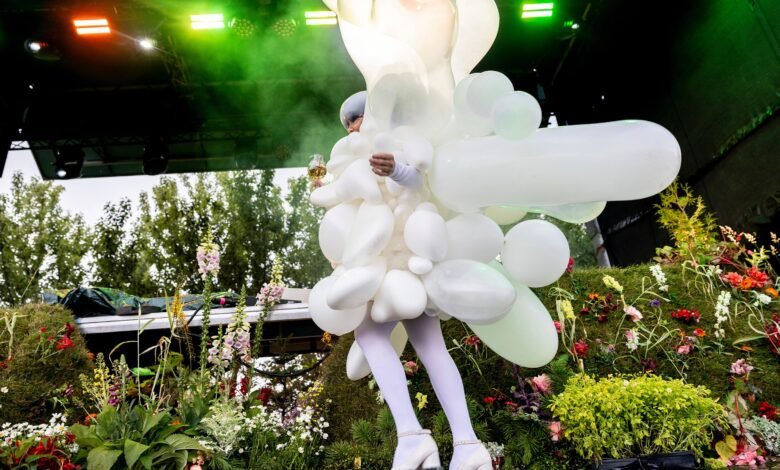
Björk welcomed daylight’s return with an hour-long soundtrack
Björk welcomed daylight’s return with an hour-long soundtrack of high-energy beats, which would sound equally at home in outer space as down here on Earth. Taking breaks to bang a pair of drumsticks and bounce around in her Robert Wun-designed balloon couture, Björk was the nucleus of the outfit expanding around her, much like the dance floor that sprawled around the DJ booth on stage.
Sometimes you travel all the way to Iceland to see a total solar eclipse… and you don’t get to see it. Not really, at least. The world doesn’t end, the planet keeps on spinning, and we all continue on, doing it together.
Source: www.cntraveler.com


One Comment