

This is the first in a series of columns about the decline of shame in the age of social media. Foxworth’s lament has been stuck in my head ever since. Shame is one of the ways that groups of people mediate their norms without state intervention. This, of course, is not always a good thing. But any community without shame must have moral consensus, or else it risks splintering into the chaos of personal interpretation and individual will.
How much of today’s societal collapse and atomization can be attributed to the blatant disregard for shame by what Foxworth called optimization culture? The answer might seem obvious, at first, and certainly this territory has been well trod since Donald Trump entered the political conversation, more than a decade ago. Still, I want to spend the next few weeks thinking a bit more about shame, specifically as a cultural backstop that prevents people from flagrantly violating norms.
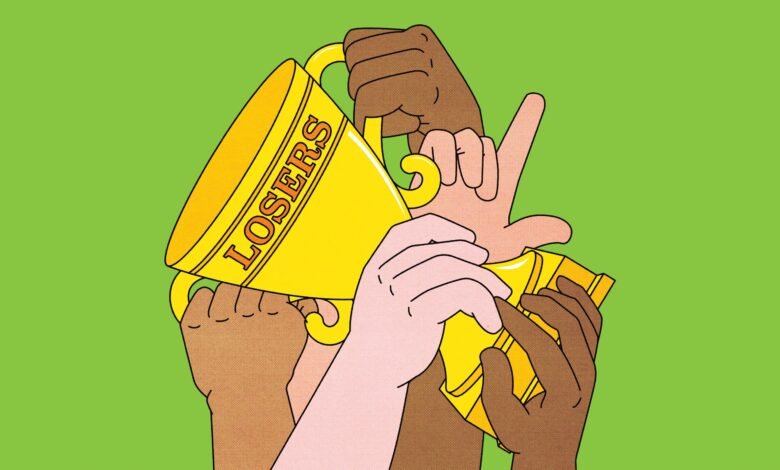
Since then, the panic about tanking has waxed and waned. If there was a high-water mark, it was between 2013 and 2015, when Sam Hinkie, a former finance and management-consulting professional, took over as the general manager of the Philadelphia 76ers and installed what came to be called the Process, a multiyear plan to lose as many games as possible. Hinkie’s idea was simple and, on its face, incontrovertibly expedient: if the point was to win a championship, the Sixers needed star players; the best way to get star players was through high draft picks; the best way to get high draft picks was to lose.
As with the Rockets, three decades before,
As with the Rockets, three decades before, the problem wasn’t so much the losing as it was the shamelessness with which the franchise conducted itself. Tanking was understandable, even acceptable, but much of the public—albeit less of it than one might have thought—wanted the Sixers to at least pretend that they were trying. Hinkie, basically, said no. He would not pretend.
Hinkie was forced out of his job in 2016. Tanking, of course, continued. Post-Hinkie, the league experimented with variations of the lottery, but none of them could deter teams from losing on purpose. And so, this past summer, the N.B.A. announced a full revamp of the system, with a new approach that penalizes the worst teams in the league. We will see how long this remediation lasts.
If losing on purpose is a sin, the N.B.A. systematically escalated its efforts to scrub it from the game. The league did this because its leadership became more sensitive to fan and media outrage. In prior decades, sports were primarily covered locally, meaning that a particularly bad team in Cleveland which was obviously trying to lose would not necessarily catch the attention of a columnist at, say, the New York Post or the Los Angeles Times—and, in any case, those writers wouldn’t waste their column inches on the Cavaliers.
During the 1996–97 season, for example, the Boston
During the 1996–97 season, for example, the Boston Celtics went 15–67 and effectively admitted to tanking for the right to draft Tim Duncan. (The effort was not successful.) This was a bit of a scandal at the time, but it didn’t lead the national sports news. Even now, not every mediocre team tries to lose every single game and maximize their draft odds—last year, the Sacramento Kings, who had one of the worst opening-day rosters in the league, tried to win games for much longer than reason would seem to dictate.
But the media environment has changed. When all news is national and every outraged fan can post their thoughts on social media, a suspicious lineup in Utah in April can feed a daylong news cycle. Under this interpretation of events, front offices aren’t necessarily more shameless than they were in the past; rather, shame itself is dictated by changes in the media and in technology.
A competing theory might hold that, in the pre-Olajuwon era, a coin flip sufficed because the degrees of shame and basic decency were sufficient to prevent teams from doing what the Rockets did. Once the Rockets broke the shame seal and stole away with Olajuwon, the league needed to take drastic measures, because everyone would now feel emboldened to make a mockery of the game. This view suggests that the sense of shame was collectively weakened by a series of self-interested actors who shattered the social firmament and opened up the gates to chaos.
The league’s anti-tanking rules are, then, responses
The league’s anti-tanking rules are, then, responses to moral decline. Some amalgam of fan input, ticket sales, ratings, and media outrage determines what’s right and wrong, and this collective taste shifts more slowly than the behavior of front-office opportunists. The McLuhanite in me wants to stick to the first interpretation, in which the apparent shift in shame is a matter of morality getting funnelled through a new medium.
This kind of technological effect, detailed by Neil Postman in his book “Amusing Ourselves to Death,” provided the underlying premise of this column when it launched, and I still believe in its broad explanatory power. If it feels like all discourse has become unhinged and flooded with hate, full of provocations that once would have been shamed out of public life, this is probably because social media allows us the cover of anonymity and physical distance.
Most people communicate digitally now, so most interactions are less mediated by shame. In person, you are much less likely to insult someone’s wife, for instance, because you would have to calculate the very real possibility that you would get punched in the face. In tech, finance, and, to a lesser degree, politics, those preaching a piecemeal gospel rooted in maximum optimization believe that they have ob
There is a conflict between those who still
There is a conflict between those who still believe in social barriers and those who believe that all actions should be based on a proper calculation of the return on investment. That conflict constitutes both the present and the future of America’s culture war. The optimizers have all the money; the empaths only really have one another—and the assurance, however fleeting, that there are more of us than there are of them.
Efficient and sometimes monstrous thinking existed in the past, of course, but it generally made some effort to hide. Today, everything from our kids’ sports leagues to our parents’ nursing homes are profit-optimized right in front of our faces. Shame can no longer curtail a private-equity firm from buying up children’s sports facilities and shaving away every soft edge that made them feel like community property.
Like the N.B.A., our world at large will need intervention and direct regulation to counter the gospel of flagrant optimization. ♦
Source: www.newyorker.com