
Darby Allin
All Elite Wrestling
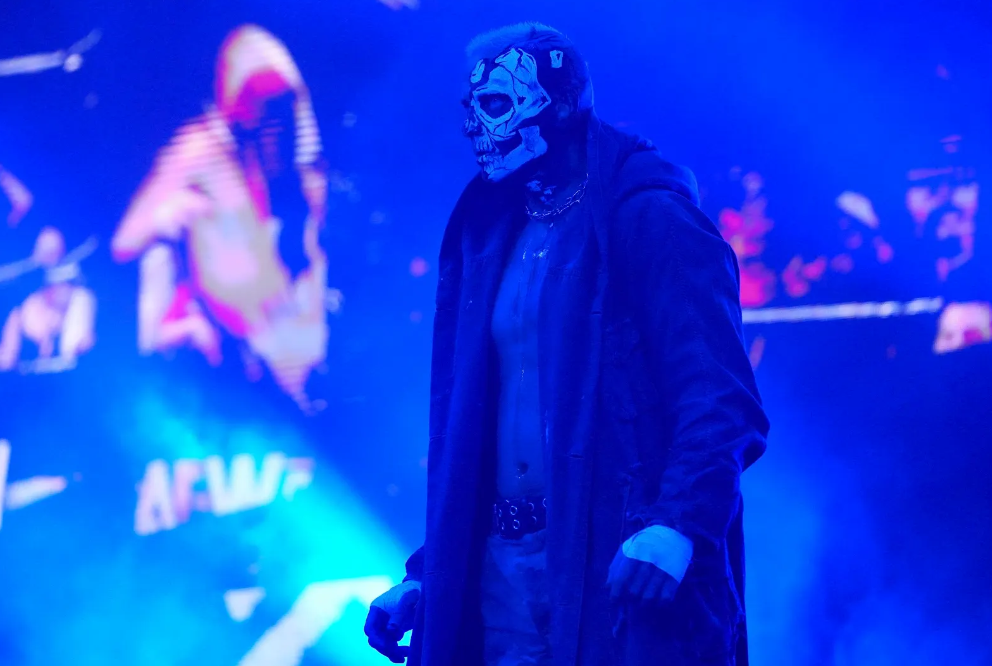
Darby Allin has been part of All Elite Wrestling since its inception, but by his own estimation, 2026 has been the best year of his career.
The 33-year-old’s first AEW World Championship reign began with a match that lasted mere minutes and sparked one of the most unique and fast-paced title reigns in the company’s brief history. He defended the title seven consecutive weeks, putting on high-caliber matches with all eyes constantly on him.
And while Allin’s reign ended within two months, it still came to a close in front of a raucous Louis Armstrong Stadium crowd on a night when he shared the ring with Mick Foley to open the show.
Now, Allin’s next test comes at Wembley Stadium
Now, Allin’s next test comes at Wembley Stadium for All In, where he’ll pursue gold again in a Falls Count Anywhere match for the TNT Championship against Kevin Knight.
Before he steps into the ring, Allin spoke with Forbes about the upcoming match, his chaotic title reign and the advice Sting gave him that’s resonated.
Rob Wolkenbrod: To start broadly, how would you summarize what 2026 has been like for you?
Darby Allin: Hands down the best year
Darby Allin: Hands down the best year of my career. It was an amazing ride, and I thought it wasn’t going to be topped after Everest last year, 2025. But 2026 has been a rollercoaster. It’s been insane, and the fact that I was able to climb to the top of this mountain of AEW and become world champion—I have no complaints. It’s incredible.
Wolkenbrod:You’ve had a few months now to look back on the night you became AEW World Champion. When you think about standing there with the championship and seeing the locker room come out to celebrate with you, what do you remember feeling in that moment?
Allin: It’s funny because I felt nothing, and that’s because my body was so depleted. I was so beat into the ground leading up to that week, dude. It took everything to get to that point. So afterwards, it felt numb. It was crazy. But moments after, when I finally got to the back and started to decompress, I realized that I climbed to the top of AEW without having to compromise myself, and that meant everything to me. Because to me, what’s the point of becoming a world champion if you’re just an industry plant and what you’re doing is not from the soul and isn’t pure? Like, hey, we’re going to tell you what to do every step along the way, and then we’re going to put something on you. Well, what’s the point of that? So the fact that I was able to do that in AEW without compromising anything was everything to me. So yeah, that night was incredible.
Wolkenbrod:Was there a moment when you developed
Wolkenbrod:Was there a moment when you developed that thought process you just explained about becoming world champion that way?
Allin: It was in the very beginning of AEW. Once they started kind of letting me do what I wanted to do, and then just naturally connecting with people, it’s like, whoa. I think people want to see what I have from my soul, as opposed to this character that gets everything handed to him. It’s really hard, especially when you’re first starting, and there are so many bumps to take.
And then here I am, five-foot-eight, wearing booty shorts and leggings and a skateboard, tiny as hell. Like, where does he fit in? Where does he fit into the grand scheme of this wrestling world? It’s the reason I was so intimidated to start wrestling in the first place. When I was 18 and I graduated high school, I wanted to be a wrestler. I went to the local wrestling school there, and everybody was big and jacked, wearing sweatpants and sweatshirts. They looked like athletes. I’m like, “There’s no way I’m going to fit into this world,” and I was so intimidated.
I told my dad, I want to be
And I told my dad, I want to be a wrestler. He’s like, dude, if you’re gonna be a wrestler, you gotta get serious. But, like, I wanted to stay true to myself because there’s gotta be a kid who’s out there feeling the same exact way that has the passion for pro wrestling, but doesn’t want to compromise anything about himself getting into it.
So when AEW first started and I was able to stay true to my original vision, that’s when it clicked that I need to make it to the top of this game without compromising anything to inspire the next generation or the current generation. Even people like Sting just inspires everybody. Like, dude, you don’t have to change anything. Just stay true. That’s all you got to do.
Wolkenbrod:Now, when you talk about that next generation, would you consider yourself a trailblazer for younger wrestlers coming up who might look at you for inspiration?
Allin:Time will tell with that one
Allin:Time will tell with that one. I really believe time will tell with that one because I helped Mick Foley a couple weeks ago, and he didn’t know he inspired my career so heavily. I’m like, why would you not know? And then the thing is, I think about kids years down the road coming, “Hey, dog, I remember watching you when I was six.” So time will tell with that one. However, I’d like to think that maybe people were inspired that you don’t have to compromise anything and you can make it on national TV.
Wolkenbrod:You defended the world title week after week after week in a pretty short stretch. What did that kind of pace demand from you, and did you enjoy the pressure of having to deliver every week?
Allin:Yeah, I love the pressure. I do good under pressure.
[Points behind him] You see that flag? That’s the same flag that I brought to the summit of Mount Everest. And when everybody told me that I wasn’t able to do that, I proved them wrong.The thing with me, I love the pressure
But the thing with me, I love the pressure because I want to rewrite what it means to be a champion. Normally, a champion—someone has to build up your number one contender; it takes months to have a match. I was like, every single week, let’s go. Let’s rewrite the whole script here. And I thought that’s what we did. It was incredible.
I remember week three of AEW TV when I got the opportunity to wrestle Chris Jericho for the world championship, and that kind of helped push me into a whole different atmosphere. And I want to give that to everybody. Everybody deserves an opportunity. So it was crazy, man.
Wolkenbrod:You’ve talked before about how climbing Mount Everest changed your perspective and how you didn’t need a championship to feel validated. Once you actually became AEW World Champion, did that perspective allow you to experience or appreciate the moment differently?
Allin:Yeah, my whole thing with Mount Everest was,
Allin:Yeah, my whole thing with Mount Everest was, you have to remember, in wrestling, there have been hundreds of champions. They come and they go. That’s just the nature of the beast. But with Mount Everest, I was going to be the first pro wrestler to do that, so it meant much more.
And people ask me, “Why would you do that? Why would you want to go climb Mount Everest?” Why would you not? Because my life doesn’t begin and end with wrestling. I got so many different interests outside of the ring because this is just a 15-minute ride, and if you put everything into this and it chews you up and spits you out, and you have nothing left, it’s going to be a very dark place.
So I just like to do stuff outside the ring and just remind myself that this isn’t my end-all, be-all in life. I’m very passionate. I love wrestling more than anything, but this isn’t my end-all, be-all. So, I definitely experienced gratitude for being world champion. I was just grateful that the company viewed me in that sense to give me the ball. That’s all I ever wanted.
Once you get the ball, it’s just going
Once you get the ball, it’s just going to take on another thing. Because I believe that no one in the world of wrestling is willing to go the way I’m going to go. I believe that it’s not just a character. It’s not just a gimmick. If I say I’m going to do something, I’m going to risk my life. I’m going to do something to risk my life.
So it’s like Sting’s last match, for example. When I said, “Hey, I’m going to jump off this,” you know, like, “Hey, I’ll do something so reckless and insane that no one’s going to forget,” and that’s what I did with the glass. It’s just like, yeah, I like fun. Sorry, guys.
Wolkenbrod:And you mentioned him before, but on the final night of your title reign, you got to share the ring with Mick Foley for his AEW debut. What was that experience like for you, and did you allow yourself to appreciate that moment as a fan?
Allin: Yes, you have to stop and smell
Allin: Yes, you have to stop and smell the roses. You have to because everybody’s so fixated on what’s next to stay relevant. But I do a thing every day where I talk about what I’m grateful for every single day of my life. Along with all my breathwork and meditating, I’m very in the moment.
So to be in the moment there with Mick Foley, it’s so inspiring because there’s not a lot of guys growing up when I was a kid watching wrestling that I viewed myself like, “Oh, I’d like to hang out with that guy. I see myself being buddies with that guy.” But for some reason, I always saw that with Mick Foley. I don’t know what it was. Maybe it was just the many moments and interviews. He seemed easy to talk to. I don’t get that from a lot of wrestlers.
So, to be in the ring at Double or Nothing and share that, I’m like, yeah, this is surreal. I didn’t know what he was going to say. I had no idea what he was about to say. So I’m sitting there listening. I’m like, “Oh yeah, that’s right. That’s fun. That’s cool.” He’s one of the nicest guys you’ll ever meet.
Wolkenbrod: So after wrestling there a few times
Wolkenbrod: So after wrestling there a few times now, when you’re in the middle of a match at Wembley Stadium, are you able to take in the magnitude of where you are? How does wrestling in front of 40,000 or 50,000 people compare to a typical wrestling venue?
Allin: It’s weird. It’s a double-edged sword, and I’ll explain what it’s like on camera. It’s fascinating just to step out and then look around when you’re backstage, watching the shows. And then when you make your entrance, you’re like, “Oh, this is crazy.”
But here’s the disconnect: I’ve seen so many great punk bands at small, tiny, intimate buildings. I’m talking about tiny, intimate buildings. And then they get a little name, they play a bigger arena, and it loses that intimacy. In something so big, I feel like it just becomes something of its own.
It’s strange, but there’s good and there’s bad
It’s strange, but there’s good and there’s bad within both because, like, being in the crowd for a small, dingy punk show, I was like, “This is incredible.” But then being in the arena, there’s a disconnect because there are security guards ripping you down when you’re trying to stage dive and stuff like that. So it’s weird. I appreciate both ends of it, but it’s a tough thing. It’s a tough one to explain. It’s massive. Yeah, I don’t know.
Wolkenbrod:And does it change how you have to operate when you’re trying to connect with the fans? When you’re performing in front of 40,000 or 50,000 people compared to a typical show, do you feel like you have to approach things differently?
Allin: No, absolutely not. When I was wrestling on the independents, I wrestled in front of three people at a bowling alley. We’re talking about three people at a bowling alley, and I always approached my matches the same. Also, during the pandemic, when there was, like, nobody. So it never changes with me how big or little the crowd is.
The one thing I can say about all
But the one thing I can say about all those people, it shows what AEW is capable of, and that’s what I’m very proud of. It shows that AEW has this energy to attract so many people. That’s what I’m grateful for. When I see everything, I’m like, “Well, this is great. This is what our company was able to do.” But for me as a performer, like I said, it’s kind of back and forth with how I feel out there.
Wolkenbrod:You’ve watched Kevin Knight from afar and have now worked with him for several months. What do you see in him, and do you see any of yourself in where he’s at in his career right now?
Allin:Yeah, absolutely. Here’s a funny story. I met Kevin Knight when he was only two months into training, so he was brand new. And at this point, I was about five years into wrestling, and he was two months brand new. And I saw a lot of potential in him, and I told him that. And I’ve always kept an eye on him. To me, the point that he’s at right now is where I was in 2020 when I became TNT Champion.
There are so many routes in wrestling
There are so many routes in wrestling to make it to the top, and sometimes people take the easier route. But I didn’t. I didn’t find the easy route. I didn’t want anybody to allow me to make it to the top. But Kevin went a different route. So, I see that he’s at that crossroads right now in his career that I was at.
Well, it’s time to humble him in front of everybody and show him that foundation isn’t going to last.
Wolkenbrod:You’ve had some of the wildest stipulation matches in AEW history. At this point, when somebody tells you you’re having a Falls Count Anywhere match at Wembley, do you immediately start thinking about what you can jump off?
Allin: Yeah, with Falls Count Anywhere, the possibilities
Allin: Yeah, with Falls Count Anywhere, the possibilities are endless. There are multiple things we could do. So, I get excited because we’re not boxed in.
Here’s the thing: everybody always thinks, like, I love coffin matches, but the reality is I don’t love coffin matches because it boxes you in, literally. But the thing is, like, I like to just go as crazy as possible. Falls Count Anywhere, the fact that I don’t have to bring his lifeless body back to the ring again, I’m like, sign me up. So yeah, I’m really excited for this.
Wolkenbrod:Now that you’re a few years removed from working with Sting on screen, is there something he taught you that you didn’t fully understand until after he retired?
Allin:Yeah, how to carry yourself out
Allin:Yeah, how to carry yourself out of the ring. We’re talking about a guy who’s done everything there is to do in the industry, and when you talk to him, he’s the most humble, chill guy. He doesn’t big league anybody, and that’s kind of what I realized later on because there’s so many egos where it’s like, “Oh, I can’t show any weakness.” He’s so chill and so happy all the time.
That’s what I hold on to most now that his career ended—how he conducts himself when the 15-minute ride is over. That’s what kind of inspired me the most.
Wolkenbrod:Is that thought process something you try to pass along to younger wrestlers who might look up to you or others within the AEW locker room?
Allin: Absolutely. I tell everybody, keep this
Allin: Absolutely. I tell everybody, keep this in check, keep your mind in check because if the mind goes, the body follows. And it’s scary, man, how an ego can turn someone into something so different. It’s crazy. I’ve seen it. I’ve seen it many times.
I’m like, man, I remember 10 years ago, we were just chilling and blah, blah, blah. Now I can’t even have a conversation with you. Like, you need to stop, dude. People have to be humble. They have to be grateful for what they have. There’s so much more in life, and so I’d love to just inspire people, like, just to be present and be grateful for everything that we have.
Wolkenbrod:You’ve been here almost from the beginning. When you look around AEW in 2026 compared to the company you joined in 2019, does it still feel like the same place?
Allin: I think the bar got set way
Allin: I think the bar got set way higher now because you have to remember, it’s year one on TV. We were throwing a lot of stuff at the wall, seeing what stuck because we’re brand new, and a lot of guys like myself never had any TV experience. So we got to see what worked.
But now the talent is so high, and everybody needs to step up. You aren’t going to be on TV unless you’re literally the best of the best. So, I feel it just shows everybody that no one can coast, no one can just chill, and that’s the beauty of it.
Because I never wanted to be in a company that felt like me and all my friends have a TV company. I don’t care if I don’t know you. I don’t care if I don’t like you. As long as you care about AEW and you want to produce some of the best, then I want you on my team.
I’m not going to say a lot
I’m not going to say a lot of people—it felt like maybe some people were taking it for granted. Year one, they were treating it like spring break, like, “Oh, this is so fun. I got a job for life. I’m just hanging out with my boys.” They weren’t going there with a mission. But I’m like, “I have to show the wrestling world what AEW is capable of,” because this changed the whole landscape.
When I first got in, I never thought it was possible to have another game in town like this. I thought at the time, “This kind of sucks.” And then AEW started, and I thought, “I’ll do anything to be part of that company. Anything.” And that’s where I knew I needed to finish.
So, I saw the importance of AEW from the beginning, but I don’t think a lot of people did.
Wolkenbrod:Now that you have an AEW World Championship
Wolkenbrod:Now that you have an AEW World Championship reign on your resume, what’s left for Darby Allin to accomplish that matters most to you?
Allin: Just doing things my way and never compromising because we go back to Sting; he had nothing left to prove when he had the injury in 2014 that eventually ended his wrestling career. The fact that he came back to wrestling and went out on his own terms—that’s important to me.
So just keep doing things on your own terms and living life to the fullest and never, never phoning it in, never taking it off. Some will say, “Just slow down.” I can’t. I physically and mentally can’t. Every time I step in the ring, even if it’s, like, a six-minute match, I’m going ballistic because I just never want to take anything for granted.
That’s kind of my whole goal with this, moving on. Just keep doing things my way, lead by example, and show everybody that you should never take it off.
This conversation has been condensed and edited for clarity.
Source: www.forbes.com