
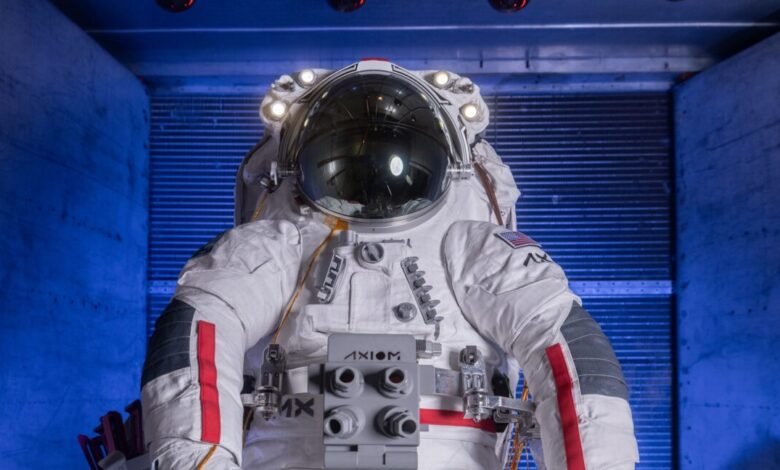
NASA has decided to use a simpler spacesuit for its initial missions to the lunar surface, Ars has learned.
The agency announced the decision during an internal meeting this week as it seeks to accelerate its program to land humans at the south pole of the Moon as early as 2028. At the direction of Artemis Program Manager Jeremy Parsons, NASA will work with Axiom Space to develop a “Sortie Suit” variant of the planned spacesuit for the lunar surface.
missions flown on landers developed both by SpaceX and Blue Origin. Among the goals of the initiative are to lower the mass of the spacesuit, reduce its complexity, and simplify interfaces between the spacesuits and lunar landers
Accelerating Artemis
Since arriving at NASA in December 2025, Administrator Jared Isaacman and his team have been reviewing the space agency’s Artemis Program, which had fallen significantly behind schedule. At the time, it appeared increasingly likely that NASA would not return to the Moon before at least 2030 and that this would allow China to reach the lunar surface in advance of NASA’s return.
Isaacman has been searching for ways to get Artemis back on track and, with the blessing of Congress, has already made some major changes, including streamlining production of the Space Launch System rocket, canceling the Lunar Gateway to reduce the burden on lunar landers, and working aggressively with SpaceX and Blue Origin to understand their needs and how NASA can help.
Less has been publicly reported about NASA’s work with Axiom Space, which, under a spacesuit-as-a-service contract, is the agency’s only current provider of suits for astronauts to venture out onto the lunar surface.
This does not mean suits are unimportant, however. For NASA to have a meaningful mission to the lunar surface, it needs more than a spacecraft, a rocket, and a lander—it needs modern spacesuits capable of allowing astronauts to wander around outside, take pictures, and conduct science.
Slimming down the suit
About four years ago, NASA awarded spacesuit development contracts to two providers, Axiom Space and Collins Aerospace. In 2024, after falling behind schedule and presumably because it was having difficulty making the finances work, Collins dropped out, leaving Axiom as the sole provider of suits. Axiom has remained committed to the process, but private
We began to get some answers about progress this week during the Aerospace Safety Advisory Panel. One of the panel’s members, former astronaut Charlie Precourt, revealed that NASA leadership is meeting with Axiom six days a week, often in person, to address concerns about schedule and performance. Precourt added, “Requirements are being adjusted to reflect near-term mission needs, including shortening the spacesuit certification duration requirements.”
Although he did not name the “Sortie Suit,” this now clearly appears to be a reference to a slimmed-down version of Axiom’s AxEMU suit. Ars has reached out to Axiom for comment and will update this story if a response is received.
There have been repeated industry rumors that Axiom’s current design is significantly over its mass budget. One reason for this is the requirements NASA initially established for these suits, which the space agency’s inspector general later characterized in a 2024 report as “over-burdensome.”
Initial requirements asked … a lot
Among these challenging requirements, NASA mandated that the lunar spacesuits be capable of six spacewalks over a 6.5-day mission; that even after being stowed in a dormant condition, the suits must still be capable of further spacewalks for a period of 210 days; and have a thermal system capable of not just shedding heat from an astronaut exerting themselves but also operate nominally for at least two hours in an exceptionally cold, permanently shadowed region.
These and many other requirements led Axiom toward a suit design that was complicated, necessitated many layers of protection that drove mass upward, and had a stiffer design that reduced astronaut mobility. The result was a much heavier suit, one that was more difficult to build, was falling behind schedule, and cost more.
Essentially, with the “Sortie Suit” design, NASA is seeking to pare back requirements to allow Axiom to develop a suit that is good enough for initial Artemis missions and becomes more capable over time as NASA and Axiom learn about conditions on the surface of the Moon and can fold operational experience into upgrades.
Such an approach would better suit NASA’s needs now.

Eric BergerSenior Space Editor
Eric BergerSenior Space Editor
Eric Berger is the senior space editor at Ars Technica, covering everything from astronomy to private space to NASA policy, and author of two books: Liftoff, about the rise of SpaceX; and Reentry, on the development of the Falcon 9 rocket and Dragon. A certified meteorologist, Eric lives in Houston.
Source: arstechnica.com