
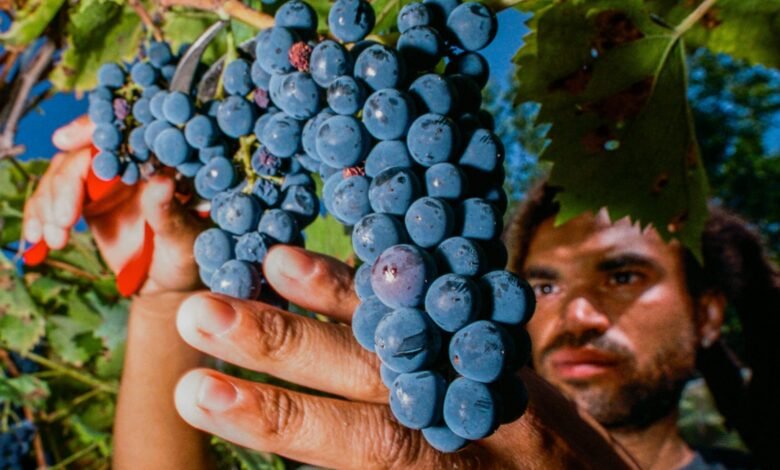
At the tail end of the summer, a powerful thunderstorm rips across southern New Hampshire. Winds approaching 40 miles per hour bring a sudden 20-degree drop in temperature. Within minutes, the cloudburst has deposited almost an inch of rain onto vineyards around the state farmed by upstart winery NOK Vino. Extreme weather can destroy an entire vintage at virtually any time during the growing season, but these late-summer days just before harvest are particularly crucial—the nearly ripe grapes are at risk of being crushed by hail or waterlogged, causing the fruit to split open and spoil.
The next morning, when NOK’s founder and winemaker Nicholas Kimberly checks on the Mermaid Hill Vineyard, he’s relieved to find his grapes largely intact. Their flavor and sugar content are temporarily diluted, but the forecast calls for sunny conditions that will allow the grapes to recover in time for a harvest at ideal ripeness. Kimberly runs NOK, which stands for “Not Otherwise Known,” with his business partner, Ryan Williams. They’ve chosen a formidable place to make wine. New Hampshire’s highest point, Mount Washington, claims the “world’s worst weather” at its summit and holds the record for the highest wind speed ever recorded in the Western Hemisphere—a gust of 231 miles per hour. And while conditions are more hospitable toward the valleys, winters usually see temperatures lower than 10 below zero. Warm, humid summers promote scourges like downy mildew and black rot. It’s not a climate that supports ordinary viticulture.
That’s why NOK doesn’t rely on ordinary grapes. Virtually all wines around the world are made from a single European species, Vitis vinifera, or the common grape vine. Sauvignon blanc, pinot noir, valdiguié, zinfandel—they’re all the same species, as genetically similar as a labrador is to a poodle. NOK, however, grows hybrid grapes: varieties crossed between V. viniferaand native North American species, often bred to withstand the harsh continental climate. If traditional wine grapes are like types of dogs, then you can think of these hybrids as wolves—similar, but in a completely different category.
Critics, sommeliers, and wholesale buyers—those who determine which bottles earn shelf space and prestige—once dismissed these types of wines. Hybrids can present unusual flavors, like tropical fruit or medicinal notes. Classically trained drinkers have been taught to disdain anything that’s outright grape-y, and hybrids can achieve somewhat cartoonish flavors of purple gummy bear. Most notoriously, many tasters describe an animal note, like wet fur, often called “foxy.”
“That’s a word that was made up by the established wine culture to pooh-pooh the taste of native grapes because they’re supposedly less noble, or some other purity bullshit,” Kimberly tells me while we’re at one of his vineyards, a few days after the storm. We’re standing in a two-acre block of marquette grapes, a red variety descended from pinot noir and hybrids of Vitis riparia, a cold-hardy endemic species. The vines are trained high on wires, with a tangle of grasses, goldenrod, and Queen Anne’s lace growing beneath. “It’s just another word for musk,” Williams chimes in. “Plenty of people like that.”
Those musky aromas are characteristic of wines made with Vitis labrusca, a species that includes concord, the table grape most commonly associated with mass-market grape juice and jelly. V. labrusca isn’t a major part of NOK’s production, but that’s not to say their wines taste like ordinary screw-cap pinot grigio or silky steakhouse cab. It’s far easier to compare NOK’s bottles to offbeat wine bar fixtures. One of them, River Rose, a blend of Frontenac gris and La Crescent, resembles fruity Sicilian orange wine. Another, Solidago, a white blend, suggests the Jura’s yeasty vins jaunes. But the offerings, which often feature thrilling combinations of exuberant, almost kombucha-adjacent aromas and precise, mineral flavors, ultimately defy easy comparisons. They’re their own thing.
NOK is part of a growing wave of American vintners combining exacting, old-fashioned production with hybrid fruit. In New England and around the world, climate change is forcing winemakers to reconsider varieties that can withstand extreme weather, thrive in subprime soil, and resist disease without heavy chemical intervention. And since these traits also help bring down production costs, hybrids are creating opportunities for winemakers who might otherwise be locked out of American viticulture.
Concurrently, a generation of natural wine obsessives has come to cherish funky flavors, and they’re primed to appreciate the nuance of a well-made hybrid bottle. These drinkers have moved beyond the narrow understanding of what’s “correct” and don’t consider wines with a bit of wildness to be flawed. Instead, these grapes are increasingly regarded as an exciting frontier.
Exactly what’s going to happen next is still up in the air. “No one has come from California or Bordeaux to say, ‘Here’s how we do it.’ ” Kimberly says. “Which, in a way, is great, because we get to define it ourselves.”
When Leif Erikson and his shipmates first reached Newfoundland, Canada, around the year 1000 B.C.E., he named the continent Vinland, which some scholars suggest meant vine land or wine land. While Norse seafarers are not famous for honest place-names (these are the people who named Greenland), North America does have many native grape varieties, and it’s possible the Vikings plucked wild V. labrusca off the vine.
Fermented alcoholic drinks were known to the Indigenous peoples of the Americas, but the first wine from American grapes seems to have been made by European colonists. Thomas Jefferson failed to grow imported V. viniferaat Monticello, but by the early 19th century, Cincinnati horticulturist and winemaker Nicholas Longworth was making sparkling wine from Catawba, a hybrid of V. labruscaand V. vinifera that had emerged in North Carolina. Longworth’s wines found fans as far away as California and London, and even inspired a poem by Henry Wadsworth Longfellow.
Later, a Texan horticulturist named Thomas Volney Munson developed dozens of hybrid varieties specifically adapted to North American climates. When phylloxera, a tiny plant pest, devastated Europe’s vineyards in the late 19th century, Munson’s work held the solution: grafting European vines onto hardy North American rootstocks. In gratitude, the French government awarded Munson the Legion of Honor. Today, nearly every European grapevine is a chimera of North American roots and European tops, but unlike the cross-breeding that created hybrids, grafting didn’t change the flavor of V. vinifera.
The rootstocks saved European wine culture, but acceptance of North America’s grapes never fully materialized before Prohibition gutted the U.S. wine industry. And while alcohol was outlawed on one side of the Atlantic, European nations began efforts to safeguard their own winemaking traditions (as well as their food products) based on where they were made. With these designations of origin, Europe codified the concept of terroir—the idea that the best wines are reflections of the soil and climate where their grapes are grown—and established European styles at the top of a hierarchy of prestige.
When the U.S. wine industry finally revived, makers venerated European styles. Growers smuggled in cuttings—so-called suitcase clones—clipped from the most storied French vineyards. Success was measured by how closely a burgundy or bordeaux could be replicated. Meanwhile, hybrid grapes were banned in winemaking by the European Community (a forerunner to the European Union) in 1976. In the United States, hybrids lived on, primarily in low-quality jug wine, grown for quantity over quality and often adulterated with cane sugar for extra alcohol.
Today’s hybrid renaissance is often traced to 2007, when restaurant owner Deirdre Heekin planted hybrid grapes on a small farm in Vermont. Heekin was hardly the first in the region, but she distinguished her winery, Domaine La Garagista, with a painstaking, artisanal approach: organic farming, lower yields, careful harvests, and meticulous, low-intervention winemaking. Her wines were a hit.
One of Heekin’s bottles made it to Kimberly when he was working at a wine bar in Burlington. “I opened it by myself on a weeknight because I was like, ‘Vermont wine? Whatever,’ ” he says. “Then, all of a sudden, I had this psychedelic experience.”
The next morning, Kimberly wrote to Heekin to ask for a job. For two years he worked at La Garagista as an apprentice, planting vineyards, pruning vines, and monitoring fermentations. He also learned how to improvise while working with hybrid grapes. Unlike growing and fermenting V. vinifera, there’s no textbook for making wines like La Garagista’s, but Kimberly got to work on several aspects of the operation. “A bigger winery is going to have a viticulturist and a winemaker and a sales staff,” Heekin says. “We’re tiny, so you can see all the elements, not just one piece.” Eventually, Kimberly was hired to manage Shara, the only organic vineyard in New Hampshire, where he spent the 2020 season farming vines and making wine under their label. The next year, he negotiated to begin producing his own.
Now, Kimberly produces thousands of cases a year. After starting out in borrowed space, NOK’s latest vintage is being made in a new facility in Hooksett. The spot includes a tasting room, which was inspired by Japanese listening bars—complete with 1970s hi-fi audio gear. The lineup includes effervescent wine-cider coferments, savory skin-contact whites, and intense, chewy reds, all made using small-scale farmhouse techniques: spontaneous fermentation, neutral vessels instead of oak, and lots of stomping by foot. Kimberly also employs a semi-carbonic maceration method—half of the grapes are gently crushed to release juice while whole clusters are nestled on top, creating an oxygen-free environment that produces distinctly fruity wines. He never removes the stems, believing they add structure and interesting flavors. (There’s no room for an expensive destemmer, anyway.) These methods allow for a transparent expression of each individual vineyard, creating the types of wines that today’s adventurous drinkers go crazy for.
It’s why NOK’s bottles are carried by influential distributor and importer Zev Rovine. “You do have to have an open mind,” Rovine says. Most people have never tasted anything like these wines. But, he suggests, they ultimately do what great wines are supposed to: complement good food and connect you to the place and people behind them. “They’re also just really tasty,” he adds.
NOK also fits in at Bridges, the glamorous Michelin-starred Manhattan restaurant that’s known for using luxurious old-world ingredients like foie gras, lobster, and Dover sole in modern and inventive ways. Bridges’ sommelier Oniyx Acosta appreciates how hybrid wines work with the menu’s various cultural influences, but acknowledges that some customers require some encouragement. With a little education up front, Acosta says, “Most of the time, people are receptive.”
New Hampshire can feel far from buzzy New York City restaurants. Kimberly and Williams live with a handful of roommates in a tumbledown 19th-century farmhouse
that’s a mile and a covered bridge from the nearest paved road. (A local land trust rents the house to farmers on favorable terms.) The days are long and unpredictable, and hardy hybrid grape varieties offer no guarantee of success. The current vintage has been affected by a severe drought—and resulting pressure from thirsty birds. When fall arrives, every harvest is a gamble. Wait too long for ideal ripeness, and a sudden storm might destroy the crop in an afternoon; pick too early, and the wine will taste tart and flat. In the spring, late frosts—those that hit when fragile new growth has already emerged—are a particular terror.
But on this late-summer day, as Williams cooks lunch for the harvest crew, the mood here is sunny. Family-style meals cooked over a propane burner in the open air power a great deal of this operation. As we toast with a few dusty bottles of NOK’s early vintages, the opportunity to create community and a brand-new wine culture make all the work and risk worth it. They’re coaxing something special out of these windswept, rocky hills. “If you believe terroir is a thing,” Kimberly says, “then it should apply anywhere in the world.”
Recipes
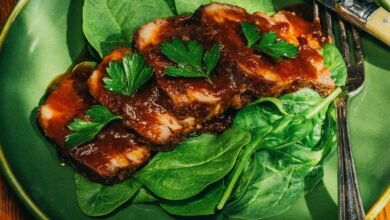
Wine-Braised Short Ribs
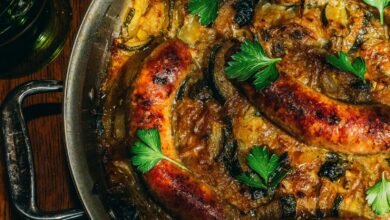
Roasted Sausages With Cider-Caramelized Onions and Zucchini
Keep Reading
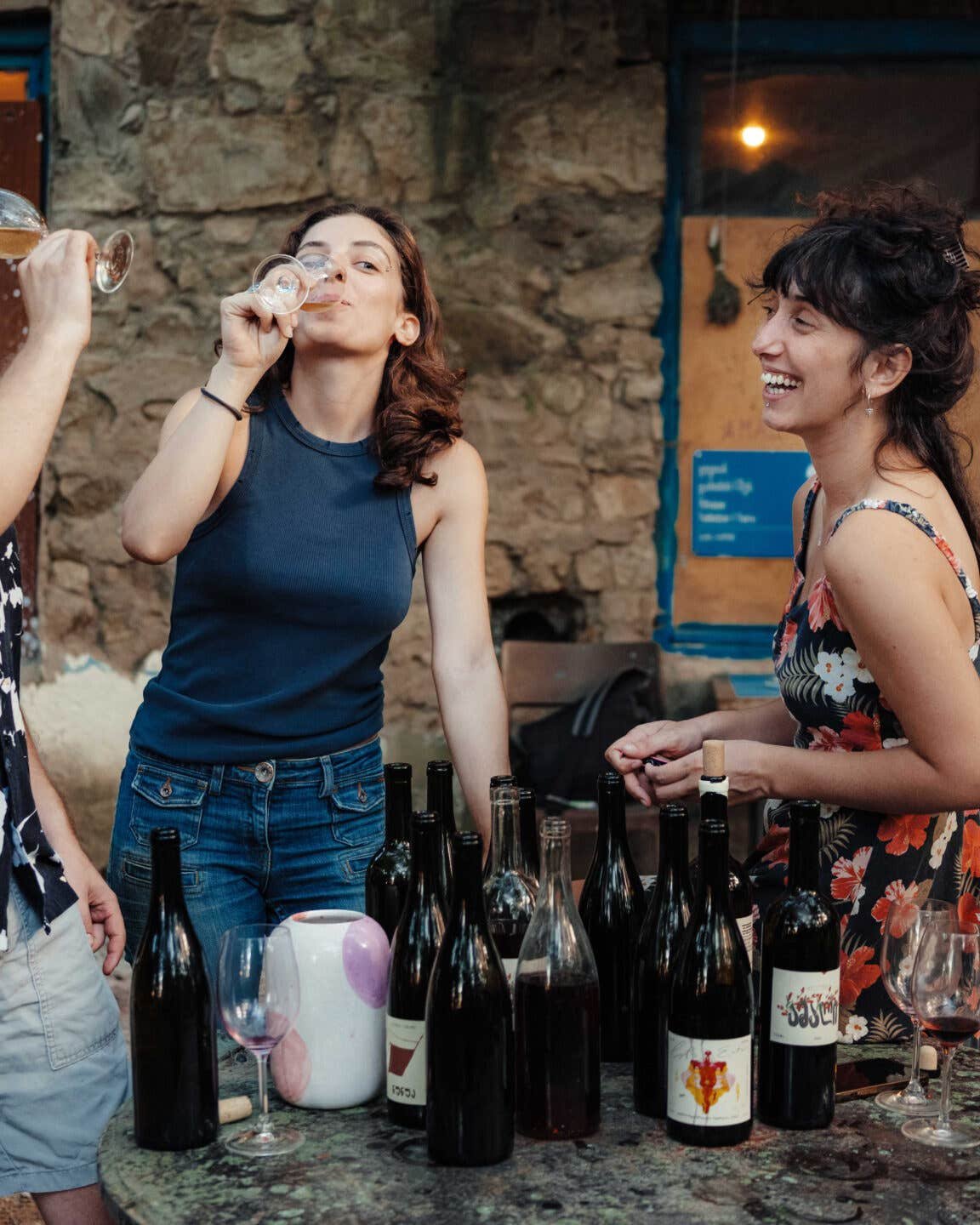
How Women Are Breathing New Life Into Georgia’s 8,000-Year Wine Tradition
These Indigenous Winemakers Are Making History
Welcome to the New Era of Eau de Vie
In Portugal’s Vinho Verde, Wine Is Green in More Ways Than One
10 Essential Vietnamese Coffee Drinks and Where to Try Them in Saigon
Black Raspberries Are the Fleeting Summer Fruit Worth Seeking Out
Meet the Children’s Book Illustrator Who Sees the World Through Food
The Mortar and Pestle Is the Timeless Kitchen Tool You Need
Eat Your Way Through Saigon
Source: www.saveur.com