
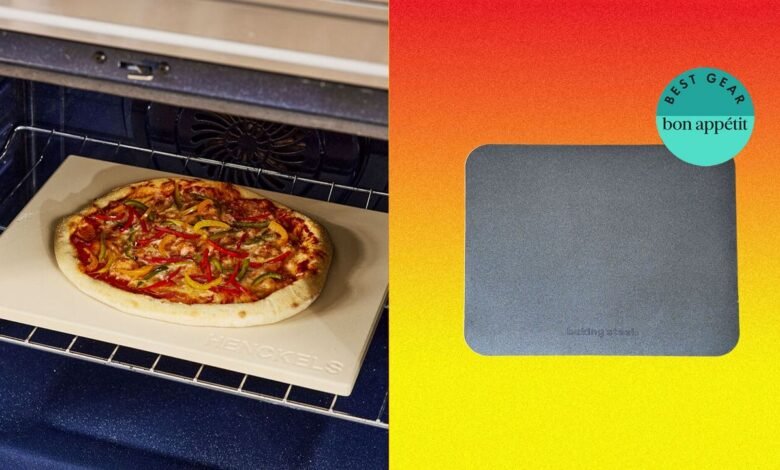
You may have heard the old maxim “there’s no such thing as bad pizza.” But I’d argue there is such a thing as great pizza. And if you’ve ever aspired to such greatness in baking pizza at home, you may have fallen short with a pale, limp crust or one that’s super thick and bready. Chances are, it’s not your pizza dough, it’s your baking surface. Most home ovens can’t crank up to brick-oven-level temps, and aluminum sheet pans, or even most pizza pans, won’t do you any favors when it comes to crispy crust.
The good news is that a true leopard-spotted bottom crust on a Neapolitan-style pizza from your own kitchen is possible even if you don’t want to shell out for a pricey pizza oven. You can still achieve near-perfect pies using a pizza stone or pizza steel. These composite, ceramic, or metal slabs absorb and retain heat, mimicking the intense, even cooking of a professional pizza oven to get that blistered, crunchy crust you expect from a restaurant.
But stones and steels have their differences and not all of them live up to the hype. Read on to see which pizza stones and pizza steels will work best at turning your home oven into a pizza-making machine.
Our top picks
- Best pizza steel overall:The Baking Steel Original
- A great, budget pizza steel: French Pantry Pizza Steel
- A practical pizza steel for beginners: Williams-Sonoma Pizza Steel
- Best pizza stone overall:Fibrament-D Baking Stone
- Best pizza stone for beginners: Emile Henry Square Pizza Stone
New in this update: I tested 10 new stones and steels and have three new top picks, including an affordable steel and one that will suit beginners particularly well.
Best pizza steels
Best pizza stones
How we tested pizza stones and pizza steels
What to consider when buying a pizza stone or pizza steel
Pizza stone questions you should be asking
Other pizza stones and pizza steels we tested
Best pizza steel overall: The Baking Steel Original

- Durable
- Retains heat well
- Cooks evenly
- Versatile
- Easy to clean
- Comes pre-seasoned
- Expensive
- Heavy
- Can rust if not properly cared for
- Material: Steel
- Weight: 16 lb.
- Dimensions: 14″ x 16″ x 0.25″ or 11.5″ x 11.5” x 0.375″
What we love: This has long been one of the best user-reviewed steels and those users are right. Heavy and unadorned, this simple slab of metal makes delicious pizza pies that are crispy and crusty in all the right places. It gets screaming hot fast and holds on to that heat beautifully, even with the oven door open for longer periods, trying to shuffle pies around with a pizza peel.
It’s versatile, able to double as a baking sheet for cookies or bread baking, or a cold platter (if you clean and freeze it first). It comes pre-seasoned, and caring for it is easy too. When it’s cooled down, wash it (you can use soap if you plan on re-seasoning it; otherwise, just rinse with water), dry it thoroughly, and oil it up to prevent rust. Its heft translates to incredible heat retention and evenly bakes pies with perfect bottom char.
What we’d leave: It’s pricey, and its weight (around 16 pounds) can make it awkward to handle. You may want to just leave it in the oven until you really need to clean it. Speaking of, it also needs to be dried completely after cleaning to prevent rust.
A great, budget pizza steel: The French Pantry Pizza Steel

- Inexpensive
- Thick steel
- Requires seasoning
- Heavy
- A bit annoying to clean
- Material: Steel
- Weight: 15 lb.
- Dimensions: 16″ x 16″ x 0.187″
What we love: At less than half the cost of The Baking Steel Original, this pizza steel performed exceptionally well, though with a few caveats. The model I used was a manageable 15 pounds and 3/16 of an inch thick, but it’s available in a few thicknesses, up to ⅝ inch (which ups the weight to 45 pounds and the price to $150), and a stainless steel option. It comes unseasoned, so it requires a little TLC before you can use it. Yes, seasoning a pizza steel feels a little unnecessary when so many preseasoned models exist at slightly higher price points. But in my experience, those pre-seasoned layers were prone to scratching with metal scrapers and still stained or held onto burnt crud. The thin layer of oil I put on the French Pantry steel before baking it at a high temperature for an hour still did the job and felt much more maintainable.
What we’d leave: It will need regular seasoning as it’s basically just a slab of carbon steel. The engraved French Pantry bicycle logo is cute but it will collect oil and debris over time (I’ll update this after future testing), however if that worries you you can probably just flip it over and use the non-logo side. This steel didn’t get as hot or heat up as quickly as some of the stones and steels I tested, but it maintained its heat well. If you’re looking for faster ready-to-bake temperatures, check out the Williams-Sonoma steel below.
A practical pizza steel for beginners: Williams-Sonoma Pizza Steel

- Preseasoned
- Generous size
- Steel performance without the weight
- Scratchable finish
- Material: Steel
- Weight: 9 lb.
- Dimensions: 15.25” x 15.25” x .125”
What we love: In my experience, Williams-Sonoma doesn’t usually put its name on a subpar product, and this pre-seasoned pizza steel is certainly evidence of that. It’s only ⅛ of an inch thick, but over the course of multiple pizzas I made, it did not seem to lag much behind beefier steels. I got high, consistent heat across the steel that peaked earlier than thicker options. To that end, I think it’s great for novice bakers or anyone who doesn’t want to keep their steel in the oven full time because it heats quickly and, especially if you’re going to use an upper rack, it’s light enough to put in and take out without hitting the gym.
What we’d leave: Normally, thickness would be an issue but because I’m recommending this as a steel for people who don’t want a heavy steel, I won’t dock it any points for that. However, it only has a tolerance of up to 550º F, so it’s definitely limited to home oven use. It did discolor a bit and some of the seasoning scraped off with a metal bench scraper.
Best pizza stone overall: Fibrament-D Baking Stone

- Durable
- Lightweight
- Versatile
- Affordable
- Intimidating to set up and care for
- Heavy
- Material: Unlisted and proprietary
- Weight: 17 lb.
- Dimensions: 17.5″ x 13.375″ x 0.75”
What we love: If you want a stone instead of a steel, the heavy, rectangular pizza stone from Fibrament is about as close as you can get to a commercial pizza setup at home. It’s made from a proprietary composite material that retains heat incredibly well and, in the right hands, churns out scrumptious homemade pizzas that look like something you could find on the streets of Naples. At around 17 pounds, it felt more solid and durable than most of the stones tested here. It’s crafted to handle years and years of use, an heirloom pizza stone you’ll have for the long haul, provided you take good care of it. It’s the pick for folks who make pizzas or other baked goods at least a few times a month, or those zealous home cooks who understand the science of baking and want to invest in a tool that delivers results.
What we’d leave: You can’t submerge it in water, use soap, or expose it to moisture, and the detailed care instructions are a bit nerve-wracking if you’re new to baking stones. You’re only supposed to use a scraper to slough off melted cheese or stuck-on dough. It’s also expensive and takes a long time to fully preheat.
Best pizza stone for beginners: Emile Henry Square Pizza Stone

- Lightweight
- Glazed surface
- Easy to clean, dishwasher safe
- Less even heat than steel or thicker stone
- Doesn’t maintain heat as well as steel
- Can break, chip, or crack
- Materials: Ceramic
- Weight: 5 lb.
- Dimensions: 14″ x 14″ x 0.5″
What we love: For pure user-friendliness, an easily removable, glazed ceramic pizza stone might be the best option. It’s lightweight and includes handles, so you don’t have trouble lugging it into or out of the oven. Its surface is so smooth, it shouldn’t have any issues with sticking and stains are come out more easily. It’s also dishwasher safe, so you’re not always stuck scraping or wiping it down (or seasoning it, like steel). Emile Henry’s also comes in a circular shape, but I think the square and rectangle models will serve pizzamaking needs a bit better if you’re planning to use a peel and make multiple pies in a row.
What we’d leave: Some hotter and cooler spots created uneven coloration on the crust (something you’ll find more commonly on ceramic or stone than steel). Burnt on cheese and sauce still stained a bit, even with a dark charcoal gray glaze, but that was more of an aesthetic issue than anything affecting performance. However, I found some additional scouring was necessary to get a fully smooth baking surface after use. And that glaze can scratch or chip, especially if you accidentally use metal tools, pizza wheels, or knives on it (which you shouldn’t do). Given its raised handles and ceramic makeup, I probably would not want to leave this in my oven fulltime for fear of cracking or getting too gunked up, so it’s probably better for cooks who want the occasional stone-baked pizza.
How we tested pizza stones and pizza steels
We preheated each stone or steel in an home oven set to 500ºF. We took temperature readings (at the center and edges of the baking surface) at the end of the oven’s preheat cycle to gauge how quickly the stone or steel heats up. We then let each stone or steel preheat for an additional hour and took temperature readings once again before proceeding to baking.
We made two pizzas on each steel or stone we tested, cooking them back to back, checking for both even heating and temperature consistency. While we would much rather make our own pizza dough, for consistency we worked with readymade, store-bought dough (the kind you find in the refrigerated section), forming it into balls and giving each one a good rest on the counter while the oven preheated. We also did not use any kind of convection setting as not everyone has that function (though we should note that if your oven has convection, you should definitely be using it for pizza).
Cook times varied depending on the stone or steel (we used our judgment on “doneness”), but we cooked both pizzas on each product for the same amount of time to judge recovery time on the second pie. While wood peels are preferred for a variety of reasons (i.e. less prone to sticking and safer on ceramics) we used a metal pizza peel to load and unload pizzas, checking for any scratches or marks left on the baking surface.
We pre-cleaned (and/or pre-seasoned) any product that suggested to do so in the instructions. At the end of each baking session, we placed a small pile of cheese and dollop of pizza sauce on the surface and let it burn in, mimicking a potential spill or other pizza making accident. After cooling completely, we cleaned each product according to the instructions.
What to consider when buying a pizza stone or pizza steel
Pizza steels are made of—you guessed it—steel, which conducts and retains heat better than stone, and is also more durable. Steel creates crisper, faster-cooked crusts but thicker models are very heavy and also require a bit more maintenance (steel can rust if not dried properly). Pizza stones, typically ceramic or composite, are porous, heat more slowly, and are lighter and generally easier to move in and out of the oven, though they can break or crack if not handled or stored properly. Glazed pizza stones are either ceramic or composite as well, but have been coated for a smooth, nonporous finish. Both steels and unglazed stones often caution against using soap or fully immersing the product in water, while glazed stones are more forgiving in the cleaning department, they can be prone to scratching or chipping.
Pizza stones and steels come in a variety of shapes and sizes, and which one you should choose may depend on how big your oven (or grill) is, how heavy the product is to lift, and the size and number of pizzas you want to make at a time. A large rectangular steel or stone may let you bake two pizzas or multiple loaves of bread at once, while a square might suffice for baking one at a time. Circular stones and steels seem apt for the job (they are pizza-shaped after all), but in my experience they actually take a little more practice to accurately slide the pizza dead center. You might face the same issue with a small stone that’s barely bigger than your crust diameter. If you’re still working on your pizza peel skills, a larger rectangle or square is more forgiving.
Heat retention and preheating time
The instructions that come with most of these steels and stones tell you to preheat them anywhere from thirty to 60 minutes at a high temperature (meaning they need a good half hour after the oven comes up to temperature). Thinner stones and stills might heat up faster, but they’re also more prone to losing heat quickly between the dough resting on the surface and opening the oven door. Thicker steels retain heat better than stones, so if you want to bake multiple pizzas back-to-back without losing that crispy bottom crust, they’re your best bet.
Pizza steels are typically more expensive, ranging from $100–$150, but they’re built to last for years, if not decades. Stones are usually more affordable, starting at around $30, but they can chip, crack, or lose effectiveness over time.
Can I leave my pizza steel or stone in the oven?
Yes, many people keep their steel in the oven permanently. It helps regulate temperature and improve heat retention inside ovens. Just be aware that it may impact both preheat time and cool down time (making them both longer) when using your oven for other dishes.
But leaving a stone or steel in the bottom of your oven could subject it to unintentional splatters and spills. However, the instructions for most steels and many stones will advise you to place them on a higher rack, rather than on the bottom of the oven, so you may not want to leave yours in full place time.
Other pizza stones and pizza steels we tested

This pre-seasoned, ¼ inch thick steel heat extremely evenly with minimal disparity between the center and edges. My back-to-back pizzas came out perfect at just about seven minutes each. It comes in a variety of sizes and shapes from 13” and 16” squares to 12” by 14” and 13.25” by 16” rectangles. The one major strike against this steel was its cleanability. The surface has a bit of a rough texture that holds onto the burnt cheese and sauce. Though I was able to remove them, even after scrubbing with a scouring pad they left stains and some matte patches that look like they’d need reseasoning to stay as nonstick as possible.

You can tell just by looking at its raised edge and handles that HexClad’s take on the pizza steel is actually a pizza pan masquerading under the name “pizza steel.” But for a pan, I was impressed with how quickly it heated up and transferred that heat to the crust, though it did take a few minutes longer to achieve desired browning than other steels and stones. After a pre-seasoning, the hexagonal texture released the crust easily and burnt on cheese and sauce cleaned up well, too, sliding right off. If you’re worried about using a peel, it’s a decent, crispy-capable alternative without the risk of a sticky dough disaster. It’s meant to go into the pre-heated oven cold (as in, you make your pizza on it before putting it in the oven) and specifically does not recommend baking back to back pizzas without letting it cool in between. I ignored this and lifted my first pizza off, then loaded a second pizza on (leaving the pan in the oven) and it actually worked perfectly. Because of the lip around the edge though, I wouldn’t recommend a novice home pizza chef try this method, but it can be done.
Nerd Chef Standard Baking Steel

This hefty, 16-pound steel heats up quickly and holds onto that heat. The smooth surface makes sliding pizzas on and off a breeze, and it gives the crust a satisfying snappy texture. It comes pre-seasoned and ready to go right out of the box, which saves a step. The Nerd Chef Baking Steel also comes in two additional thicknesses for serious home chefs: Pro (.375″) and Ultimate (.5″). Be warned: These are significantly heavier than the ¼ inch at 23 pounds and 32 pounds, respectively. The only downside to the Nerd Chef is the higher price tag which may be too much for bakers on a budget.
Other pizza stones we liked

Compared to other stones, this one almost felt too light, like it would lose heat the second I opened the oven door. But the weight of the Henckels works in its favor, allowing it to be placed in and removed from the oven with one hand. That mobility also makes it versatile: We tested it in the oven and on a gas grill, and it worked well in both settings. The pizzas developed a nicely crisped bottom with a good rise and didn’t stick to the stone. Not everyone wants to shell out $100-plus on something they may not use regularly, and for them, the Henckels stone makes a lot of sense. If you’re a home cook curious about improving your pizza making but don’t want invest much yet, this is a great place to start.
Le Creuset Stoneware Round Pizza Stone

Sometimes brands with a strong identity can shoot for style over substance. That’s rarely the case with Le Creuset, and this unique, circular, glazed ceramic stone is as functional as it is good looking, delivering crispy crust fast enough to leave perfectly melty cheese. Despite the high price tag on many Le Creuset products, this one comes in under $100, is available in a few eye-catching colors, and is even dishwasher safe. A unique feature touted in the instructions is that it can be used to cook on either the glazed or unglazed side, if you have need for both baking surfaces. My biggest gripe is petty, and it had to do with cleaning: Like my enameled cookware, I couldn’t get stains to completely disappear, even with soap and scouring. It looks so pretty out of the box and then quickly, it doesn’t. You also may not like the lines the concentric rings leave on the bottom of your pizza or loaves, but that also seemed only to affect aesthetics.

Truth be told, though I came to prefer steel after doing all this testing, I’ve had this pizza stone in my kitchen for years and it’s served me well enough. I like that it comes in a wide variety of sizes and price points, all of them relatively affordable. It heats up well, but in direct comparison to other stones on this list, it takes longer to cook the crust to perfection (meaning the cheese overcooks while you wait) and recovery time between pies was slow as the second of the back-to-back pizza came out underdone. It’s beige, so it holds onto stains and burnt food, but it can be scraped clean. Just don’t expect it to look pretty after a while.

Williams-Sonoma notes that this Italian-made, stone is “cut from the volcanic lava of Italy’s Mt. Etna.” If that pedigree isn’t enough for you, the stone produced exceptional crust results and delivered high, consistent heat. But a few qualms kept this from being the best stone I used. My first is its size; at just 11.75 inches by 15 inches it’s not even large enough for a pretty standard 12-inch pie. I wish it was available in larger dimensions. (It does come with an appropriately small wooden pizza peel, which is a nice touch.) Secondly, it looks beautiful with its terrazzo style, but that beauty quickly became marred by burnt-on cheese and sauce, which I was able to clean off flush to the original surface but left irremovable black marks. Finally, it is actually only rated for 480ºF (I used it at 500º, seemingly without issue) which means you shouldn’t put it on something like kamado grill, though it does say it can be used on a stovetop, which seems slightly suspicious because it’s hard to monitor the temperature of the direct heat you’d get from a gas burner.
Pizza stones and pizza steels we don’t recommend
The Made In Pizza Steel is a compact option that performs well for small pies, but it has some limitations. We liked that it was noticeably lighter and smaller than other steels we tested—at just 12.6 inches in diameter, it’s much easier to maneuver, store, and clean. That said, the smaller size limits the size of the pizzas you can make, and it didn’t retain heat as effectively as larger, heavier steels like the Original Baking Steel or Nerd Chef. It also functions more as a pan (though it can be preheated, unlike HexClad’s version).
The Nordic Ware Pizza Stone Set is a lightweight, budget-friendly option that’s great for casual pizza nights, though not more serious pizza making. It heats up quickly and comes with a convenient wire rack that makes it easy to carry and serve straight from the oven. In our tests, it produced a decently crisp crust, though it didn’t deliver the deep browning or blistering you’d get from a steel or a thicker stone. Its circular shape was also a strike against it, as it limits the size and shape of possible pizzas.
If high heat is your main concern, you’ll be pleased to know this glazed cordierite pizza stone can allegedly withstand temperatures up to 1,100ºF. But, while all of the glazed stones held onto stains somewhat, this one ended up the least salvageable of the bunch. Despite getting most of the debris off, the surface still felt rough. As for cooking, my first pizza turned out fine, but the second pizza was noticeably underbaked, meaning recovery time is lackluster compared to some of the competition. If you’re going for glazed, the Emile Henry or Le Creuset are more reliable choices.
Pizza steels are pretty low-tech, so all of them at least work to some extent. Vevor, a catch-all brand that makes a dizzying array of products on Amazon, offers preseasoned steels in a range of sizes and two thicknesses. This steel’s shortcomings came down to the details. Pizza cook times were inconsistent, with the first coming out burnt on the bottom after just 6 minutes and pulling the second at 5 minutes yielded an underdone pizza. I tested the largest size, 16” by 20” with a thickness of ⅜ inch and I felt like it needed a lot more dialing in when it came to temperature, time, and desired doneness. The biggest red flag for me was its cleanability. I was able to scrape and wipe away most of the burnt-on messes, but my metal tools left visible scratches on the surface. It gave me flashbacks to PFAS and Teflon. No thanks.
What to do with your new pizza steel
- Almost two dozen recipes for every kind of pizza night
- BA Bake Club’s incredibly good cheese pizza
- A galette that will bake up beautifully on a stone
Additional testing by Francesca Krempa
Source: www.bonappetit.com