There are certain destinations we know we’ll visit some day, but for one reason or another, they sit on the back burner. Since moving to New York City over a decade ago, I knew my time with the Berkshires would eventually come. Earlier this summer, at long last, it finally did. If you’re familiar with this highland region in western Massachusetts, it may have something to do with Edith Wharton, who famously relocated here in pursuit of “the real country.” Or Herman Melville, who wrote Moby Dick from a desk overlooking Mount Greylock, said to be the inspiration for his white whale.
Or perhaps you’ve heard of Tanglewood and Jacob’s Pillow, prolific music and dance centers, respectively. If you’re an art lover, MASS MoCA is likely on your radar. Wellness enthusiast? The concentration of pioneering spas (like Canyon Ranch) is notable. And for the leaf peepers, the area’s astonishing fall landscapes are probably on your bucket list. But how did the Berkshires come to be such a swirl of interests?
“This area has often been described as a cultural vortex,” Scott Edward Cole tells me. He and his partner Frank Muytjens are the owners of The Inn at Kenmore Hall (my home base for this excursion). “As creative people ourselves, we are nurtured in so many ways.”
Cole suggests the natural landscape is what initially attracts creative types to the Berkshires. And then, the proximity to Boston and New York.
It became a popular summer escape
“It became a popular summer escape in the advent of railways, and during the Gilded Age many grand homes, referred to as ‘cottages’, were built by families like the Vanderbilts, Carnegies, and Choates,” he explains. “In the 1900s, there was more of a cultural critical mass,” Cole says in reference to a small music festival that grew to become Tanglewood (the summer home of the Boston Symphony Orchestra), as well as the Jacob’s Pillow Dance Festival (now America’s largest and longest-running international dance festival).
Summer stock theater such as the Williamstown Theater Festival and Berkshire Theatre Festival also brought major stars from film and Broadway to local stages. “And of course,” Cole adds, “Norman Rockwell moved to Stockbridge and immortalized the people and places of his daily life here.”
Throughout the decades, the Berkshires have continued to thrive as a creative bubble, with chefs, hoteliers, and artists decamping to towns such as Lenox, North Adams, and Great Barrington.
Even still, destinations like the Hudson Valley and Catskills continue to overshadow their well-rounded neighbor to the east in terms of tourism. I have a hunch why, and it’s because I’m guilty of it: convenience. For New Yorkers, the Berkshires require more commitment to reach than, say, Beacon or Kingston. A visit means going the extra mile, booking the rental car another day, staying one more night.
I think that’s a good thing
And I think that’s a good thing. Say what you will about a low lift, but it’s usually those further afield locations that make for the more compelling travel experiences. With a wave of new openings in recent years, and renewed appreciation for some legendary old-school spots—praised in detail below—there’s never been a better time to take the Berkshires off the back burner and onto the calendar.
Ahead, a few destinations that exemplify the region’s enduring appeal. Walker Street Market
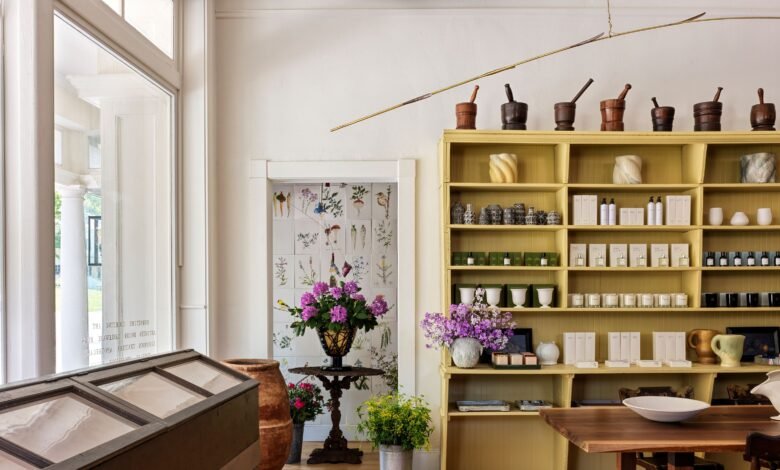
When Matthew Ames spotted a listing for an early 20th-century building in downtown Lenox, he knew it would be the perfect home for a project he’d been conceptualizing for nearly three years. A design and interiors gallery, anchored in craft, and bringing together work by makers in a wide range of disciplines.
The 3,000-square-foot space—now known as Walker Street Market—has had previous incarnations, including as a general and dry goods outpost, a jeweler, an antique shop, and then as a department store. “People who grew up in town have memories of shopping here as kids,” Ames says. “It’s a very special building for the community, so it’s really exciting to get to be the caretaker of this space and, you know, give it a new life.”
If his name rings a bell, Ames was previously a fashion designer during the early aughts, whose minimalist collections would certainly still find a home in our current ’90s-obsessed closets.
After several well-received seasons, he packed up
After several well-received seasons, he packed up for Chicago to work as a gallerist, before eventually making his way back east. After a year or so of restoring the building, Ames unveiled Walker Street Market to the public in July 2026. The gallery highlights work by over 70 artists, with categories spanning furniture, lighting, textiles, ceramics, jewelry, kitchenware, basketry, apothecary items, and everyday objects for the home.
Several pieces were commissioned specifically for the space and are available made-to-order, as well as select antiques, including a cast iron zodiac table from the 1800s. Ames also partnered with Robin Hill’s head gardener James McGrath to create a flower market for customers, which occupies a dainty nook in the front that’s accentuated with floral tiles hand-painted by Bruno Grizzo.
It’s the sort of imaginative emporium where you discover something new and novel every time you return. Simone Bodmer-Turner’s organic ceramic tables, a handsome Shaker bench by George Sawyer, exquisite brooms with wood sapling handles by Erin McIntyre, hand-carved walnut pendants from Ashley Joseph Martin—all summoning a profound appreciation for objects made by hand, and with materials from the natural world.
The Inn at Kenmore Hall In the 1880s,
The Inn at Kenmore Hall
In the 1880s, the property that is now The Inn at Kenmore Hall served as a summer arts residency. “Painters like Robert Lewis Reid and Frederic Crowninshield spent days painting en plein air in our fields and then would hang their work in our center hall for nightly critiques,” Cole says. It also became a summer boarding house for visiting musicians and composers in town for nearby Tanglewood.
“It was, by all accounts, a very bohemian scene with pianos moved in, violin or woodwind sounds wafting from other rooms,” Cole says. A young Leonard Bernstein (early in his tenure with the BSO) even took residence a few summers in what is now their Carriage House cottage. In its current iteration, the 18th-century Georgian-Federal home is a charming six-key escape that straddles the line between feeling blissfully at home and on holiday.
“We wanted guests to feel as though they were visiting their friend’s lovely country estate. Well-appointed, but not fussy or imposing in any way,” Cole says. Since the inn is also their residence, you’ll find Muytjens and Cole’s combined collections of books, objects, and furniture throughout the house. “We are always adding or editing things here and there, but letting the arrangements shift and evolve according to our whims.”
My visit coincided with agreeable early June weather, but as summer drifts to autumn, Cole says a particular magic washes over the landscape.
The change in sunlight becomes more golden
“The change in sunlight becomes more golden and seems to heighten everything you see,” he says. Their garden reaches its peak, with dahlias, amaranth, and celosia in abundance. “We have a trail that runs through about 10 acres of meadows, and by autumn, there are huge drifts of native asters, goldenrod, and centaurea.” And if you’re an early riser, he also shares that cooler mornings mean that most days there are veils of mist that rise up between the valley and Lenox Mountain in the distance.
“It’s truly breathtaking.”
Shaker Village & Museum Outpost
When Mother Ann Lee and her small group of converts arrived in America in 1774, their first settlement was established northwest of Albany. It wasn’t until after her death that the Hancock community was formed, reaching its peak in the mid-19th century, before fading out and selling the land in 1960. The lasting impact The Shakers left on the Berkshires, however, really can’t be overstated—from sustainable agricultural techniques (continuous-direction farming, anyone?) to innovative craft and design, including the utilitarian (but beautiful!) Shaker box.
That’s a long way of saying: a visit to the historic Hancock Shaker Village is a quintessential experience when one finds themselves in the Berkshires. In fact, do as I did and attend a demonstration of how these boxes are crafted by hand (and buy your own from their Mercantile Store). Drive less than 30 minutes west, and you’ll arrive at the Shaker Museum pop-up. Here, artists like Maira Kalman and Kiki Smith are curating a rotating series of exhibitions, pulling their favorite pieces from the museum’s extensive collection and creating new paintings that interpret the chosen Shaker objects.
The pop-up also has a General Store
The pop-up also has a General Store that sells small goods curated by the artist-in-residence, from books and textiles to design objects. All proceeds benefit fundraising for the Shaker Museum’s renovation, which will be unveiled in 2028. The Dream Away Lodge
Call me a nostalgia groupie, but when I find out somewhere was a previous haunt for true icons, I’m all in. In the case of The Dream Away Lodge, legendary patrons abound.
The 1820s-era farmhouse is rumored to have been a brothel and speakeasy during The Great Depression, but officially became a restaurant and bar in 1949. The original owner, Mama Frasca, welcomed Arlo Guthrie, Bob Dylan, Joan Baez, Allen Ginsberg, and the Rolling Thunder Revue in 1975, which led to The Dream Away’s prominent inclusion in Dylan’s film Renaldo and Clara, further cementing the destination as a Berkshire County staple.
‘Tucked away’ is the best way to describe the location of this hidden jewel, which sits at the edge of October Mountain State Forest and is surrounded by flowers, towering trees, and a lush lawn that leads to a small fire pit (a great spot to go after your dinner). For the 2026 season, The Dream Away Lodge is helmed by chef Caroline Fidanza, who was the opening chef at Williamsburg’s Diner and founder of Saltie, a beloved sandwich shop in Brooklyn that closed in 2017.
Source: www.vogue.com