

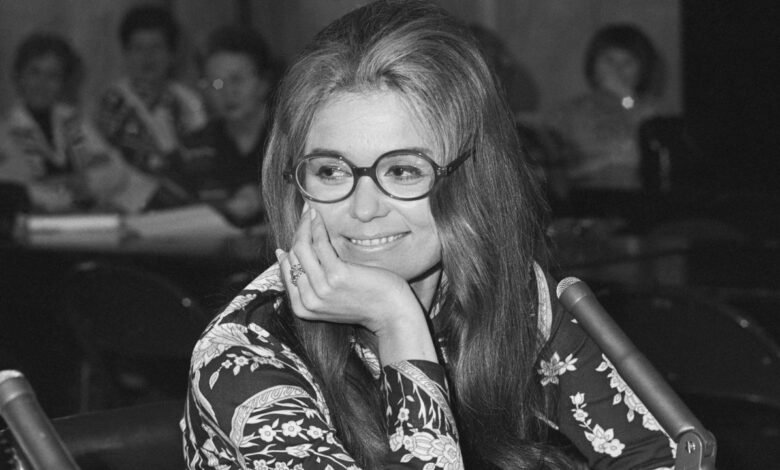
Gloria Steineim—the era-defining feminist activist, journalist, author, and organizer—has died, according to a statement from her foundation. She was 92.
Here, we revisit a profile of Steinem by Liz Smith, “Coming of Age in America,” originally published in the June 1971 issue of Vogue.
For more of the best from Vogue’s archive, sign up for our Nostalgia newsletter here.
Around Gloria Steinem is that faint nimbus
Around Gloria Steinem is that faint nimbus of sexy fanaticism thrown off by those who are righteous in dedication and devotion, who can’t be bought or bossed, who have turned their backs on the usual rewards. Gloria is an incipient excitement—any minute she may cut loose, grab a rope, and drive the money changers from the temple, do battle in behalf of women, lettuce workers, grape pickers, Black Panthers, peace students, draft dodgers, the racially deprived, or anyone who is disenfranchised or underprivileged in her eyes.
“Gloria is my symbol of the modern woman. Intelligent, beautiful, and idealistic. She’s thought out the way she wants to live and acts on it.” —Clay S. Felker, editor, New York magazine
“You know that guy in Chicago who killed all those nurses. That’s Gloria—the Richard Speck of the Radical Left.” —Al Capp, cartoonist/columnist
“Miss Steinem is a political analyst of acumen and influence.”
If you were a man, I’d hit you
“If you were a man, I’d hit you right in the mouth!” —Hans Conried, actor, to Gloria Steinem on television talk show
With the exception of a few such enemies as Al Capp and Hans Conried, the general feeling among even those who find the Women’s Liberation movement a hateful toad is that Gloria Steinem is the shining jewel in its forehead. When Gloria rises to give her “Fundamental Revolution” lecture, eyes glaze with admiration.
Gloria figuratively struck down the tough reporter Pete Hamill like some Saul on the road to Damascus. Pete was on his way persecuting the “Chris-tians,” as it were, but Gloria turned him into a regular Paul, and he’s now for Women’s Lib.
I was slow to catch on: I’m Irish,
“I was slow to catch on: I’m Irish, you know. I couldn’t take the Ti-Grace Atkinsons, and so, like a lot of men, I tended to triw is eliminating a lot of these crazy barriers. She is the best spokesman the movement could ever have, because it’s not like she’s into some kind of freaky public therapy when she does it.”
Gloria appreciates Pete, but not such compliments and distinctions. She believes the movement is breaking down barriers between women of all kinds, between the beautiful and ugly, the married and single, the old and young, and, surprisingly, between the housewives of middle-class suburbia and lower-income Black women. She says she’s even learned to stop reacting to the occasional fearful male who assumes any Women’s Lib member is a lesbian. (“If one reacts in a shocked, defensive way, saying, ‘Well, I’m not gay and I can prove it!’ she’s just condemning her lesbian sisters in and out of the movement. Women who are lesbians are twice discriminated against. And the movement is for all women. If I’m happy as I am, why should I feel threatened at being called something I’m not, or putting lesbians down by acting offended.”)
Why is Gloria Steinem so effective? For one thing, she is a beautiful person, both in the lower- and upper-case senses.
She has made it in the world
She has made it in the world and doesn’t need recognition, so her integrity stands fairly unquestioned. The eligible attractive men in her life dispel any notion that she might be—well, you know, not normal. She speaks softly and looks as cool, effortless, and unfrenetic as a rich girl on a frat picnic. This is an illusion—she is burning for causes, dying inside of stage fright, trammeled with care born of undertaking too much.
Gloria Steinem is a good writer (her socio-political articles for the weekly magazine New York won a Penney-Missouri Magazine Award last year). She is brave (she answered Hans Conried: “Why don’t you? At least you’d be taking women seriously”). She put her money where her mouth is (withholding taxes meant for Vietnam defense is a time-consuming, troublesome bookkeeping juggle; and she distributes lecture fees around to women’s movements). She is an activist (not only traveling hard as a spokeswoman for Women’s Lib but for populist labor causes and politicians in whom she believes). Her personal life is a rebuke to racists (her current man is the Black athlete-actor Rafer Johnson; her best friend is the dynamic day-care-center leader Dorothy Pitman Hughes). She is scrupulously uncompromising these days in her work (although in demand by most of the mass media, she has almost stopped writing for money, her philosophy being, “If someone else can write it, then it’s not for me to do it”).
Inevitable martyrdom must be in store for this creature who sums up today’s liberated, committed, involved, dedicated, individualistic, independent woman as the kind of female who simply won’t conform, compromise, sit down, shut up, or stop pointing us all in the way we should go. (Every bit as irritating to David Susskind of television and Murray Kempton and Jules Feiffer of the liberal press as Joan of Arc was to the Earl of Warwick.)
Yet Pete Hamill said: She is just
Yet Pete Hamill said: “She is just the greatest girl around. Most of the men I know are in love with Gloria Steinem, and it isn’t difficult to understand why.”
Asked about this overkill of popularity, Gloria’s broad, serene face goes concerned around the eyes. “Well, I must be doing something wrong. Because sometimes I think I could call for a Viet Cong victory; and with the exception of a few vitriolic enemies, I’d probably get away with it.
“This always makes me realize that I’m just not getting my points across. I see that now and again when I realize people I dislike intensely like me. Then I know something’s wrong with my life, as if my convictions aren’t strong or emphatic enough to overtake some dumb image of what most people stupidly call ‘feminine’ or ‘successful.’ Of course, it’s my own fault. “It reminds me of the Dorothy Parker dictum about the girl who lost her virginity for fear of seeming impolite. I think I have an authority problem.”
It hadn’t seemed so the day I went
It hadn’t seemed so the day I went to The Plaza hotel for Gloria’s act before The Copy Club of New York. Scene: She stands there long-legged in a blue-print challis mini-dress that could be wadded up for a hankie. Her shoes are still the sling Chanel type. Her Alice in Wonderland hair, with its blond streaks, falls artfully over her bosom. She looks just right, peering through her perennial blue-tinted prescription specs. The effect is all very “together,” though she isn’t talking quite loud enough. Voice just barely shaking with nervousness, she makes the points she has been making before college groups and others for almost two years now:
“This is not a frivolous revolution; it is deep and fundamental. We will never have a less violent society until we realize that manhood doesn’t depend on the subjugation of other people and womanhood doesn’t depend on submissiveness or being cheap labor.”
“The best women are not thin and rich, and neither are the best men.”
“Money and success are not sexy. That is an obscene statement. Masculinity isn’t measured by the size of the paycheck.”
Making women supportive secondary beings only creates women
“Making women supportive secondary beings only creates women so angry that they then control their men by guilt, nagging, and underhanded pettiness.”
“If a woman gets her identity from a man or plays the game as a conspicuous consumer, a sex object, it teaches her to use slaves’ tactics in order to ‘win.’”
“There is a myth, just as there is about Blacks, that women don’t like each other and can’t work for one another.”
Gloria then nods and says, Isn’t
Gloria then nods and says, “Isn’t that the most incredible shit?” The audience sits stunned, hands paralyzed over coffee cups and petits fours. Then they titter. Yes. They came here to see a star, and that’s just what they have seen, for only a star could get away with that—a woman who isn’t afraid she’ll ruin her “femininity quotient” by saying “shit” right out loud in the White and Gold Suite.
“Is Gloria for real, or did somebody make her up?”
What is a Gloria Steinem, after all? Not just a girl who can swear in The Plaza, nor one who selects as her favorite fan letter the variation she receives over and over on “long-haired, n—er-loving, Commie slut.”
The first part is easy to answer. Brewer’s Dictionary of Phrase and Fable says, “A Gloria is a mixture of silk and wool used for covering umbrellas, etc.” The Steinem part is more complex. In this instance, a Steinem is descended in equal parts from a flamboyant, mercurial, nonreligious Jewish father and a sensitive, gentle, French-German gentile mother.
Here’s the cleaned-up version, with curly quotation marks
Here’s the cleaned-up version, with curly quotation marks and apostrophes, corrected punctuation, and obvious hyphenation/spacing fixes while preserving the original wording. The parental romance is Ohio, U.S.A., melting-pot stuff: Daughter of railroad engineer falls for devilish son of Ohio’s first woman’s suffragette leader in the looked-down-upon mixed marriage of their time and place.
Eventually, everyone got to say “I told you so” about Ruth and Leo Steinem. The marriage ended when their daughter was eleven years old. But it had produced Gloria, a girl of wool and silk to shelter the weak under an all-encompassing concern.
Complicated. Gloria thinks of herself as “Hopelessly Ohio.” Once, one of her interviewing gambits was to ask Paul Newman or Lee Radziwill or Barbra Streisand or Renata Adler or James Baldwin to define himself in terms of “essences”—food, flowers, smells. Told, in return, that she was a cucumber sandwich on thin whole-wheat toast, Gloria insisted she be lunch meat with mayonnaise on white Wonder Bread: “It’s like when I’m described as a thin blonde and I think of myself as a fat brunette.” There is a reason for that. To learn it, one must consider Gloria in parts.
Take One: Depression’s Child Yearns to Be Rockette.
She was born March 25 on a lionish
She was born March 25 on a lionish day in Toledo thirty-five years ago. Her father was a charmer whose mother, Pauline Steinem, had been a briefly rich feminist, one of the first women ever to address a Congressional committee on the subject of women’s suffrage. (“Maybe feminism, like certain diseases, skips generations,” Gloria said.)
Leo Steinem lived on the periphery of show business, always his own boss, never saving any money. “I see his characteristics in myself,” Gloria said. “He liked the infinite possibilities of life, and so do I. It’s just the other side of the coin from needing security. Not knowing what is going to happen has always been my security. I guess that’s one of the reasons I haven’t married. I once said the word ‘marriage’ was like a door slamming in my head. That’s only because the role of ‘wife’ is so inhuman and unattractive to me. I’ve always feared that even if I married a liberated man, I’d do the role thing anyway, out of my own brainwashing and the feeling that to be loved and approved of by husband and society I’d have to be submissive or phony. Oh, I’d do myself in. I care too much about people’s good opinions.”
Gloria spent early childhood summers at a resort run by her father. Here she learned to tap dance from a cigarette girl; later, she starred in a dance-studio revue, “Glorifying the American Girl.” After the Steinem divorce, Gloria and her mother survived rough days in the industrial slums of Toledo. The young Gloria nursed her fantasies on NeHi grape soda and dreams of upward mobility.
Take Two: Show Biz Loses Headliner to College.
My mother sold her family’s old house, which
“My mother sold her family’s old house, which made it possible somehow for me to go to Smith,” Gloria said. “Well, you can’t imagine the revelation involved in college life. People lived in houses, had jobs, took naps! I was full of awful little desires then, wishing I had money or a more solid social position. I had this collegiate romance with the middle class. I loved Smith. They gave me all the books I could read and fed me three times a day. It was like finding a home in the army. I majored in government and yearned to become I don’t quite know what.”
Take Three: Passage to India.
“In spite of my wanting the things other girls had, my consciousness was developing. I went to India after I graduated, on the Chester Bowles Asian Fellowship. That wasn’t so great; frankly, almost nobody wanted it. I lived two years with Indian families, mostly around Delhi. Seeing how the other half lives cured me forever of wanting to be middle class. Up until then I had thought the United States was normal; but when I got home from India, I saw this country was like some big frosted cupcake in the midst of starving millions.”
Take Four: Poor Little Match Girl Comes to Grips with New York City.
“I’m afraid I wasn’t much fun then. Seriousness had descended on me. And I was very academic. After all, that was what took me out of Toledo.”
This little brown wren worked for an absurd
This little brown wren worked for an absurd avant-garde black-humor magazine, Help! She got the back of every important magazine’s hand: “We don’t hire young girls; we want writers.”
For a friend, then Esquire’s art director, Bob Benton, she began suggesting ideas and wrote a number of unsigned, unsung pieces for the magazine. It seemed self-defeating, but Gloria recalls, “Without Benton, it’s possible I might never have written anything. He made me understand that even my own childhood was interesting.
“At the time I was living on about $3,000 a year. I loved clothes, but had one outfit. One day I said to Benton: ‘I know how to sew. I could make myself some clothes.’ I’ll never forget it. He stopped, stood there, hands in pockets, and just looked at me. Then he said, ‘Who wants a girl that makes her own clothes?’ Well, it’s funny now, but it was the first inkling I ever had that I didn’t have to assume some mythic female role I wasn’t suited for. He made me understand that I could be loved for myself, and I’ll never stop being grateful to him.”
Gloria’s friend Bob Benton and I had gone
Gloria’s friend Bob Benton and I had gone to college together, and in the late ’fifties I saw a lot of him around New York. I had a job as a society reporter and thought I was really something, sliding along in greased-lightning splendor on sheer press-agent slickum to superficial nowhere.
When we’d meet, Benton always brought this mousy, bespectacled girl along. I wondered what a bright art director saw in a girl like that. She seldom spoke and was too shy to join the exhibitionism that passed among us for dancing. Still, I liked her all right and even offered to give her a leg up into what I thought of as my own “successful” world. She seemed not to have the wit to take me up on it, and I dismissed her as not quite bright.
Much later, I was working on a big charity fashion show in The Waldorf-Astoria. The models were all either movie stars or other famous names, everybody somebody, the dress rehearsal on a Busby Berkeley scale. Suddenly, down the runway came a long-haired girl with the mouth of a film star and exquisite, long-nailed hands spreading out the material of her pajamas. I wondered which one she was, but couldn’t place her.
She descended the runway as if the steps
She descended the runway as if the steps might be about to disappear, came toward me, looked anxiously in my face, and said, “Liz, don’t you remember me? It’s Gloria—Gloria Steinem.”
I was so struck by the awesome reality that had occurred, so bemused by my obvious misjudgment, so flabbergasted that I said, “Oh, I didn’t know you without your glasses.” She whipped them onto her nose, but she was still beautiful, so different it was unbelievable, and yet with the same diffidence as when she’d been Benton’s girl. She was writing something called The Beach Book and doing a few magazine articles. Nothing spectacular.
Nothing spectacular! The next thing I knew, Gloria Steinem had become a Pop Culture star, up with Tom Wolfe and Baby Jane Holzer. My conscience hurt and my ego smarted. She wrote a sensational story for Show magazine after pretending to be a Playboy bunny. She was seeing the director Mike Nichols, and stories went around that Ted Sorensen had wanted to marry her. The Beach Book came out with an introduction by John Kenneth Galbraith. Her bylines were happening like tracer bullets.
Gloria refers to this period as a time
Gloria refers to this period as a time when “I was always doing everything wrong. The bunny piece, for instance, was a disaster for me. It locked me into silly girly stuff for years. I reinforced all the problems women have by writing it and letting the notoriety of it take me over.
“At the time, I guess, like most women, I was sort of shopping for the right husband. I went out with Tom Guinzburg (the book publisher) because I liked his family so much and longed to be part of something like it. I fell for the glamour and for the idea of marrying accomplishment rather than doing it myself. I was brainwashed as a woman. I was into the success, the ‘important’ right man for all the wrong reasons. It happened, too, with Mike Nichols—it was my fault that I let it go on and then fall apart, because I was in it for the wrong reasons. At that time, I went around writing about Jacqueline Kennedy and Instant Sociology and movie stars and writers and Pop Culture.
“But things were gnawing at me. I wanted to write about politics, but no one would let me. I was beginning to meet people I respected in the Kennedy Administration.”
Take Six: Goodbye to All That.
Gloria stopped writing just for money
Gloria stopped writing just for money. She tried to soft-pedal her personal publicity. The New York literary establishment bitched: “She’s just afraid to expose her affairs with Black men because it might hurt her ambitions for a future public life.” At The New York Times they said, “If she can’t stand the heat, let her stay out of the bedroom.”
Gloria was hurt by this: “It’s the press that ‘protects’ me from myself. When I’m photographed with Henry Kissinger, it’s published everywhere and becomes a romantic myth, which never happened, of course. But let me be with Rafer Johnson and, though they take pictures, nobody prints them. Well, I’m proud of all my friendships, including the ones found unacceptable. And since I have no intention of running for office and wouldn’t change my private life if I did, it’s ridiculous.” (It must be true; when Norman Mailer and Jimmy Breslin wanted Gloria on their New York mayoralty ticket, she refused: “The life is too painful for me. I couldn’t be answerable for such responsibility.”)
Take Seven: The Total Commitment.
Whatever was in the air had captured Gloria in return. “Of course, it started for me with President Kennedy’s death. But I didn’t really begin to get it together until the Democratic National Convention in Chicago. That was a war, you know.
There were pools of blood on the sidewalk
“There were pools of blood on the sidewalk where the police had beaten peace demonstrators. No one had slept in days. Everything was chaos. I’d already had a bad time, because I had to show the R.F.K. memorial film to newsmen in order to keep L.B.J.’s people from keeping it off the convention floor. I sat with a big lump in my throat all through it. John Kennedy’s death was terrible, but it became more bearable every day. Bobby’s death gets a little less bearable every day, because we began to see that he had been the only link between so many disparate people.
“I was crashing down the stairs in my hotel. I had on a shirt and skirt, all wrinkled. I ran into a crowd of Democratic candidates, and a reporter from The Washington Post rushed out, right in the middle of this hell, and said, ‘Whose shirt is that you’re wearing?’
“I said something like ‘Get away from me, you fucking lady!’ It’s as good an example as any of the roles we force on each other, asking silly things, holding teas in the middle of street battles.”
Gloria, who gets fed up with being described
Gloria, who gets fed up with being described as efficient and cool, says she really went to pieces later, after the ten days’ traveling with the Nixon campaign. Asked the question she sometimes asks people, “Do you cry often?” she said, “Not often, but when I do, I can’t stop. I ended my Nixon piece describing myself in tears, but I toned it down. The truth was I went back to the press plane and couldn’t stop crying. Nice people tried to comfort me, but I kept sobbing. My friend Barbara Nessim used to cry every day, but I don’t know how to cry for just a minute. And, yes, I have cried since then—over a man and a situation I thought was impossible.
“As for the changes in my life, I can’t say I have had any big sudden revelations. The changes came about gradually. I didn’t make concrete decisions. When I went to work for New York magazine, I thought I’d still do a lot of conventional things; then I found out I couldn’t.
“Many people go through a social-butterfly stage; you have that party thing going for you. You wonder if by not going out you may be missing something. Now I really don’t care. I’d rather see my lover, talk to Dorothy, or be by myself. My idea of a big evening is to sit at home with one person I love, watching old movies and eating Sara Lee cake.
Women’s Liberation is very important to me,
“Women’s Liberation is very important to me, but in a way it’s just a part of life now, not a cause. Life’s experience influenced me toward it. I had been rebelling privately, hoping no one would notice. Then, about two years ago, I went to a meeting of the radical Women’s Lib group Redstockings, called to protest the absurd abortion hearings held by the New York State legislature, at which fourteen men and a nun were asked to testify. I can’t think of a more moving occasion, hearing all these women get up and speak of the humiliation and danger of getting abortions. After all, one out of every three American women has one; that’s almost as bad as the common cold. That meeting made me understand that women are oppressed together, and so have to get together. Race, economic condition, and sexual preference don’t matter. We are all women.”
Gloria was sitting folded up neatly on the floor of her New York apartment. The living room has a sleeping balcony hidden up over a North African bower, all upholstered in cushioned orange-and-red batik. It is an exotic room with parquet floors, glass tables, a fireplace, and Gloria’s Indian “chachkies” scattered around. The rest of the apartment is chiefly a study where two phones ring constantly, books flow in tidal waves off of stacks, posters of everyone from George Wallace to Isak Dinesen (Gloria’s favorite writer) to Bogart to Che Guevera to Bobby Kennedy line the walls. In one corner is a magnificent photograph of the late Senator, gratefully inscribed from his wife.
Gloria sat stroking “Crazy Alice,” a large gray cat. The brown eyes were hidden behind the blue glasses. “I just wear these all the time now because I can’t bother with my contacts. Any woman who spends more than fifteen minutes getting herself ready to face the world is just screwing herself.”
When I asked what size dress she wears,
When I asked what size dress she wears, she said, “You’d never ask a man his suit size.” When I asked what brand of cigarette she smokes, she said, “Pall Mall—because of the red package.” This let me know that she’s no movie star willing to be treated like a second-class citizen and that too many silly interview questions have already been asked of too many women. But she added, “I don’t inhale.”
Since many people believe Gloria to be on the side of the angels, I sought out which angel might be her guardian. It has to be Anabiel, the one in charge of curing stupidity. I remembered how she questioned Hugh Hefner in a rare interview where her irritation with him showed through every line. Finally she asked, “What would you like on your tombstone?”
So I asked her the same. A pause. Then in that unforgettable Ohio timbre that is either enthralling or irritating thousands these days: “Oh, I guess, Here lies a good person. I mean it in the Jewish sense, a person with a good heart. That’s how I’d like to be remembered, as somebody who tried to change things, to leave a little less pain in the world.”
Source: www.vogue.com