
After Testing 16 Pizza Ovens, These Are the 5 I Recommend For Perfect Pies at Home (2026)

Ever since I started testing pizza ovens four years ago, pizza night has become my family’s favorite excuse to get together. I’ll bring whatever in-season produce I find at the farmers market, my mom stops at our local cheesemonger for fresh mozzarella, my brother queues up an Italian playlist, and my sister pours the wine. If it’s a last-minute affair, my dad swings by our hometown pizzeria for dough. We crowd around the kitchen counter, stretching dough, piling on toppings, and catching up as we build one pie after another. Once the oven is fired up, the pizzas come out so quickly that we barely bother with plates.
That’s the magic of a backyard pizza oven. It turns making dinner into an occasion. Everyone gets involved, and suddenly a few humble ingredients have become the reason your family and friends are standing around the kitchen for three hours. But great homemade pizza does require a few things: good dough, good toppings, and an oven capable of getting much hotter than a standard home oven.
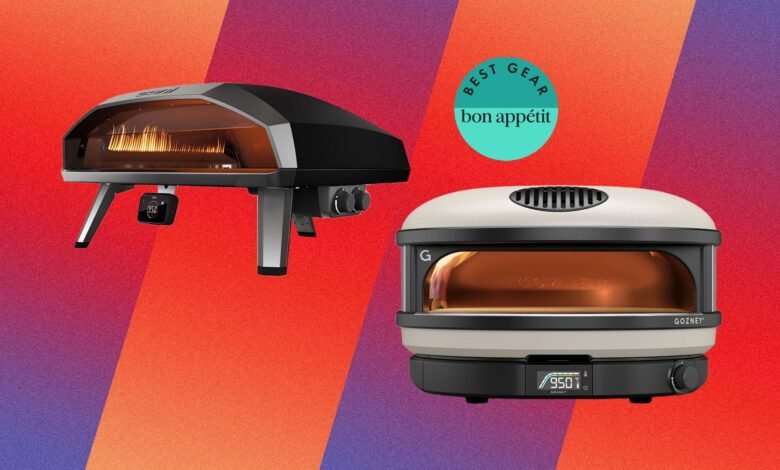
Best outdoor pizza oven overall: Gozney Arc XL
Best budget pizza oven: Gozney Arc Lite
A great larger pizza oven: Ooni Koda Max 2
Best electric pizza oven for outdoor use: Current Model P Smart Pizza Oven
A professional-level, dual-fuel splurge: Fontana Forni Volta
After testing 16 pizza ovens for this story, I’ve learned that getting hot is only the beginning. The best ones hold their heat, recover quickly between pizzas, and produce the blistered, charred crust you’d expect from a great Neapolitan pizzeria. Just as important, they’re easy enough to use that you’ll want to fire one up even in the dead of winter, when the temperature is sub-freezing outside. (Yes, I’ve done this.)
Ahead are the pizza ovens that impressed us most in testing, whether you’re looking to upgrade your weeknight pizza or feed a crowd at your next backyard party.
New in this update: We tested two new outdoor pizza ovens this round. The Gozney Arc Lite, which is a smaller version of our best overall pick, became our new budget pick, unseating the Solo Stove Pi Prime. We also tested the Fontana Forta Volta 70, a pricey, dual-fuel option with smart features, that we recommend if you’re interested in shelling out a few thousand dollars for a luxe pizza-making experience.
What we love: After testing over a dozen outdoor pizza ovens, Gozney’s Arc XL is the one I use regularly. It’s why we named it one of the best new products of 2025 in our Gear of the Year awards. The thing about the Arc XL—and all Gozney products, for that matter—is that you can tell it’s designed by people who think about every small detail. For example, it comes with a tiny metal tool that lets you adjust the pizza stone’s position by fractions of an inch until it’s exactly where you want it. And while some ovens require you to buy a separate infrared thermometer to measure temperature, this one has a built-in digital thermometer.
The Arc XL’s signature feature is its namesake flame that arcs over the top of the oven. Most pizza ovens have long lines of side or rear burners, but this design mimics a traditional wood-fired oven. The single burner gave us way more control over the cook; whereas leaving a pie a little too long in one spot in other double-burner ovens would result in half the pie charring, it was much easier to recover from mistakes in the Arc XL. And with over 300 square inches of cooking space, there’s plenty of room on the stone to move a pie away from the direct flame. During our testing, we got far fewer burnt crusts and a perfect Neapolitan-style char every time. The rolling flame also allowed us to lift each pie to the flame to get blistered, bubbling cheese on top without worrying about burning the crust—something trickier to accomplish with shorter flame rows.
While compact enough to live on a backyard table, the Arc XL also looks beautiful sitting on its custom stand, which keeps everything at the right height for a seamless pizza-making experience.
What we’d leave: It’s hard to find faults with the Arc XL. The only thing we can say is that it’s on the pricier end of our recommendations, but we think it’s well worth the investment.
Long-term testing: After a year of testing, the Arc XL has held up great. I’ve gotten better at dialing in the flame and moving a pizza around the spacious stone, positioning it closer to or farther from the fire depending on whether I want more char on the crust or blistering on the cheese. But what keeps me coming back to the Arc XL is that it’s much more than a pizza oven. I’ve fire-roasted mushrooms and chicken thighs in it, and even baked a whole focaccia. It’s big enough that I keep finding new things to cook in it, which is a big part of why it remains my favorite.
Gozney’s new Arc Lite carries the same design
Gozney’s new Arc Lite carries the same design as our top-pick pizza oven, the Arc XL, for $400. That’s $600 less, which puts our favorite pizza-making setup within reach at under half the price.
What we love: One of the reasons the Arc XL is our top pick is because of its precise single-burner flame, which arcs over the top of the oven to get that desirable browning on top of the pie. The Arc Lite uses that same design. It’s easy to dial in, and the mouth is wide and open enough that launching and turning a pie never feels cramped, even though you max out at a 12-inch pie. We ran it through our standard testing and then handed it to a few novice pizza makers, who pulled off evenly cooked pies with no burnt patches on their first attempts. That makes it one of the more forgiving ovens we’ve used for beginners.
What we’d leave: There are some concessions. The 12-inch stone (versus 16 inches on the XL) runs a little small for our liking, and there’s no built-in thermometer, so budget another $50 for an infrared thermometer to read your stone temp before you launch. Our test unit was also finicky to light, taking a few tries to catch, and when it was up and running it took 28 minutes to hit 800°F, a bit slower than we’ve seen with other small ovens. Even so, you’re getting that arcing flame, which is the whole reason we love the XL.
A great larger pizza oven: Ooni Koda 2 Max
Tested by: Jeff Akin, contributor
What we love: If you have the budget and space to upgrade, the 24-inch Ooni Koda 2 Max is as good as it gets without committing to some sort of immovable brick oven. At $1,199, the Koda 2 Max is on the pricey side for our tests, but it’s still less expensive than most professional-grade pizza ovens. The Koda 2 Max shares the same basic design as other ovens in the Koda line, with one big exception: two separately controlled burners, one on each side of the oven. This dual-burner functionality gives you greater control of the temperature and enables two-zone cooking. Because of its size, this oven takes longer to heat up, but thanks to the dual-burner setup, once it does it stays very hot. It continues to fire in even the coldest, windiest conditions.
What we’d leave: As we said, it’s big, and as such, it burns through propane at approximately twice the rate as the smaller ovens we tested, so always be sure to have a backup tank in hand.
What we love: Electric pizza ovens have improved significantly over the past few years, and the Current Model P is an example of an electric oven that produces results rivaling those of gas ovens. Electric pizza ovens are quite large if you think of them as countertop appliances (as big as some outdoor models), which makes them particularly hard to store inside. That’s why we appreciate that the Model P can be kept outside year-round as long as you use a cover.
The controls are intuitive and helpful. It has presets so you can pick the style of pizza you want and the corresponding temperature the oven should reach—for example, 850℉ for Neapolitan or 635℉ for New York—along with an estimated cook time. We made both Neapolitan and New York style in the Model P, and the bottoms came out evenly cooked with just the right amount of browning and bubbling on top, with no rotating required. The Model P is also a more versatile appliance than many electric pizza ovens. Thanks to a recent firmware update, the temperature settings can dip down to 350℉ so you can bake bread, roast vegetables, or even reheat pizza you previously made in it.
What we’d leave: Although the presets are a nice touch, they can be a bit restrictive. At the moment, it’s not possible to adjust the oven temperature once it reaches the set temperature. You have to turn the oven off and then back on to set a new temperature, which can be frustrating.
Long-term testing: “I was especially drawn to the Current Model P’s preset cooking modes that I could simply set and let preheat (ie: Neapolitan cooks at 800-850℉ for just a couple of minutes while New York-style needs a far lower temp around 500℉ for about 15 minutes). I appreciated the ample pizza stone that doesn’t require turning (but you can if you’d like), and the cart and accessories bundle that truly streamlines the pizza-making experience when the party’s on. Not only is the Current oven technically sound, but its user-friendly features are also ample enough to actually increase my likelihood of using it (near weekly, as of this writing), and that, perhaps, is its strongest feature.” —Hana Asbrink, deputy food editor
A professional-level, dual-fuel splurge: Fontana Forni Volta Tested
A professional-level, dual-fuel splurge: Fontana Forni Volta
Tested by: Noah Kaufman, senior shopping editor
What we loved: A problem budding home pizza makers run into frequently is that they either can’t or don’t know how to properly control the temperature of their ovens, resulting in such a hot stone that pies don’t get cooked all the way through before getting carbonized. That is the problem the Volta was designed to solve. With thermostatically programmable temperatures, it gets as close to dialing in 750℉ as anything else we’ve tried. And not only that, but the settable temperature range goes down as low as 300℉, meaning this really can act as a versatile second oven for roasting vegetables, proteins, even baking bread (although the way the burner throws heat over the top of the oven gives a broiling effect that’s not ideal for the job).
It was ready to cook in less than half an hour, and even the smaller of the two models, the Volta 70, is luxuriously large, capable of holding two 12-inch pizzas easily.
It’s so easy to use the gas burner in the oven that most people will probably not be interested in the feature, but the Volta has one of the easiest transitions from a gas oven to a wood-burning one (note that if you go the wood-burning route, you won’t be able to set the temperature).
And finally, this is an oven of incredible quality. The steel and insulation make for a bulletproof cooking experience. The brand has been making ovens for 50 years and, no knock on the other recommendations in this piece, produces cooking equipment that would be right at home in a professional pizzeria.
What we’d leave: The downsides of this oven are mostly what you’d expect: It’s quite expensive and requires a permanent commitment of your space. It weighs almost 250 pounds, and you’ll need to set it up either on a heavy-duty cart (Fontana sells one that adds $800 to the total price) or a well-built outdoor kitchen. And once you set it up, it’s not moving.
It also comes with app connectivity that feels superfluous. Pizza ovens are generally quick, hands-on experiences, and of all the appliances that have been made “smart” with apps in the last decade, they are amongst the least valuable.
Read Noah’s full review of the Fontana Forni Volta 70.
We made a lot of pizza. For each oven, we started by cooking a basic Neapolitan-style Margherita at the maximum temperature of each oven (between 800–900℉), as well as a simple New York–style pie with raw sausage cooked between 600–700℉.
From there, we tested a variety of pizza doughs (e.g., sourdough, pre-frozen, gluten-free, etc.), temperatures, and toppings to determine overall ease of use, finished-product quality, and value for the price.
The Solo Stove Pi Prime was our previous budget pick until it was unseated by the Gozney Arc Lite, which is also priced at $400. We still think it’s a great pizza oven—particularly for beginners, thanks to the well-distributed flame along the back of the oven that covers half the pie and means less turning to get an even cook compared to the Lite’s single flame.
While the Pi Prime doesn’t have the bells and whistles of more expensive ovens, it does its most important job very well: It gets hot fast. In just 15 minutes, the stone preheats to more than 900℉ and is able to cook a Neapolitan-style pizza in 90 seconds. Weighing in at just 30 pounds, the Pi Prime is also relatively portable. The simple, familiar stainless-steel design requires no setup or additional accessories, and it’s easy to clean and store. The one thing it doesn’t have that the Arc Lite does is a bespoke Booster that puts your countertop oven at a more comfortable height for making pizza—not a dealbreaker at all; the booster is just a nice-to-have.
One of the most important skills you need to develop when making pizza in an outdoor oven is understanding when to rotate the pie. Wait too long, and you burn half the pie. Turn it too quickly, and you may not get the crispy bottom you’re looking for. That problem is solved with All-Clad’s Outdoor Rotating Stone Pizza Oven. The battery-operated rotating pizza stone is timed so that when you set the flame height and launch your pie, all you have to do is sit back and wait until the crust is done to your liking. Not only is it nice to be hands-off, but it also means you don’t have to invest in a separate pizza-turning peel. The All-Clad pizza oven is also powerful. Its curved flame lines the back of the oven and generates impressive heat. It was one of the fastest to come to temperature and easily exceeded 900℉. If you don’t get the placement on the stone just right, the pie won’t rotate properly and can cook unevenly, which happened to us the first time we tried it. If you’re just starting out in your pizza-making journey, we’d recommend starting with smaller pies and really nailing your launch before graduating to larger doughs in this oven. While the oven comes with its own peel, we’d recommend buying Gozney’s Pro Placement Peel, which we’ve found lets dough slide off as easily as a hockey puck on ice.
Ooni 18 Koda 2 Pro (2nd Generation) Ooni’s
Ooni 18″ Koda 2 Pro (2nd Generation)
Ooni’s second-generation Koda 2 Pro got some upgrades that really improved the cooking experience compared to the first generation. For starters, the flames are now on opposite sides of the oven rather than in an L-shape in the back, which we found not only helped with heat retention but also cooked the top of the pie more evenly. It also has a larger 18-inch cooking stone, giving it 33% more capacity than gen one. Although it comes with a Bluetooth-enabled digital temperature hub, it was finicky and disconnected when we went inside (but were still within range), so it didn’t end up being as useful as we’d hoped. We also found that the oven had trouble getting above 800℉ even on full power (although Ooni says it can reach 950℉). This didn’t affect pie quality, but it’s worth noting. Our pies came out evenly cooked with tender crusts, crispy bottoms, and bubbly cheese. This is absolutely a great pizza oven, but we enjoyed the Arc XL’s cooking experience, heat retention, and build quality a bit more.
Ooni Koda 16
The Ooni Koda 16 was previously our top pick, but Ooni has since come out with a second-generation option, the Koda 2 Pro, which we tested for this review. We still like the first-generation Ooni Koda 16 for its size, price, and overall performance. The L-shaped burner ignites easily and heats the stone to 950 degrees in less than 20 minutes. From there, the oven can crank out a perfectly charred Neapolitan pizza in just 90 seconds. Like any pizza oven, there’s a learning curve to heat management, though this task was easy with the Koda 16. The 16-inch surface also offers plenty of space for maneuvering or using with a cast-iron skillet to sear and roast steak, chicken, fish, and vegetables. As mentioned, the upgraded Koda has a Bluetooth digital thermometer, which is a nice-to-have, but not essential, so if you’re okay with using an infrared thermometer, the Koda 16 is still a great option.
Gozney Tread
The Gozney Tread makes a convincing case for taking your pizza oven on the road. At 30 pounds, it’s technically portable, though adding the carrying bag, stand, propane tank, and other accessories makes it more of a car-camping situation than a spontaneous beach-day accessory. Still, tester Jeff Akin found that the Tread heats quickly, holds its temperature well, and turns out beautifully charred, leopard-spotted 12-inch pizzas. It also cools to the touch in under 30 minutes, making it easier to pack up after cooking. Even if you never take it farther than your backyard, it’s one of our favorite small outdoor ovens—albeit a pricey one, especially once you add the accessories.
Gozney’s top-of-the-line oven is an excellent performer. It heats up quickly, has a generous mouth to accommodate full-size pizzas, and features dual fuel capabilities that let you choose between the ease of gas or the hands-on flavorful option of wood. This is a heavy oven, though—nearly 130 pounds—and should be elevated for comfortable use. To that end, it’s a little disappointing that the stand is sold separately (and costs an extra $350), especially when the price tag of the oven itself is quite high. But if you’re in the market for a pro-quality home pizza oven, you’ll be happy with the Dome.
Pizza ovens we don’t recommend
Meet your reviewer
Oli have tested 20 ovens, indoor and outdoor, across gas, wood, and electric
Source: www.bonappetit.com