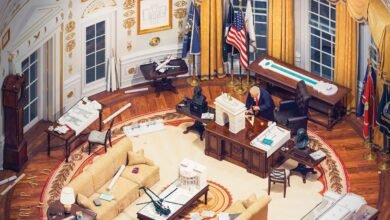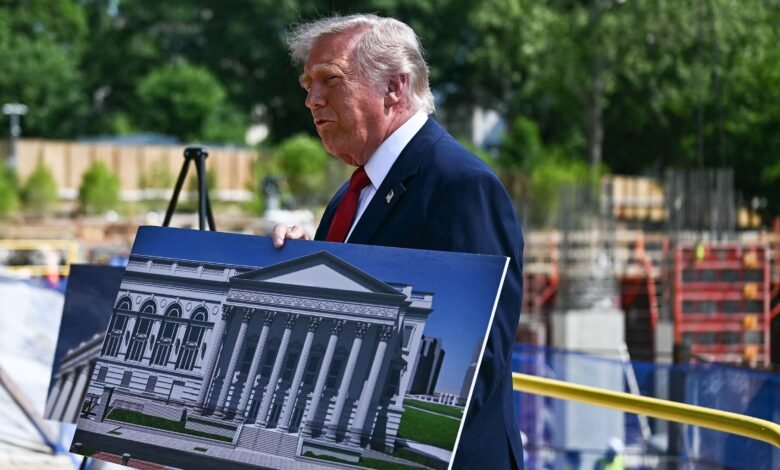
On Monday, a bare majority of the Supreme Court enabled, as it often has, what Justice Ketanji Brown Jackson has described as Trump’s catch-me-if-you-can approach. In an unsigned ruling, issued through the Court’s emergency docket, five Justices said work on the ballroom could proceed because the plaintiffs challenging the project—the National Trust for Historic Preservation and one of its members, an architectural historian with an interest in the White House—likely would not suffer the kind of “concrete and particularized” injury sufficient to bring a lawsuit.
At the same time, the majority said, the Administration would “likely suffer irreparable harm” from a lower court’s order blocking ballroom construction—even though the judge, a George W. Bush appointee, had allowed work to continue on a five-story military complex being constructed beneath the ballroom, in order to protect the President and senior officials. (The Administration has described both the military complex and the ballroom as “vitally required by national security,” though the announcement of the ballroom project, in July, 2025, mentioned nothing about security concerns.)
The majority presented its ruling, which rejected the conclusions of two lower courts, as interim and limited.
“Today, we do not pass upon the legality of the government’s East Wing project,” it said. But a finding that the project required authorization—in the unlikely event it were to come—would be of little comfort once the ballroom is built. That fait accompli, all ninety thousand square feet of it, is, of course, what Trump has been counting on as his lawyers have fended off court challenges and a two-hundred-and-fifty-person construction crew has raced toward completion.
A system premised on legal niceties and compliance
A system premised on legal niceties and compliance with established procedures has proved no match for Trump’s strategy of build first, deal with the consequences later. The lower courts have, in large part, resisted Trump’s efforts to, as the plaintiffs in the ballroom case put it, “outrun judicial review.” But the Supreme Court’s conservative majority has all too often demonstrated extraordinary deference to the executive branch, while also putting procedural roadblocks in the way of those challenging Trump’s actions.
In this case, the majority took a swipe not at the President for overstepping his constitutional bounds but at the district court for daring to interfere with “the activities of a coordinate branch of government.” Courts, it added, “may not exceed the bounds of their lawful authority simply because they may think another branch has exceeded its own.”
Perhaps the most unexpected aspect of Monday’s ruling was that Chief Justice John Roberts dissented.
Roberts has typically been supportive of Presidential authority, and reluctant to use the Court’s emergency docket to block the Trump Administration from implementing its initiatives. In the ballroom case, Roberts broke with that stance, not only joining the three liberal Justices but reserving his authority to write the dissent himself. The six-page document did not exactly pulse with fiery rhetoric.
Today’s decision is no victory for the separation
“Today’s decision is no victory for the separation of powers,” Roberts observed, with characteristic mildness. But Roberts did not shy away from his bottom-line conclusion about the ballroom: “That construction is likely unlawful.” Under the Constitution, Roberts noted, Congress has complete authority over the District of Columbia and federal property; it has, he added, “explicitly prohibited” construction on federal property without congressional authorization.
“The ballroom is a building or structure being erected on federal park grounds—President’s Park—in the District of Columbia,” Roberts wrote. “Yet Congress has not passed any law resembling ‘express authority’ for the Executive’s construction of it.”
It is not difficult to discern, in Roberts’s words, his frustration with Trump’s behavior: he quoted Theodore Roosevelt on the White House’s “stately simplicity.” There is, Roberts concluded, “reason to ensure that those responsible follow the rules in deciding what to tear down and what to build up at the People’s House.” A rule-follower Trump is not.
This does not sit well with the rule-bound Chief Justice. Roberts’s vote was especially notable because, like other conservatives, he has long endorsed a parsimonious view of the constitutionally based doctrine of standing, which limits courts to deciding actual “cases” or “controversies.” The notion is that only those with a real stake in the dispute, not a generalized grievance, have the right to a hearing.
In a 1993 law-review article, while still
In a 1993 law-review article, while still in private practice, Roberts praised standing requirements as a tool of “judicial self-restraint” that “compels the other branches of government to do a better job in carrying out their responsibilities under the Constitution.” In a 2007 case, in which the Court found that states could seek to force the Environmental Protection Agency to address global warming, Roberts dissented, accusing the majority of engaging in “sleight-of-hand” to find that the states could sue.
On Monday, Roberts turned to the kind of loosey-goosey standing arguments he might once have disdained. “A historic preservationist,” he wrote, “can be aesthetically injured in a concrete, particularized way by the transformation of a historic building that she frequently enjoys, just as an environmentalist can sustain a concrete, particularized aesthetic injury from the extinction of a particular animal or the transformation of a particular forest or river that he regularly enjoys.” Jonathan Adler, a law professor at the College of William & Mary who has written on Roberts’s views on standing, told me he was surprised by Roberts’s vote.
“The other conservatives viewed this as a case where standing has run amok,” Adler said. (Adler, for his part, said he is inclined to agree.) “Something about this case—the way it was argued, the occupant of the White House, the particulars of what was done to the White House—caused the Chief to see this differently.”
As offensive as the ballroom is, legally and aesthetically, it pales in importance next to other Trump initiatives that are hurtling toward the Court—among them his bid to limit the use of mail-in ballots in time for the midterm elections.
Last month, the conservative Justices cleared the way
Last month, the conservative Justices cleared the way for the Administration to proceed with implementing Trump’s executive order on mail-in ballots, which, among other things, ordered the federal government to assemble a list of voting-age citizens in each state and said ballots should be delivered only to eligible voters in special bar-coded envelopes. This move, the order stated, was necessary to “enhance election integrity.” The majority, once again overturning the conclusions of the lower courts, said that a challenge by some two dozen states was premature and that the states lacked standing because they weren’t harmed by the order.
Now a district judge has blocked the regulation adopted by the Postal Service to implement the order. “The record continues to lack any evidence regarding fraudulent absentee or mail-in voting,” the U.S. district judge Indira Talwani wrote. “In any event, the USPS’s interest in correcting an unsubstantiated problem through likely unconstitutional means is dwarfed by the overwhelming risk of pervasive disenfranchisement of citizens who need access to mail ballots in order to vote.” The Administration is appealing, comparing the need to supervise mail-in ballots to the handling of cremated remains.
(Ashes, both pet and human, must be shipped in special U.S.P.S.-provided boxes trackable by bar code.) Having mail-in ballots, it argues, “creates an opportunity for the mails themselves to be used to facilitate serious criminal activity—and the Postal Service must have at least as much authority to prevent that sort of harm as it does to ensure that mortal remains are not lost in the mail.”
On Thursday, the Administration returned to the Supreme Court, seeking an emergency order allowing the rule to take effect.
With two states poised to begin sending mail-in
With two states poised to begin sending mail-in ballots, the Solicitor General, D. John Sauer, warned, blocking the rule “partially nullifies the Postal Service’s efforts to address the risk that the federal mails will be used to perpetrate voter fraud.” Will the Justices view the matter differently than in their initial ruling? Perhaps—they are now confronting a final rule, with immediate consequences for the midterm elections, and more tangible harm to states.
But, even if the Chief Justice were to again defect from the conservative bloc, he would have to lure to his side one of the two other more moderate Justices, Brett Kavanaugh and Amy Coney Barrett. It is not an auspicious sign that both voted with the majority in the ballroom case. This Court has been willing, at times, to resist the most egregious of Trump’s excesses; see its decisions this term invalidating his emergency tariffs, rejecting his order eliminating birthright citizenship, and, at least temporarily, frustrating his effort to fire the Federal Reserve governor Lisa Cook.
But, time after time, the majority has acceded to the Administration’s invocation of technical doctrines such as standing to allow policies to remain in place; it has also credulously accepted the Administration’s claims that its actions are necessitated by national-security concerns. The emergency docket has become a mechanism for the Administration to create facts on the ground.
The litigation on the ballroom, for example, will limp along, with, almost certainly, little effect on the construction of the ballroom itself. In that sense, the Court’s latest ruling is not strictly about the ballroom. It is, rather, about the judiciary’s willingness to stand up to a President who has repeatedly demonstrated his disrespect for the rule of law. ♦
Source: www.newyorker.com