

Business
Meta, states agree to $17 billion settlement in child safety trial
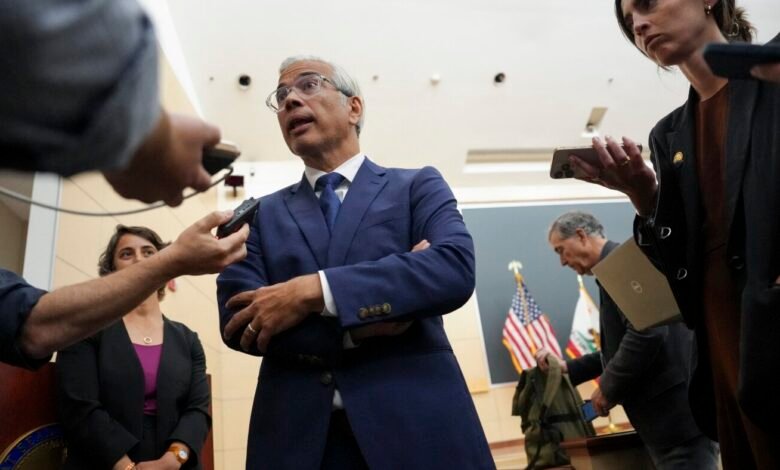
California Attorney General Rob Bonta speaks to reporters at a press conference after opening arguments took place in the Meta trial over a lawsuit brought by US states about social media addiction at the Ronald V. Dellums Federal Building and United States Courthouse in Oakland, California, on August 18, 2026.
GODOFREDO A. VASQUEZ/AFP
toggle caption
GODOFREDO A. VASQUEZ/AFP
The social media company Meta and states suing it have agreed to a proposed settlement that would resolve a landmark federal child safety lawsuit and could be a turning point for a wave of lawsuits against social media companies.
Business
Meta heads to court in a landmark trial about kids and social media addiction
Business
‘Profits won.’ The child safety trial against Meta kicks off in federal court
California, Colorado, Kentucky and New Jersey represented a larger consortium of states that alleged that Meta designed its apps — Facebook and Instagram — to be addictive to kids, knew about the risks those platforms posed, but hid that information from the public.
In addition to claims that Meta broke state consumer protection laws, the states accused Meta of violating the Children’s Online Privacy Protection Act (COPPA) by collecting data about children under the age of 13. Meta has a policy of not allowing kids under 13 on its platforms, but some skirt the rule by registering with false birth dates.
Technology
Verdicts against Meta and Google may bring a new era of big tech accountability
The proposed settlement would require Meta to pay $17 billion in penalties to the states over 10 years, and to make significant changes to how its platforms operate so that they are safer for minors.
“Today, we have secured a settlement with Meta that will make social media less dangerous for our kids and make a world of a difference for children and their families,” California Attorney General Rob Bonta said in a statement.
“Meta has agreed to make massive transformations that will reduce the risk of harm from its platforms — and will do it within months,” he added.
Meta’s Chief Legal Officer C.J. Mahoney said in a statement the framework was groundbreaking and “will empower parents to easily manage how their children access our platforms.”
“But its success depends on all other social media platforms following Meta’s lead,” he said, making an explicit call for TikTok and YouTube to implement this same framework.
Meta has denied the allegations brought by the states.
Bonta’s office also said Meta had agreed to a default time limit of two hours for users under 18 and a nighttime block between midnight and 6am, both of which can only be lifted by a parent; default night and schooltime notification blocks; a ban on displaying the numbers of “likes” or reactions to posts made by minors; a ban on cosmetic surgery image filters for minors; and an option for young users to have a “non-personalized feed” that is not run by an algorithm targeting them with content.
Meta must also bring on an independent auditor with “expansive access to information and rethe announcement said, and would also be subject to an injunction “prohibiting it from making further false, misleading, or deceptive statements around its safety features.”
“I am proud to deliver this settlement that addresses the concerns at the core of our lawsuit and institutes real change, real transparency, and real enforceable protections for children on Facebook and Instagram — right now, no more waiting,” Bonta wrote.
The proposed settlement says a portion of the funds would go toward things like youth mental health programs, after school programs and crisis intervention services.
The trial started last week in federal court in Oakland, Calif., and was expected to run through early October. But the settlement announcement comes only midway through the trial’s second week.
Business
Whistleblower Arturo Béjar leads testimony in landmark trial against Meta
Business
Instagram head Adam Mosseri testifies in defense of Meta in child safety trial
Key testimony came from insiders who worked at Meta, including whistleblower Arturo Béjar, who testified that the company culture was obsessed with increasing user numbers and that Meta’s internal studies showed that young users were exposed to harmful experiences at much higher rates than the company acknowledged publicly.
Yesterday, the states brought Instagram head Adam Mosseri to the stand and questioned him about the effectiveness of some features added to Instagram to try to keep teens from using it too much. They accused Mosseri of publicly touting the use of one of those safety features — called “Take a Break,” a feature that nudged kids to close the app — when the reality was that it had very limited uptake by teens.
The proposed settlement must be approved by the judge in the case, Yvonne Gonzalez Rogers of the U.S. District Court for the Northern District of California.
The case is part of a wave of lawsuits that has been compared to litigation against tobacco companies in the 1990s. Those suits led to record settlements, changes to the way the companies operate, and a shift in the public discourse about cigarettes.
The case was consolidated from a series of lawsuits by attorneys general around the country against Meta, and the settlement resolves the cases and claims of 51 of those, according to the California Attorney General’s Office.
NPR does not offer or accept money for coverage or interviews.
Anyone who makes such an offer or request is not an NPR employee and does not represent NPR.
Source: www.npr.org