
A few years ago, sitting in my childhood home during the pandemic, I posted a video of myself on social media doing a full face of glam. A stranger commented, “So you’re Persian, nonbinary, and queer. What age did your dad leave you?”
I found the comment oddly funny—not only because my dad has always been my biggest advocate but also because he had actually filmed that exact video for me because I didn’t have a tripod.
In response, I made a TikTok crafted around the idea that I was “trying to bond” with my straight dad. It was tongue-in-cheek, of course, since anybody who knew me knew my dad and I are already extremely close. I posted the video without thinking much about it and went to bed. When I woke up, it had 10 million views. Our family backstory is this: My parents left Iran after the revolution, met in France, and immigrated to the United States for work.
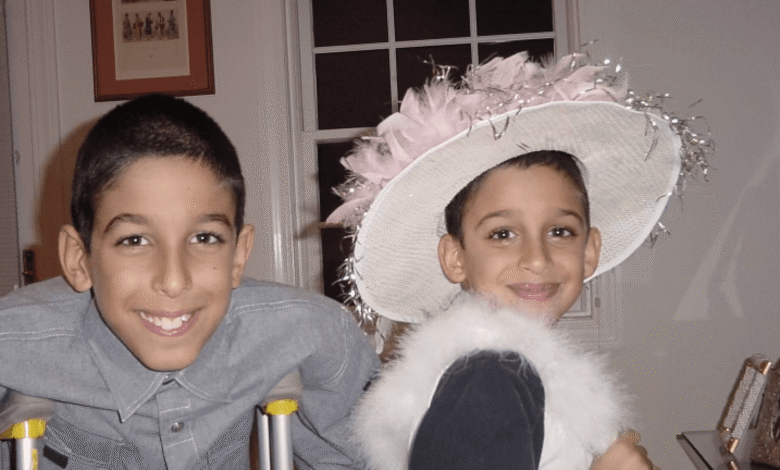
In our family, it was always very clear that creativity and love were the centerpiece of our home; I actually came out as gay to my parents when I was around 11 years old. At the time, their only immediate concern was navigating school and what that would be like for me. Like many, the adversity I faced thickened my skin and built up my backbone. I also discovered that laughing was a powerful tool—one I never imagined would play such an important part in what I do now every single day.
To quote my friend (Queer Eye’s Jonathan van
To quote my friend (Queer Eye’s Jonathan van Ness), “Can you believe?”
I eventually came out as nonbinary too. Genderfluidity became my freedom. And as I began to navigate my sexuality and gender throughout adulthood, I remember having many conversations with my dad about the double-edged sword of being Iranian American with these intersecting, marginalized identities. It’s complicated to simultaneously see Western ideals of beauty and femininity impact gender through the rise of homophobia and transphobia across the US while also acknowledging the privilege of not being in Iran, where oftentimes deviating from sexual and gender norms is punishable by death.
As I reflect upon my personal identity, thousands of miles away the Iranian people are doing the very same under rising political tension. They are also doing so in the dark (both literally, with electricity frequently being withheld, and figuratively). There are so many conversations about what is or isn’t right for Iran or the Iranian people. As someone who grew up in the diaspora, I feel this tug between wanting to support every Iranian while balancing the act of giving space to the people living in Iran right now.
It feels, however, like the overarching tie that binds us all as Iranians is the desire for a free Iran—an Iran where the people, especially women, have their own agency. It’s made me reflect a lot about my position as a comedian and creator of Iranian origin. How do I teach people about my culture? How do I educate minds about the beautiful spectrum of gender and sexuality in a way people will listen?
What is the language everyone can understand
What is the language everyone can understand in what feels like an absolute storm of divisive rhetoric online? I believe the answer always lies in a good old belly laugh. My dad and I turned that first bonding video into a viral video series, Bonding With My Baba, that still goes on today. It’s given us a unique way to show people the capacity for unconditional love in parenthood and cultural identity—but we’ve found that the comedy is what first gets people watching.
For now, that’s just a dream. My Farsi may not be as strong as it once was, but I know laughter will serve as the language we’ll choose to speak with each other over a glass of chai.
Source: www.vogue.com