

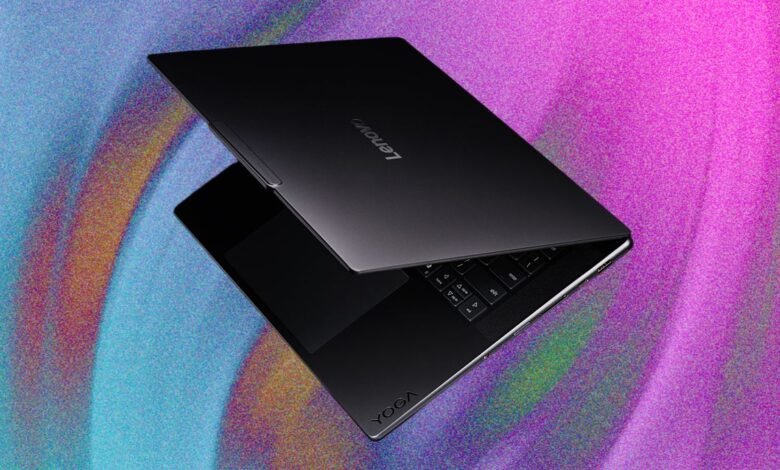
And now, as announced at the IFA 2026 tech show in Berlin, we’ve had our first hands-on look at one of these laptops, as well as some announcements around RTX Spark-powered mini desktop PCs. Demand for running agentic AI workflows like OpenClaw locally on your computer keeps rising, and these new PCs look like they are designed specifically to feed it.
Nvidia Alternatives to the MacBook Pro
The laptop in question is the Lenovo Yoga 9n 2-in-1, a 16-inch laptop with a 360-degree hinge. As I assumed it would, this thing looks incredibly premium, aiming to be a MacBook Pro competitor in every aspect. The OLED touch display has a sharp 2880 x 1800 resolution and a 120-Hz refresh rate. The whole chassis is surrounded by rounded metallic edges and some very thin display bezels. Other high-end features we don’t typically see include a six-speaker sound system and a 9.2-megapixel webcam.
But here’s the important bit: It’s 0.69 inches thick, just 0.03 inches shy of the 16-inch MacBook Pro. That’s possible thanks to Nvidia’s Arm-based chip under the hood, which combines a Grace CPU with “up to 20 cores” and a Blackwell RTX GPU with “up to 6,144 cores.” The CPU, GPU, and memory are packaged together into a single system-on-a-chip (SoC), sharing more in common with Apple silicon than a conventional Windows laptop. Based purely on core count alone, that would theoretically put the integrated GPU capability of this chip somewhere between an RTX 5070 Ti and an RTX 5080 as found on laptops available today. Those specs also indicate that lower-powered configurations will be sold, though we don’t know how broad the performance range will be. There was no mention of battery-life claims, though presumably one benefit of using an Arm-based SoC (rather than a discrete GPU) is greater efficiency and, thus, better battery life.
Personally, I don’t prefer laptops this large with 2-in-1 capabilities and number pads, so I’m happy that Lenovo is also offering a 15-inch model, the Yoga Pro 9n. While it wasn’t available to see in person, that’s the model I’m more interested in checking out. It shares a lot in common with the 16-inch model, such as the rounded edges, higher-resolution webcam, and very large haptic touchpad. But it has a smaller 15-inch OLED screen with a resolution of 2560 x 1600 and is thinner at 0.66 inches (at its thinnest point). Another unique feature is its Force Pad touchpad, which lets you use a stylus (such as the Yoga Pen Gen 2) to write or draw directly on it.
Interestingly, the Yoga 9n 2-in-1 can only be configured with up to 64 GB of memory, which is less than I thought these AI-focused PCs would offer. I suppose what makes the Yoga Pro 9n a “Pro” model is its configuration options up to 128 GB of memory, as it otherwise seems to have the same performance.
Lenovo’s device is just one among a new line of RTX Spark-powered laptops coming this fall, including the Dell XPS 16, Asus ProArt P16, and Microsoft Surface Laptop Ultra. These larger laptops all seem focused on pleasing the creator and AI enthusiast demographic, though only one 14-inch model has been announced so far: the HP OmniBook X 14.
AI Boxes
The point of all these new PCs is to offer hardware that can capably run on-device AI models locally. That means less dependence on the cloud and more ability to run full agentic AI workflows without worrying about privacy. That’s crucial when an AI model handles sensitive personal data like your financial information, email accounts, or anything else you feel comfortable providing.
Acer announced its own mini PC solution, the Acer SFF RTX Spark, following up on Asus’ ProArt Mini PC shown off earlier this summer. Both are around the same size as the Mac Mini, but offer a “petaflop of AI performance,” up to 128 GB of memory, and the same RTX Spark superchip at its core. These mini PCs are interesting, coming just a week after the announcement of Apple’s M6 Mac mini and M5 Ultra Mac Studio. These small, efficient desktop computers are going to (and already are) play an important role in the adoption of local AI.
Nvidia isn’t the only player here. Lenovo announced an AMD-powered ThinkCentre X Ultra, which also puts 128 GB of memory at the disposal of agentic AI models, alongside AMD’s Ryzen Max+ Pro 495 chip. This is another popular chip being used for local AI, such as on the Framework Desktop. You can even buy the AMD Developer Kit with 128 GB of RAM right now. The expected starting price of the ThinkCentre X Ultra is $3,699, which should give you an idea of how expensive these systems are getting. And note that’s the base model, not the maxed-out, 128-GB version.
Price remains the most crucial missing element. RAM has never been more expensive or more necessary, so I wouldn’t expect any RTX Spark systems to be cheap. The most affordable MacBook Pro (aside from the M5 base model) is $2,349, which gets you the M5 Pro and only 24 GB of RAM. For a 128-GB MacBook Pro, you’re currently looking at $6,139.
Power up with unlimited access to WIRED. Get best-in-class reporting and exclusive subscriber content that’s too important to ignore. Subscribe Today.
Source: www.wired.com