
This Founder Built the RV He Wanted for Ski Trips. It Led to a $20 Million Business

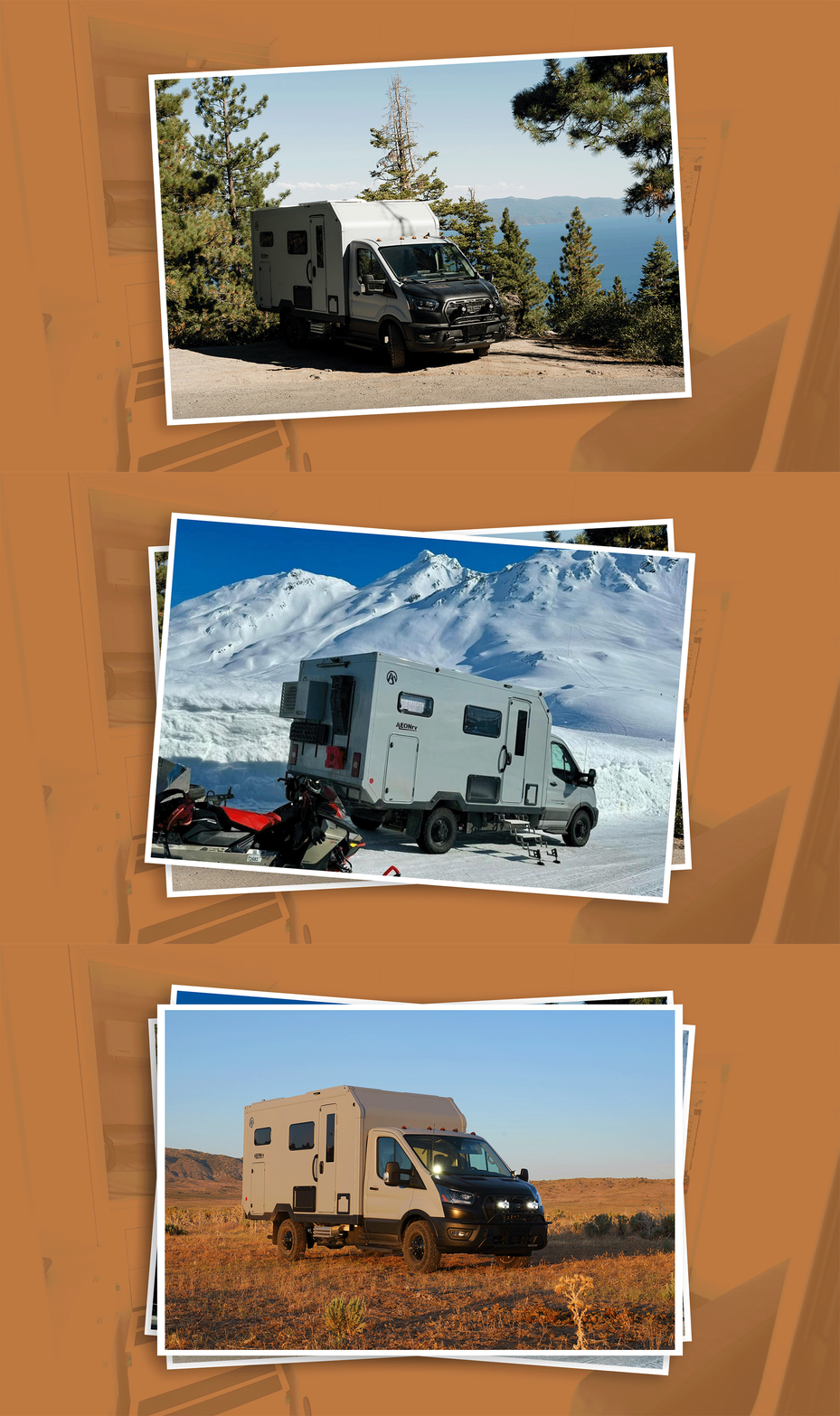
Jim Ritchie started AEONrv, a Nevada-based company that sells a high-tech hybrid RV, because he wanted to create a new kind of vehicle for himself to use. The result is an RV with a modern, all-electric cabin mounted on the chassis of a gas-burning Ford Transit van. The company’s growth has been strong enough to land it at No. 66 on the Inc. 5000 list this year, with a three-year growth rate of 4,231 percent.
And it has managed to pull off this growth while the overall RV industry has declined from a Covid-era high. Ritchie, a software engineer, says pondering his own outdoor adventures jump-started the creation of the company. “I’m a big skier, and I was thinking maybe I’ll retire sometime soon, and it’d be cool to have a vehicle to take to go skiing and biking and things I like to do,” he says.
“I was looking around at vans. Van life was big, and I didn’t really like what was going on there. They seemed hard to insulate.” All told, he says, the traditional RV industry “seemed pretty old-school” to him. Ritchie designed the vehicle for fun, and to help make it a reality, teamed up with a friend, Lars Severin, who became the company’s CTO (Severin retired earlier this year).
What began as a weekend project grew into
What began as a weekend project grew into a business. By the end of 2021, they had published a website and started taking deposits for the vehicles. “We hired our first employee a little over four years ago,” he says, “and the rest is history.” They bootstrapped the company to get it off the ground, and then raised under $2 million of outside capital from investors in 2023 and 2024.
The vehicle boasts a tech-forward design centered on a snugly insulated, all-electric cabin. Solar panels on the roof generate electricity, which is stored in lithium-ion batteries. Starlink provides an internet connection. Ritchie emphasizes that inspiration for the build came from the marine industry, and that the cabin is built out of fiberglass-reinforced insulated panels. “There’s no aluminum or metal in the actual build,” he says.
“It’s all composites and fiberglass, and it’s all glued together.” There’s also no propane, which traditional RVs use for appliances like stoves and even historically as a power source for refrigerators. Photo: AEONrv The result is an energy-efficient cabin that’s so airtight, Ritchie says, occupants “have to crack a window at night, so you don’t get carbon monoxide poisoning.” The company, which employs some 60 full-time employees, has delivered more than 150 vehicles in total through its direct-to-consumer approach, the same way EV companies Tesla and Rivian sell their rides.
They deliver about eight vehicles each month,
They deliver about eight vehicles each month, with the starting price for the base model at $229,500. Ritchie predicts that the company’s 2026 revenue will land around $20 million; he says the company was profitable as of last year and remains on track to turn a profit this year as well. AEONrv remains a niche, if tech-forward, player in a $159 billion industry with three big companies: THOR Industries (companies under its umbrella include Airstream and CrossRoads), Forest River, and Winnebago Industries.
Those companies “make up the bulk of the RV production in the United States,” says Monika Geraci, a spokesperson for the RV Industry Association. Not only that, 88 percent of RVs last year were made in one state: Indiana. RV shipments in the U.S. spiked in 2021 amid the Covid pandemic, hitting a high of 600,241 that year, according to the RV Industry Association. Then they fell.
Shipments from manufacturers to dealers last year were 342,220, a drop of about 43 percent from that Covid-era high. Geraci says that current estimates hold that RV production in the U.S. will drop by about 8 percent this year compared with last. She attributes the decline to economic factors. “For people who own RVs, we see them use them more because it is a more economical way to travel,” she says, compared with flying and staying in a hotel.
She says that economic uncertainty and factors like
But she says that “economic uncertainty” and factors like interest rates and inflation are “keeping a lot of people who want to purchase an RV on the sidelines.” Photo: AEONrv If you’re picturing a motorhome like a bus when you think of an RV, that type of vehicle is actually in the minority of RV sales. Last year, nearly 90 percent of RVs shipped were the towable kind.
In fact, Ritchie says that they’re working on a towable version of their product that will cost less than $100,000. Besides AEONrv, other players in the electric RV space include Lightship, which sells an electric trailer called the AE.1 that can lower to become sleeker on the road; and Pebble makes the Pebble Flow, which is also an electric RV trailer. Pebble said in July that it had delivered more than 100 of its trailers.
Lightship declines to share how many units it’s delivered, but notes that it started shipping production vehicles late last year and has already sold all the vehicles it plans to build between this summer and next. The products from both Lightship and Pebble embrace a tech-forward, spaceship-like design for their trailers. As for the appeal of an RV with an electric cabin, Geraci notes that “there is an RV for every lifestyle and every price point, and so this is another option that is out there.
I don’t foresee the RV industry going all electric.” Jason Epperson, a longtime RVer who hosts a podcast and YouTube channel called RV Miles along with his wife, Abby Epperson, says that startups like AEONrv are “all trying to do something a little bit different from what the traditional Indiana RV industry has done.” As for those traditional RVs, Ritchie is blunt about what he thinks about their appearance: “They look like 1980s Vegas or something.”
Source: www.inc.com