

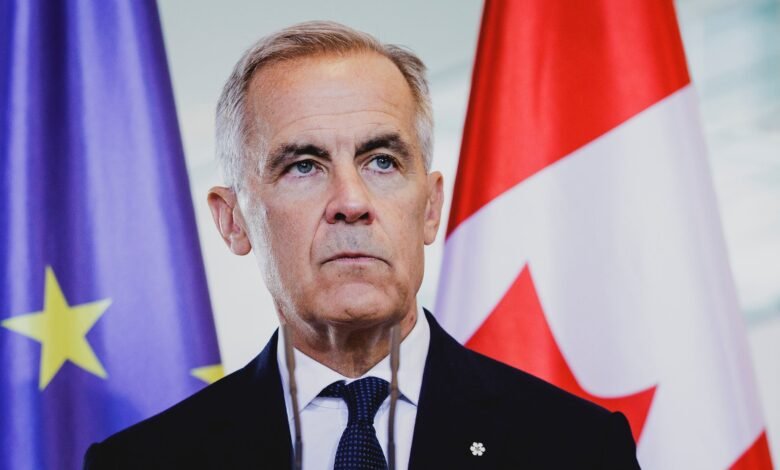
Even in 2025, that friendly pitch didn’t seem likely to succeed. The White House had a dim view of Canada’s Liberal government, and Trump was already trying to undermine Canadian sovereignty, urging Canada to become the U.S.’s “fifty-first state” while branding its Prime Minister at the time, Justin Trudeau, a “governor.” I told Champagne that a European diplomat had idly suggested to me that Canada should consider trying to join the European Union, given the escalating tensions with Washington.
Champagne laughed. “We know that there will always be a close and deep relationship with the Americans,” he told me. “But I would say also that the rules of the game have changed.”
I thought about that conversation on Tuesday as I watched clips of Champagne, who is now Canada’s Finance Minister, leading a press conference about trade relations with the U.S. Last week, a round of negotiations between the two sides had ended in failure and on Saturday, the Trump Administration’s new fifty-per-cent tariffs on tens of billions of dollars’ worth of Canadian goods, including automotive parts, dairy products, and hockey sticks, came into effect.
In response, Champagne announced that his country would be implementing retaliatory tariffs of up to fifty per cent on hundreds of American goods. “When the United States of America asked too much and offered too little, we made a choice—we chose Canada,” Champagne said. His government is now preparing for levies that will inflict economic harm on both sides of the border.
Of Trump’s tariffs, tens of thousands of Canadian
As a result of Trump’s tariffs, tens of thousands of Canadian jobs could be at risk. This protectionist spiral reflects Trump’s crude and obstinate misreading of dynamics between the two countries. He and his allies have cast the U.S.’s northern neighbor as a free rider out to cheat the American worker while sheltering under the U.S.’s security umbrella. Never mind the Canadian troops who have died fighting in various U.S.-led wars around the world, or the reality that the U.S.
has a significant trade surplus with Canada, if you exclude the crude oil that Canada pipes to U.S. refineries. (The oil has long been sold to the U.S. at below-market value.) Trump’s animus is almost mystifying in its depth: amid a slew of online diatribes this week, he declared that he wanted to rename Lake Ontario, which abuts Toronto, Lake America, for good measure. The heated rhetoric has infuriated and astonished most Canadians; in a recent poll, seventy-six per cent supported the decision of the Prime Minister, Mark Carney, to walk away from trade talks with Washington.
In a speech on Saturday, Carney said that the Trump Administration expected concessions that would “compromise Canada’s sovereignty”—including moves that would harm critical manufacturing industries and even, according to Carney, undermine French language and cultural protections in Canada. “We cannot control the storm blowing in from Washington,” Carney said, but added that the country “can chart a new course” by “diversifying our trading relationships abroad.”
And so we return to the question of the European Union.
Ever since Trump’s combustive, combative second term began,
Ever since Trump’s combustive, combative second term began, a conversation once consigned to academic circles and the parlor rooms of Brussels and Ottawa has entered the mainstream: forget being the fifty-first U.S. state—what if Canada became the twenty-eighth member of the E.U.? A widely read column in The Economist from January, 2025, laid out the case: Canada’s huge territory and abundant natural resources offered a complement to the crammed, resource-sparse European continent; Canada’s social-welfare state and social-democratic foundations dovetailed well with the values and practices of European democracies; Canada’s vast Arctic border with Russia presented obvious shared strategic interests; and, perhaps most pertinent, an upgraded Canadian-European alliance would be a useful hedge against the uncertainty posed by a bullying Trump and an increasingly unpredictable United States.
Kalypso Nicolaïdis, a Franco-Greek professor of international affairs at the European University Institute in Florence, Italy, has advocated for Canadian accession into the bloc for almost two decades; she believes that Canadian entry would engender a stronger, more “unbound” E.U., grounded not in geography but in principles. “The arguments at the time have become even stronger thanks to Trump,” she told me.
“If you cannot change your neighbor geographically, change it institutionally.” Bruno Maçães, a public intellectual and a former Portuguese politician, intends to stump for Canada’s E.U. entry at a conference in Calgary next month. “Canadian full sovereignty may well need a radical economic shift away from the U.S.,” he told me, adding that the E.U. “looks increasingly unsustainable without access to raw materials and energy, and access on sustainable and secure terms.” (Canada and Europe do share a nominal land border—a kilometre-long track on a barren island in the high Arctic, in the icy strait that runs between Greenland, which is part of Denmark, and Canada’s northernmost territory of Nunavut.)
The idea has gained ground on both sides of the Atlantic.
A poll of Canadians conducted in March found
A poll of Canadians conducted in March found that almost half the respondents would support joining the E.U., with only twenty-eight per cent against it. In Europe, various prominent officials are keen: the French Foreign Minister, Jean-Noël Barrot, floated Canada as a candidate for accession earlier this year; the Finnish President, Alexander Stubb, on a trip to visit Carney in Ottawa, said that Canada’s membership in the European Union “would be a marriage made in heaven,” a process of integration, he seemed to suggest, as logical as his own country’s recent entry into the NATO military alliance.
Joachim Streit, a liberal German member of the European Parliament, launched a campaign last year to get the European Commission to revise an ornery article in its founding treaty stipulating that membership in the bloc be available only to “European” states. Sigmar Gabriel, a former German Foreign Minister, declared that “Canada is more European than some members of the European Union.” Next year, Canada will even have an entrant in the Eurovision Song Contest.
To be sure, Canada is nowhere close to actually joining the European Union. The E.U. has not initiated any process to consider the North American country’s accession, and nobody in the Canadian government—including Carney, a Europhile—has raised the matter formally. Canadians may be intellectually curious about the prospect of E.U. membership and angry at Trump’s America—which, according to a recent Pew poll, they now view more negatively than they do China—but they may not be eager to accept the sweeping transformation of their country’s laws and regulations that E.U.
Membership would entail
membership would entail. The process would create an even more severe disruption of relations with the U.S., including the scrapping of existing trade treaties and the imposition of a strict customs operation at the border. Ratification of Canada as a new member, by all of the E.U.’s twenty-seven member states, is hardly assured; ten have yet even to ratify the bloc’s existing free-trade agreement with Canada, which went into effect almost a decade ago.
What’s important is not whether Canada’s accession is realistic or not, but that the conversation is happening at all. Thomas Juneau, a professor of international affairs at the University of Ottawa, told me that there’s a “zero per cent” chance that Canada would join the E.U., but that the talk should still “be taken seriously.” Trump has eroded the credibility of the United States in Western capitals, and it is Canada that finds itself at the forefront of the reckoning.
Carney won the election, in 2025, by capitalizing on anti-Trump sentiment, and has attempted to chart a more pragmatic and independent path for a country long in the U.S.’s shadow. At the beginning of this year, in Davos, Switzerland, he called on the world’s “middle powers” to band together in order to stand against the coercion of would-be hegemons—a thinly veiled jab at the United States.
Carney hasn’t quite articulated exactly what this vision
Carney hasn’t quite articulated exactly what this vision entails, but he has carried out high-profile visits to China, India and the wealthy Gulf states, while trying to tighten economic and security ties with Europe. Earlier this summer, after a bidding war, Canada opted to buy twelve new submarines from a German arms company rather than from a South Korean competitor. It may consider other large-scale purchases from European contractors as it tries to wean itself off decades of reliance on the United States.
“There is a real effort to deepen relations with Europe from the Canadian side, and there is a positive reception on the European side, and I think that’s a trend that is going to continue,” Juneau said. On Wednesday, Canadian officials announced that Carney was slated to deliver an address to the European Parliament next month. Carney’s political opponents in Canada disagree with him on many points, but they, too, believe that the country needs to defy Trump.
The hope is that pressure will accumulate within the United States, including from Republican politicians in U.S. states bordering Canada, and eventually force Trump to change course. In a podcast, the veteran Canadian Conservative political strategist Kory Teneycke described the current moment not as a passing “cold” but as something grave and lasting. “We’re managing a chronic disease.
This is diabetes, he said
This is diabetes,” he said. “We’re going to be doing insulin checks and taking injections on a daily basis for as long as this Administration’s around and probably for the next several. We’re in a long-term cycle of trade protectionism and might-makes-right bullying and reshuffling of the international order in a fundamental way.”
Similar concerns haunt Europeans, although the E.U., much to the chagrin of some policymakers and pundits on the Continent, gave Trump a raft of concessions in an earlier round of trade negotiations.
Watching Carney’s Saturday remarks—in which he said that the United States wanted “to break us, so they can own us” and vowed to “hit back”—the former Italian Prime Minister Paolo Gentiloni wrote, “Here’s a speech that I’d like to hear from Europe.” Canada and Europe may not share the same political path, but, when it comes to the United States, they can still teach each other how to walk away.
Source: www.newyorker.com