
Some Israeli organizations have tried to prevent violence against Palestinian communities. Doron Meinert, a retired colonel in the Israel Defense Forces, was arrested earlier this month while trying to protect a Palestinian community in the West Bank that was under attack from settlers. I recently spoke with Meinert about his work with the group Looking the Occupation in the Eye, and about how the situation in the West Bank has deteriorated so rapidly.
Our conversation, edited for length and clarity, is below. Can you tell me about your background and career? I’m sixty-six years old. I was in the army for about twenty-five years. I’ve been a colonel in the army. I’ve been a brigade commander, and then a staff officer. But, about fifteen years ago, I retired. And then I started work as a volunteer protecting Palestinians in the West Bank.
How did you decide to do this work that you’re doing now? What caused you to make this decision? All my life I believed that the Palestinian problem and the occupation problem were the deepest and most serious problems Israel had. And when I retired from the I.D.F., I decided to see what I could do about it. At first, I mostly tried to protect Palestinian olive harvests. But later I joined an organization named Looking the Occupation in the Eye, whose main issue is to move this subject to the front of Israeli discourse.
We are doing it in a few ways
We are doing it in a few ways. One of them is working in the West Bank. And we try to get a lot of media attention to this issue, and protest inside Israel. What we are doing in the Palestinian villages in the West Bank is trying to protect them from the settlers, but also to take pictures and video and bring it back to the Israeli people. They need to see someone like me talking about it and showing it to them.
What does protecting Palestinians in the West Bank entail for a group like yours? The settlers are trying to ethnically cleanse the Palestinians in lots of ways, and one of them is with violence. There are other ways they are trying that have to do with the Israeli legal system, but when the government cannot do things legally, the settlers try to expel Palestinians from their villages and their homes.
So what we are doing is coming to these communities or villages—and we aren’t big enough to go everywhere—and we are staying there twenty-four hours a day, seven days a week, and when the settlers attack, we try to stand between them and the Palestinians. Sometimes we call the police or the army. They don’t help all the time. Sometimes they do O.K. We also try to take the settlers to court.
We try to place our bodies between them
But we try to place our bodies between them. So the hope is just that settlers won’t commit as much violence with a Jewish Israeli like yourself present? Their main aim is to expel the Palestinians from their villages. We want them to stay and not let the settlers expel them. We know, and the Palestinians know, that they will start by attacking people on the outskirts of the village, rather than the center of the village.
And if those people run away, the next houses will be the ones closer to the village. So we try to protect them and stop them from having to run away, and we do what we can. But the first thing is to protect them. And we set up cameras. We also try to help with water and electricity. Have you or members of your organization faced violence? Yeah. Yeah. About five years ago, we went to plant trees in a village close to Nablus, and about fifteen settlers came and caught a group of us that got separated and beat us very badly.
I was sent to the hospital with broken bones and had surgery. But that kind of violence is not an everyday story. Most of the violence against us—I am not talking about what happens to the Palestinians, which is more crucial and worse—is to make us angry and make us feel, I don’t know, embarrassed. Like pushing you or spitting on you? They spit on us, they push us, they kick us.
Sometimes they spray tear gas in our faces
Sometimes they spray tear gas in our faces. You said things were different five years ago. What has changed? The change started in the last election when this government came to power. And then it changed again after the start of the war in Gaza, in October of 2023. Things became much more serious and much more violent. Most of the instances in which Israeli settlers expelled Palestinians in the West Bank from their homes happened after October 7th.
Right, the election was in November of 2022, which saw the most right-wing government in Israeli history come to power. So that was a change, and then settlements further accelerated after the Gaza war began? Yeah, it’s getting worse and worse and worse. But especially in the last few months. I feel like every time I get asked, I always say it’s getting worse. But it’s really true now, in the last two or three months.
This is a new step. And that’s because of the next election coming up, in October. It could be that another government will come to power. So they are trying to achieve as much as they can, because they want to prevent any hope of a two-state solution. So they want to change the facts on the ground before the election? Absolutely, they want to occupy as much as they can and change those facts on the ground.
Even if the current government is removed
Still, even if the current government is removed from power, the new government won’t be a government of the left. A new government might stop some of the violence, but I don’t think they will destroy settlements. What specifically has changed in the last few months? The biggest is the movement from Area C to Area B. In the Oslo Accord, the West Bank is split into three areas, A, B, and C.
Area A is mostly the big towns. And, in this area, the Palestinian Authority is responsible for security and the daily life of people. In Area B, it is mostly villages, and in this area the Palestinian government is only responsible for daily needs, but the Israelis are responsible for security. And in Area C, there are lots of settlements, and there is open area, and in this area the Israeli government rules totally—civilian issues and security issues.
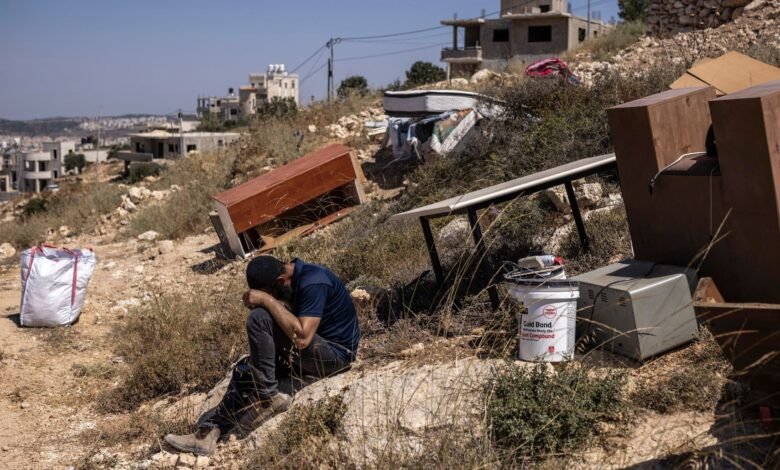
Most of the attacks that were happening, until a few months ago, were happening in Area C. Most of the efforts of the settlers were to deal with the Palestinians who lived in that area. Many of them are Bedouins. But now they have moved from Area C to Area B. They are attacking the villages and trying to make the villagers run away. In the big villages, their hope is that the Palestinians will get violent against the army or against other settlers, and then the army will do what they have done in Gaza.
They have been building these settlements very close
So they have been building these settlements very close to the villages in Area B, and they attack the villages. These villages might have as many as five thousand people, but they still attack them. Recently, there has been some international attention to some of the violence, and even some attention to the military standing by while the violence—
That is not true. I don’t agree with that.
Most of the military support the settlers. Most of the government, of course, does. But also the army and the police. They do not stand aside. They help them. They don’t just let them do what they want to do. They help them with money and roads. I will give you an example. There is a closed military zone, and the commander takes a map and claims no one can get in. And in this area, there are supposed to be no Israelis allowed—only Palestinians and the army itself.
This happened in Qusra. No one could get in except the people who lived there, they said. But then the military commander allowed a lot of settlers to come in and build, and even to start committing crimes against Palestinians. When I was arrested, it was in a closed military zone, and they arrested me because I was there. But they left the settlers. These settlers had wanted to break a kind of water well that the Palestinians were using.
The army came and took me and arrested
But the army came and took me and arrested me and left the settlers there to break the gate to the well and allow their goats to drink from it. This is how the army helps the settlers with their crimes. [Meinert called me a couple of days after our interview and told me, “The settlers came to the same place, and dumped the water on the floor. The army came again and just watched the settlers do it.”] What did they tell you when they arrested you?
They said it was a closed military zone. I said I won’t get out if the settlers don’t get out. But the army brought the police, and I spent a night in prison. They bound my hands and legs and brought me to the court, but now I am released. The court said I was right. The first court I was brought to didn’t, but the second one did. The first one said I could be released but said I shouldn’t go back to the village for two weeks.
But on appeal to the higher court, they said the first judge was wrong, and they even asked the army how this could be. Why did you arrest this man but not the settlers? The army just said, “We will take further action later.” But over all the courts are not very strong. Ruling against the army doesn’t mean the army will behave any differently. What would be the significance of the current government’s proposal to transfer some control from the military to the police, if, as you say, the military is already facilitating so much of this?
First, international law and Israeli law say
First, international law and Israeli law say that in occupied areas, the army is responsible. And in this case, the I.D.F.’s Central Command leader has full responsibility for the West Bank. He is supposed to be in charge. It sounds strange, but this is one of the international achievements after World War Two—that in an occupation, the military is supposed to protect the population.
It is better than having the government do it. And the Israeli police operating in this area are under him—under military command. And he is responsible for everything. This is supposed to be the situation. On the ground, it is different. For the last four years, almost all of the settlers, even if they steal or kill, are not brought to court. But the law is very clear about the fact that the military is responsible.
It is not a serious proposal to transfer things to the civilian government. But with this government, you never know. But what would this change mean in practice? It would mean not only that the settlers would be given free rein, but the police would be much tougher on people like us than even the military. It would get much worse. But I don’t think it will happen because I don’t think the army will allow it.
I have a lot of problems
I have a lot of problems with the army, but I still think they will fight this idea. How do you look back on your army service now? Most of my service was in the northern area, on the border with Lebanon and near Syria. And I served in Tel Aviv. I was also in the West Bank a few times for four-month periods. I think then the situation was very different than now, in terms of the army and the Palestinians both.
I am talking about the early nineteen-nineties. We understood then that we had a duty to prevent terror against Israelis, but we also felt that there was a duty not to treat the Palestinians a certain way. I said to myself that this was an illegal occupation, but that we could give the Palestinians rights. And we still fought against the settlers. I remember when I was a battalion commander around the Hebron area.
We tried to stop the settlers from the violence they wanted to commit. It was one of our duties. All my life I have been on the left, even if I was never a pacifist. I thought Israel needed an army and had enemies. But an army has to be moral and follow the law. And there has been a big change. What do the men you served with think about what you are doing? I meet a lot of them now, and many of them think that my work is very important and support me.
All of them are against the violence
All of them are against the violence of the settlers. But not all of them agree that the problem is much bigger than the settlers, and that it is also about the military. The bigger problem is the biggest problem Israel has. Not all of them agree about that. How have your conversations with Palestinians changed over the past few months? They are very worried about what is happening.
There are many more people that need help than we are able to help. People call asking for help, but we cannot help everyone. What can I say? Many of them are very brave. I don’t have one good sentence to put in your piece. They are not violent people. They have families. And they don’t want to give up their homes. ♦
Source: www.newyorker.com