

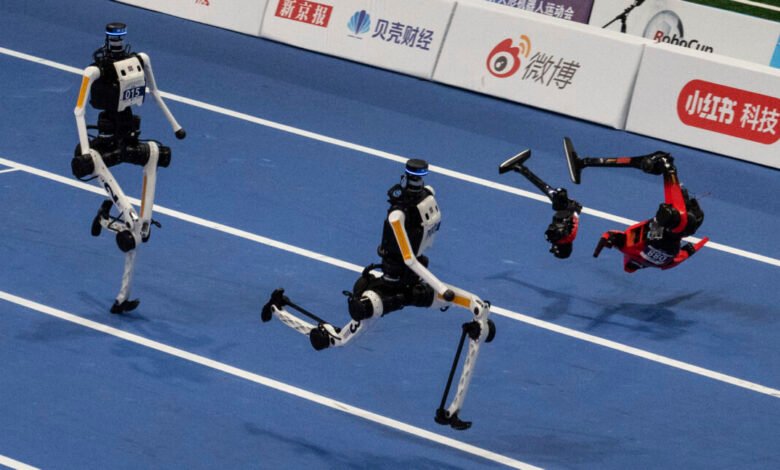
Viral videos of the World Humanoid Robot Games show sprinting robots beating the human 100-meter record held by Usain Bolt—but also feature running robots crashing into barriers and falling down because they cannot readily stop running. A few fallen robots even break at the waist in a shower of sparks or catch on fire.
That demonstration of both robotic prowess and limitations came from the second edition of the World Humanoid Robot Games hosted in Beijing from August 22–26. Like the inaugural event held in 2025, this year’s event challenged humanoid robots to run fast, perform kung fu or dance moves, fight one another in kickboxing, and play soccer or table tennis.
This year’s games also tested robots in more humdrum practical scenarios like washing and hanging laundry, where they appeared to lag behind typical human working speeds. That suggests the event organizers, including Chinese state media and the Beijing city government, are keen to showcase the commercial potential of humanoid robots at a time when China’s robotics industry is rapidly developing and testing such robots.
Endless runner
The fact that humanoid robots went from lagging behind human record-holders last year to surpassing human world records in the 100-meter sprint and standing high jump events this year suggests significant progress in robotic whole-body control for accomplishing specific tasks, Dipam Patel, a PhD candidate in computer science at Purdue University and a research assistant at the US Army DevCom Army Research Lab, told Ars.
“All of that does display whole body control, because you need to move all the joints, hands, legs, arm, body, everything to accomplish that task,” said Patel, who is also a graduate student member of IEEE. “So there has definitely been a huge push in engineering from where they were last time to this time.”
However, the robots on display in the World Humanoid Robot Games are still very far from general-purpose autonomous robots capable of handling practically any task. Instead, these robots were engineered to accomplish just one task, as shown by the fact that the running robots sprinted in a straight line and could not even slow down by continuing around the track after the finish line.
“If you cross the finish line, that’s the goal—it doesn’t matter if you stop and it doesn’t matter if you fall into different pieces,” Patel told Ars. “Some companies had different types of robots for different games or different tasks, because they were engineered for that task to be the best in that.”
Humanoid robot stumbles.
The robotic races and other flashy events provide for an entertaining spectacle that can lead to easy news headlines and viral video clips. They also give robotics companies an opportunity to attract more publicity and investor money by potentially standing out from the competition, Patel said.
One type of humanoid robot developed by the Beijing-based company X-Humanoid gained viral online fame for winning the small-group 400-meter race with an unusual “shy person hiding behind their hands” posture. The robot’s developers told the Global Times that the robot learned through reinforcement learning trials in simulation to shift from a human-style runner’s arm swing to holding its arms up near its face and swinging them back and forth through hip rotations.
Measures of robotic progress at the games could prove even more meaningful if, for example, they challenged robots to run the same race 10 times, Patel suggested. That would require the robots to demonstrate they have the software and hardware to perform reliably over multiple trials—and maybe even learn to slow down safely without endangering themselves or any bystanders.
Boring is more useful
The less flashy events that debuted during the World Humanoid Robot Games this year may ultimately prove more useful benchmarks for robotic progress. Such scenario competitions included household chores, like washing laundry, folding clothes, and cleaning up living rooms, according to the Chinese state media publication the Global Times.
Robots were also challenged by an unscheduled interruption when they had to bring a delivery package inside. That required them to switch tasks from the household chores to deal with receiving the delivery.
The Beijing Continental Grand Hotel provided robots with a different set of timed challenges, including moving wheeled luggage to assigned hotel rooms, cleaning up beds and restocking supplies. The Global Times also reported that a separate library shelving event challenged robots to collect book returns and put them in the correct place as a test of visual recognition and reasoning.
One of the livelier practical scenarios involved an outdoor firefighting and rescue event. Robots had 30 minutes to identify hazardous substances, locate and shut off three open valves of different types, spot a fire, and then find a fire extinguisher to put it out. Only three out of 12 competing robot teams completed the entire challenge, according to the Global Times.
Robots even participated in six events challenging hand dexterity, including picking up beans and driving screws. They also competed to precisely hammer nails into a corkboard without driving them in at an angle.
But Patel observed that many of the robotic competitors were still being teleoperated by human operators who directly controlled the robots’ actions. The World Humanoid Robot Games allowed for human teleoperation of robots in certain events, but penalized the final score if robots were being remotely controlled rather than performing autonomously.
Limits of robot autonomy
The fact that many events still permitted humans to directly control robotic motions shows that autonomous robot systems still have a long way to go, Patel said. Whereas humans can quickly learn many tasks on the fly, robots require much more training through repeated trial-and-error attempts either in simulation or in real-world scenarios.
“You need to have all possible edge cases for a robot to learn from interaction, which is not really feasible,” Patel told Ars. “You can simulate something like 100,000 scenarios for hammering a nail, but that’s just one task from millions of tasks in the world.”
The AI models powering many robots can also learn from huge amounts of visual data involving human demonstrations. But gathering such task demonstration data for robots has proven time- and rery people to strap cameras on their heads
“We would have to push the algorithmic development a lot to actually see a robot being able to generalize and do eight-hour work shifts in any random environment,” Patel explained.
Even the more autonomous robots competing in the World Humanoid Robot Competition still rely heavily on cloud computing to help run intensive AI models, rather than running the AI computing directly on their own onboard hardware, according to the South China Morning Post. It described robots being equipped with 5G modules to transmit data to an “embodied-intelligence system” and then receiving instructions on what to do next.
The real test for humanoid robots’ capabilities will necessarily take place in the real world beyond the demonstrations at the World Humanoid Robot Games. Investors have poured more than $6 billion into humanoid robot companies in 2025 alone, with Chinese companies being especially aggressive in testing and deploying such robots.
Meanwhile, US companies like Boston Dynamics and Agility Robotics are also ramping up their own commercialization and deployment plans in factories and warehouses. The US government has even banned the import of foreign-made robots, including China’s most popular humanoid robots.
But not all robotics researchers are convinced that humanoid robots are necessary, especially when the most useful robots currently doing productive work usually come in other shapes and sizes. For his own part, Patel is focused on developing software algorithms that allow many different types of robots to seamlessly switch between tasks.
Jeremy HsuTech Reporter
Jeremy HsuTech Reporter
Jeremy Hsu is a reporter exploring a wide range of topics across deep tech and AI. He has previously written for New Scientist, Scientific American, IEEE Spectrum, Wired, Undark Magazine and MIT Tech Review, among many other publications, about topics such as deepfakes, data centers, drones, battery tech, robotics, and GPS jamming. He also has a Master of Arts in Journalism from NYU, and a bachelor’s degree from University of Pennsylvania in History and Sociology of Science, with a minor in English.
Source: arstechnica.com