

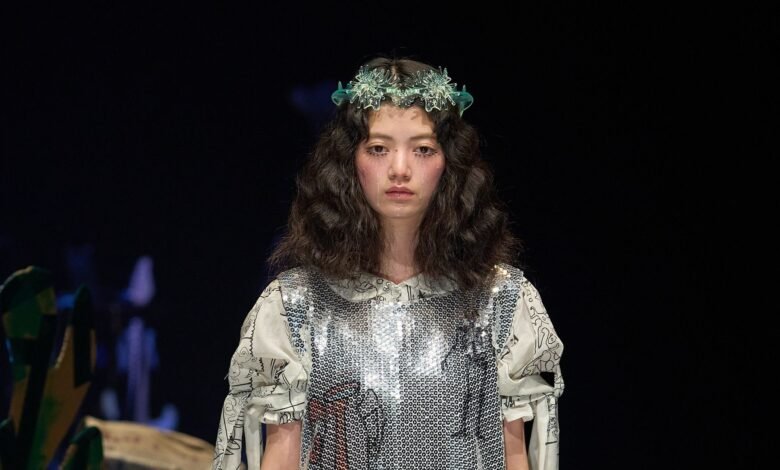
When you incubate and support local talent you hope will reach global relevance, how can you keep reaping the rewards? That’s the question that Japan Fashion Week Organization (JFWO) is wrestling with this season, as Rakuten Fashion Week Tokyo evaluates its standing as a springboard for emerging designers — who are increasingly springing away. With many of its biggest names moving off schedule or showing abroad, the event must look elsewhere to maintain relevance.
The week nevertheless remains a reliable arena to scout for talent, as new designers enter the fashion week system through a combined effort of awards systems and a fresh international push. Here’s what you missed from the week. An off-schedule exodus
There were 27 shows on the main schedule across six days, but many of Tokyo’s biggest domestic designers were absent, having either opted to showcase their collections via lookbook shoots or to hold off-schedule shows earlier in the season, usually in order to be closer to the men’s schedule or to the pre-summer buying season in Paris.
“A lot of emerging designers now prefer to show outside of Tokyo Fashion Week timing-wise, and they are also trying to show in Paris,” says Kaoru Imajo, director of JFWO. This has left the SS27 season in Tokyo feeling especially sparse. Vithat decided to skip fashion week this season and instead created a lookbook
The brand recently hired PR in LA,
The brand recently hired PR in LA, and its designs have since been worn by Lady Gaga, Bad Bunny, and Hudson Williams, which has somewhat dwarfed the attention Tokyo alone can bring. “If you are a really young brand and you need attention, it’s a good thing [to show at Tokyo Fashion Week], but for us, once you reach a point, maybe it’s not as important to be on schedule.”
Knitwear brand Pillings by Ryota Murakami, one of Tokyo’s most notable emerging talents, remained on schedule and was a highlight of the week, expanding its knitwear designs into a wider selection of items that included linen suiting and sporty-looking separates.
Owned by The Sazaby League (which operates Ron Herman Japan), Pillings was shortlisted for last year’s LVMH Prize and currently has over 25 international stockists, including Dover Street Market London and New York and Andreas Murkudis in Berlin. At the end of September, Murakami will hold a showroom at Paris Fashion Week with the goal of adding a few more to the roster. “It made sense for us to show in Tokyo before going to Paris,” says the designer, who hinted that this may be his last time showing in Japan.
“We haven’t decided on the presentation method for the next season, and I don’t think we’re in a position to do a full runway show in Paris just yet, but I’m thinking I’d like to take on some more challenges.”
Looking outward
To mitigate the void left by domestic talent flying the nest, JFWO is seizing the opportunity to plug the gaps with an increased commitment to showcasing international designers.
Out of the 27 slots on the schedule
Out of the 27 slots on the schedule this season, nine were designers from outside Japan, representing countries that included France, Spain, Thailand, Taiwan, the Philippines, Canada and China. “It’s a way for us to keep the week more exciting,” says Imajo, adding that the response from Japanese journalists and buyers has been especially positive. For the visiting designers, Tokyo Fashion Week presents an excellent business opportunity.
Continuing a partnership that began last season, the Paris-based RUN x Andam showroom brought seven designers from across Europe to Tokyo to introduce them to the Japanese market. “It means a lot for us, and it gets a real response,” says Frederic Maus, CEO of WSN Group, which operates RUN. “For [designers] that have never been to Japan, it’s a huge experience for them that helps [establish] them in Asia,” he says, adding that WSN is planning to work with JFWO on more activations and events.
Sonia Carrasco and Anthony Calydon were two designers from the showroom; both held on-schedule events for fashion week, their presence in Tokyo providing precious face-time with local fans and stockists. “Japan, in terms of fashion, they always love to discover something new,” says Carrasco, who showed a collection of deconstructed tailoring and does most of her business in Japan.
They were the first market that supported me
“They were the first market that supported me since the beginning, and they are still supporting us now, so it’s a pleasure to be here.”
Though the weak yen has made it more expensive for Japanese stores to buy imported brands, experts are confident in the resilience of the market. “Fashion is always challenging, but everywhere here there are shops, even more than in Europe,” says Maus.
“Wholesale is still really strong, and so Japan is a major opportunity. It’s a different market with its own codes, but once you deal with that, Japan is a fantastic place. The way [retailers] tell the story, that’s something I think we need to reinvent in Europe.”
An attractive market for buyers
Continuing its ongoing effort to bring more attention to Tokyo, JFWO invited 16 overseas guests, including buyers and press from outlets that included 10 Corso Como Seoul, ShowStudio, and Tessabit, a longstanding luxury boutique in Lake Como.
FWRD’s Luna was also on the list and attended the city’s fashion week for the first time. The buyer was pleased by the manageable scale of the event. “It’s definitely much smaller and calmer than other fashion weeks,” he says. “You’re less likely to be pulled around, which can cloud your thoughts when you’re buying.”
Alessandra Della Morte, a global retail development consultant, says that Tokyo Fashion Week has felt especially exciting in recent years.
It’s not just more creativity from the Japanese
“It’s not just more creativity from the Japanese designers that has helped. Factors like the weak Japanese yen [make Japanese brands more attractive to buyers], and Japanese brands now have more experience engaging with international wholesale,” she says. “As such, the pool of brands showing here in Tokyo represents a valuable offering.”
Tokyo’s appeal isn’t just commercial.
As with last season, the designers that stood out in Tokyo did so by creating immersive installations that invited attendees to step away from reality for a moment. Yusho Kobayashi, whose kawaii designs have recently been worn by Elle Fanning and K-pop group ILLIT, built a DIY set from cardboard that evoked an underwater world, while Yoshio Kubo showed a sporty collection for runners around a huge ger (a traditional Mongolian tent) that was placed in the center of the runway.
“In Europe at the shows you usually find a common thread, but you don’t see that as much here and it’s more diverse, which is super interesting,” says FWRD’s Luna. “It’s more about self-expression, and going back to the true root of personal style.”
The smash hit of the week went to Khoki, a design collective that is quickly gaining a cult following in menswear circles.
Sponsored by Rakuten’s ByR initiative (which has previously
Sponsored by Rakuten’s ByR initiative (which has previously supported a mix of global and local designers including Fetico, Paul Smith and Marimekko), the show was held in a huge warehouse in Tokyo Bay, featuring a set that was a replica of designer Koki Abe’s family home in Yamanashi. “Khoki is already very well represented here in the retail scene here in Japan, and I think he has good potential to grow further,” says Della Morte.
“A lot of Khoki’s techniques and deconstruction are pretty unique for what we’re buying and seeing,” adds Luna. “I think it’s serving a nice white space that we have for our market.”
Speaking after the show, Abe was optimistic about the show’s potential to stimulate more business. “I think [holding this show] will help us reach demographics we hadn’t been able to connect with previously,” he says.
“I’m really looking forward to the possibilities that will open up from here.”
Stimulating the next wave
The week came to a close with the announcements of two major prizes that aim to support local Japan-based fashion talent. The Fashion Prize of Tokyo, which supports a domestic designer to show in Paris and has previously been won by designers including Auralee, Mame Kurogouchi and Doublet, this time went to denim-focused brand Tanaka; designer Sayori Tanaka, who previously served as the leader of the global design team at Uniqlo, will show in Paris during the FW27 season.
Tokyo Fashion Week’s main pipeline for funneling new
Tokyo Fashion Week’s main pipeline for funneling new talent into the fashion week system is the Tokyo Fashion Award. “The award brings us eight designers every year, which is good, because they will all show during the FW27 season,” says Imajo. In addition to financial support for a runway show in Tokyo next season, the eight recipients will hold a joint showroom during Paris Fashion Week in an attempt to win over international buyers.
The winners announced this time included Midorikawa, known for artisanal menswear, and Kenta Orimi, whose eponymous label Orimi draws on Harajuku fashion culture, as well as Gurtwein, an edgy womenswear brand by Teruhiro Hasegawa, and Jianying “Wing” Lai, who cut their teeth under Riccardo Tisci at Givenchy and Burberry. For their show next season, the duo hopes to use it to connect with their customers.
“When I was working at Givenchy, I aspired to stage a massive show, but selling here in Japan has changed my perspective,” says Hasegawa. “I’ve had customers drive three hours just to get to a different store because an item was sold out at their local shop. Hearing stories like that made me feel that rather than a large spectacle, it might be more meaningful to hold a show where there’s a form of connection between the audience and us.”
Source: www.vogue.com