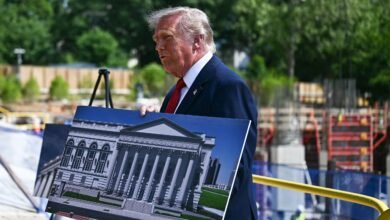

Trump often engages in this manner. Last October, during what became the longest government shutdown in American history, the President posted a series of photographs of his renovation of the White House’s Lincoln Bathroom. “I did it in black and white polished Statuary marble,” he explained. At an agriculture roundtable in Chippewa Falls, Wisconsin, he held up a picture of a fountain in Washington that he had refurbished.
“We had twenty-two fountains that didn’t work,” he said. In March, during a Medal of Honor ceremony, he paused to extoll the quality of the gold drapes that he had selected for the East Room. “These are the ‘fun’ projects I do while thinking about the World Economy, the United States, China, Russia, and lots of other Countries, places, and events,” Trump has said. The President maintains that he’s fixing up the country just like he’s fixing up the White House: applying gold accents to the ceilings, installing bronze plaques that celebrate his achievements and denigrate his rivals, constructing a new ballroom that he asserts is a matter of both pride and national security.
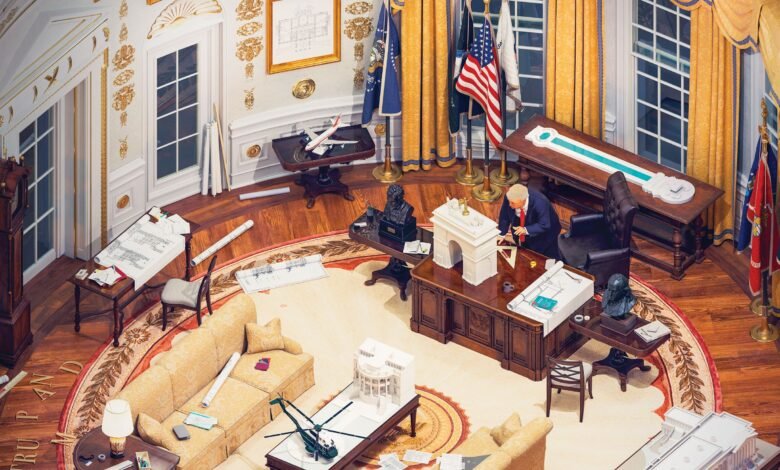
He has walked on the roof to look at prospective job sites. During meetings, he opens his desk drawer and toys with models of structures that he wants to build. In the evenings, he supervises from the windows of the Executive Mansion as crews work around the clock on the grounds. “He really cares about the renovations much more than anything in Presidential day-to-day life,” a person close to the Administration told me.
Back when Trump was a developer in New
Back when Trump was a developer in New York, he would turn up alone on city blocks where he hoped to build, peering around in what one civic advocate termed his “ ‘Fountainhead’ pose”—feet apart, hands on hips, jaw locked. These days, when he surveys possible building sites around Washington, which he does with increasing frequency, he travels with an entourage. One April morning, after an American fighter jet was shot down in Iran and a missing U.S.
airman was rescued from behind enemy lines in an overnight extraction, Trump went on a slow tour around a traffic circle outside Arlington National Cemetery. He was contemplating an empty green space in the center of the roundabout, where he hopes to build a large arch, like the Arc de Triomphe, in Paris. (When asked whom this addition to the capital’s monumental core was for, Trump said, “Me.”) The next month, his motorcade nipped over to the Reflecting Pool, which he had drained to repaint what he called “American-flag blue.”
A fair amount can be done without leaving the house.
“It’s been an amazing place to work with,” Trump said of the Oval Office. He flew his “gold guy,” a cabinetmaker named John Icart, up from Florida to help adorn the wall trimmings and the fireplace, but he occasionally tries out additions himself, using Krazy Glue. A senior Administration official recently spread a towel on the Resolute Desk and placed tile samples before the President.
He’ll look at those, make a call
“He’ll look at those, make a call to a quarry master, talk to them for fifteen minutes, asking about various attributes,” the official told me. “He’s asking you questions, and you’re, like, ‘Sir, I missed stone class in my third year of law school.’ ” The Rose Garden was torn up and paved over to make room for striped umbrellas and lawn chairs; it now resembles the patio at Mar-a-Lago.
The Administration is spending more than nine hundred million dollars on White House renovations alone, most of which will come from taxpayers. Public tours of the property were halted, owing to all the construction, but, before that, docents had noticed the President walking the grounds and slipping notes to gardeners and landscapers. Steve Witkoff, an old friend from Trump’s New York real-estate days who is currently engaged in diplomatic efforts to end the wars in Ukraine and the Middle East, told me, “Every time I’m in the Oval Office, he walks me outside and he says, ‘What do you think of what I did with the tile?
Let’s go look at the foundation of the new event space.’ ”
The building projects are the No. 1 subject that Trump brings up in his unprompted remarks. In interviews, his aides are quick to defend the virtue in his obsession. “The President is going to leave a significant architectural legacy when he finishes his term,” Will Scharf, the White House counsel, told me. Trump has not been self-conscious about narrating this desired legacy in real time.
Such attention to detail is rarely seen
“Such attention to detail is rarely seen in the modern era!” he wrote on a plaque that describes new marble floors in the Palm Room. “He’s Robert Moses, for God’s sake,” Witkoff told me. “I mean, he’s insatiable. ”
The President’s primary preoccupation engenders a certain amount of armchair psychology among those who know and work with the “builder-in-chief.” One Cabinet secretary told me, “It’s a diversion for him.
If he’s doing stuff with gravity, like Iran, he loves to be able to turn to this.” (“Oil?” the secretary added. “Enough already!”) Or, as a person who knew Trump in New York put it, “There’s a little bit of Nero fiddling while Rome burns.” One former Administration official told me that the President is “trying to project an image of American greatness,” then suggested that I consult a relevant book, “Hitler and the Power of Aesthetics.” Its author, Frederic Spotts, argues that Hitler, a painter in his youth, saw himself as an artist reshaping the cultural essence of Germany.
The former official said, “It opens with this very memorable scene of Hitler in the bunker toward the end of everything, and he’s obsessing over these architectural models of Linz, Austria, which is where he was from, and how he was going to make it this European cultural city.” The senior Administration official told me that the projects represented Trump’s attempt to overcome D.C.’s “sclerotic mind-set—all these Lilliputians tying Gulliver down.” He went on, “Break free, and build.”
To realize these visions, Trump has bent the systems of American government to his will: expanding executive authority, barrelling past Congress, stacking planning commissions and civic institutions with loyalists, and taking a legal fight that began with the demolition of the East Wing—which he ordered to clear space for the ballroom—all the way to the Supreme Court.
Some of us are getting four to five
“Some of us are getting four to five hours of sleep a night, trying to keep up with the President,” a person who works closely with Trump on the projects told me. Another adviser said, “Everything is riding on this. It’s nice to have a President who cares, but where does it stop?” He reminded me that they were now reviewing plans to paint the historic granite of the Eisenhower Executive Office Building bright white.
Trump often tells aides a story about the original architect. So many people thought his building was ugly, the President says, that he killed himself. Trump had just flown back from a NATO summit in Ankara; he’d been smuggled out of Turkeyhis life. He marked his return by posting a photograph of new gold lettering reading “The West Wing” that had been installed during his trip: “Newly revamped
. . including signage and renovated walls, maple trees, and plantings!” This was a relatively small flourish on a property undergoing so much renovation that it looks more or less like a demolition site. Next to the Executive Mansion was a gaping hole where the East Wing used to be. The South Lawn was being replaced by a new helipad for Marine One. To the north, Lafayette Park was barely visible behind security fencing.
Trump had refurbished two ornamental fountains, for seventeen
Trump had refurbished two ornamental fountains, for seventeen million dollars, and wants the park to have forty-seven maple trees, in homage to himself. During visits to the White House, I’d grown accustomed to passing by work crews, cranes swinging above the rubble, and dump trucks queuing at the security perimeter. That afternoon, I watched as workers on the North Portico draped scaffolding with a tarp depicting the Portico’s famous columns.
Later, on Truth Social, Trump posted photos of the plaster at the bottom of the (real) columns. “It hasn’t been fixed in decades,” he wrote. In a recent podcast interview, Doug Burgum, the Secretary of the Interior, explained, “President Trump comes out to greet a world leader, he sees door dings in the pillars, and says, ‘Look at all this stuff that needs to be repaired.’ ”
To the President’s detractors, the wreckage of the East Wing is an easy metaphor, a physical embodiment of the turmoil of his second term.
Trump, for his part, insists that these critics are “very, very disloyal” and that preservationists are “TREASONISTS” with bad taste. In mid-August, while his Treasury Secretary was trying to calm a tumbling bond market and the war with Iran entered its sixth month, Trump summoned reporters for a surprise tour of the new White House driveway. He had replaced the asphalt—“very basic, not appropriate”—with radial-cut granite.
This is the highest-quality stone you can get,
“This is the highest-quality stone you can get,” the President said, standing in front of construction fencing and raising his voice to be heard over the banging in the background. “It’s rated a million-year plus. That means it has a million-year life. Can you imagine that?” The stone could withstand thirty-five thousand pounds of pressure per square inch, he said. He motioned for the group to follow him to the helipad: “We’ll walk together, if you’d like.” Trump softens when taking on the role of tour guide for his projects.
When he invited reporters to inspect the ballroom building site, he had his chef put out a spread of breakfast sandwiches. Trump gestured to new sod that had been laid around the helipad. “You know, grass has a life like humans have a life,” he said. “This grass is the highest quality. It was given free of charge by ScottsMiracle-Gro.” Construction workers in reflective vests and hardhats formed a semicircle for the cameras.
Trump had insisted on cutting more than a month off of the original timeline for the helipad so that it would be ready for an impending visit from President Xi Jinping, of China. There had been a setback: Trump realized that he didn’t like how the downward slope of the helipad, a design feature to facilitate drainage during rainstorms, made it look uneven with the horizon. Trump had the contractors redo the helipad to make it flatter, so that guests can “go there for cocktails and then walk to the ballroom.”
“Nice job, fellas,” he said, waving at the crew.
Sorry to take an extra week
“Sorry to take an extra week and a half, but lifting it up was one of the best things we’ve ever done.”
Lately, the President has taken to referring to the ballroom as a “military complex-slash-ballroom,” sometimes suggesting that the whole thing had basically been the Pentagon’s idea. But the original impetus concerned women not having to get their Manolo Blahniks stuck in the mud.
In 2010, during the Obama Administration, Trump called David Axelrod, one of Obama’s top advisers. “You have these state dinners on the lawn there in these shitty little tents,” Trump said, according to Axelrod’s memoir. “I build ballrooms.” Could he interest them in one at the White House, free of charge? “The ballroom is something that’s always kind of been on his mind,” Scharf told me.
One morning last October, construction teams arrived with a backhoe. “It won’t interfere with the current building,” Trump had said, “which I’m the biggest fan of.” Within three days, the East Wing had been destroyed. Trump had some of the debris deposited on a historic golf course in East Potomac Park that he’d been flirting with developing. A few remnants of the East Colonnade, the walkway connecting the East Wing to the Executive Residence, remained, in the form of dangling wires and crumbling bricks.
Late last year, the National Trust for Historic
Late last year, the National Trust for Historic Preservation filed suit, arguing that “only Congress may authorize the demolition or construction of federal buildings.” A district court ruled this spring that construction had to stop. (“WRONG!” Trump wrote online.) The Administration appealed, and in August the Supreme Court, in a 5–4 decision, allowed the project to continue, for now, on the basis that the National Trust likely lacks standing to sue.
(Alison Hoagland, a member of the Trust, had declared that the new ballroom would harm her “aesthetic, cultural, and historical interests.”)
As part of the appeals process, a member of a three-judge panel had cast the ballroom as illustrative of the Administration’s “move fast and break things” approach. “If the government decides, very quickly, to bulldoze the Statue of Liberty,” the judge asked, “nothing can be done?”
“I think that’s right, yes,” a lawyer for the Administration responded.
With the East Wing gone, Trump saw the ballroom as a fait accompli. Joshua Fisher, the director of White House management and administration, said, “The superstructure is beyond the point of return.” The Administration argues that the ballroom is “65% finished.” (According to records obtained by the Washington Post, it’s nowhere close to that.) Trump wrote months ago that he had already ordered many of the construction materials: “All of the Structural Steel, Windows, Doors, A.C./Heating Equipment, Marble, Stone, Precast Concrete, Bulletproof Windows and Glass, Anti-Drone Roofing, and much more.” If the President gets his way, gold seals will be affixed to the outside of the finished building before the legal disputes are resolved.
IT’S TOO LATE! he wrote
“IT’S TOO LATE!” he wrote. Trump started construction on Trump Tower before the architectural plans were even complete. At community-board hearings, neighbors complained that the tower would be too tall and block too much light. The Times wrote that Trump had used “every trick in the book to maximize its size.” He wanted to have the building finished in time to hold a grand-opening party in the tower’s multistory atrium, which featured a sixty-foot waterfall, on Valentine’s Day, 1983.
“That atrium had to be put together with spit and glue,” Barbara Res, Trump’s longtime construction manager, wrote in “Tower of Lies,” her memoir. “We didn’t know how long the waterfall could run without a stone or two falling down.”
Growing up in Queens, Trump would accompany his father, Fred, as he collected rent payments from tenants. But the son had grander ambitions.
“I used to stand on the other side of the East River and look at Manhattan,” Trump has recalled. Fred introduced him to city leaders and lenders, and he began to learn how much he could get away with. Once, Trump offered to forfeit a $4.4-million commission he was owed on a property if the city agreed to name it after his father. As officials prepared their response, they realized that the commission was worth nine times less.
I guess he just thought we would never
“I guess he just thought we would never read the fine print,” one said. Trump didn’t like to be told no. He was committed to having marble sinks in the bathrooms on Trump Shuttle, the airline that he bought in 1989—until others insisted it would make the planes too heavy. In his buildings, he didn’t want to have accessible bathrooms or Braille on the elevators. (“No blind people are going to live in this building,” he said of Trump Tower, according to Res.)
The city’s élites were appalled by Trump’s destruction of the Bonwit Teller.
“I’ll never have the goodwill of the Establishment, the tastemakers of New York,” he later said. “They have never tried anything on the scale that I am trying things in this city.” He occasionally tells a story about attending the dedication ceremony for the Verrazzano-Narrows Bridge, in 1964, with his father. Robert Moses had spent decades working to build the bridge, which connected Brooklyn and Staten Island.
During the ribbon-cutting ceremony, politicians arrived in their limos and, in Trump’s version of the event, were received with pomp and circumstance while the bridge’s designer stood alone and ignored. “All these politicians who opposed the bridge are being applauded,” Trump said, and the man “who poured his heart into it” is “just standing there in the rain.” It was something of a false memory: Moses had actually called the architect up to be recognized during the ceremony, which took place on a sunny day.
I realized then and there that if you
“I realized then and there that if you let people treat you how they want, you’ll be made a fool,” Trump said. He was always on the lookout for slights, and defiant in the face of anyone who criticized him. “You can go ahead and speak to guys who have four-hundred-pound wives at home who are jealous of me,” he said in 2005. “But the guys who really know me know I’m a great builder.”
Although Trump delighted in supervising the project directly, the judge in the National Trust case had ordered the Administration to submit plans to the federal bodies that would normally review them: the National Capital Planning Commission and the Commission of Fine Arts.
The N.C.P.C. is a twelve-person panel tasked by Congress with overseeing federal construction and development in D.C. It is the capital’s equivalent of a local planning board. Last summer, when Trump was looking for ways to fire Jerome Powell, the chair of the Federal Reserve, for not cutting interest rates, he started attacking Powell for supposedly mismanaging a renovation of the central bank’s historic headquarters.
As President, Trump could appoint three of the N.C.P.C.’s members, so he fired Joe Biden’s appointees and installed replacements, including James Blair, then his deputy chief of staff, and Will Scharf, then his staff secretary, who became the head of the commission. At the new panel’s first meeting, the men tore into Powell’s renovation; one of them referred to it as an attempt to build “the Taj Mahal near the National Mall.”
Before joining the Administration, Scharf was Trump’s personal lawyer.
He was part of a team that successfully
He was part of a team that successfully argued the January 6th case before the Supreme Court, which resulted in a ruling that Trump had broad immunity from prosecution for actions taken while in office. “The President doesn’t watch the whole commission meeting and critique me on the back end, the way he used to do with my TV hits,” Scharf told me. “But he stays involved.”
I met Scharf recently in his West Wing office.
He joked that his appointment as N.C.P.C. chairman “in the technical Presidential scholarship would be called ‘ad-hoc-cracy.’ ” He told me, “There was a realization that a lot of what the Administration wanted to do was going to flow through N.C.P.C.” Staff secretaries manage and edit all the written material that ends up on the President’s desk, but Scharf had taken an unusually visible approach to the job.
He frequently stood next to Trump in the Oval Office to present and explain executive orders to the press, looking over Trump’s shoulder as he signed them in Sharpie. Now, in addition to reviewing diplomatic documents or directives to shrink the federal government, Scharf would be considering garage-door design concepts and pulling all-nighters on Air Force One while studying façade improvements for Capital One Arena.
The N.C.P.C. sometimes conducts multiple reviews
The N.C.P.C. sometimes conducts multiple reviews of a plan, and even modest projects that make it through can turn into drawn-out affairs. In Trump’s first term, a new White House tennis pavilion took nearly three years from start to finish. Scharf understood that that couldn’t be the case here. “When President Trump decides to do something, he moves fast,” he told me. “With respect to the ballroom, this is something that the federal government could have been arguing about and attempting to plan and attempting to build for decades.”
Scharf insisted to me that, given his role at the N.C.P.C., he stays out of conversations about ballroom construction at the White House.
But he and Trump find opportunities to discuss architecture in more general terms. “During our Middle East swing, we’re in this massive palace, and there are chandeliers everywhere,” Scharf told me. “Typically, at the base of the chandelier, where it connects to the ceiling, you have what he calls a medallion. He pointed out that the palace didn’t have medallions around its chandeliers.
And, I hate to say it, but it looked cheaply built. The President’s, like, ‘They really messed this up.’ ”
On the day Scharf and I met, scaffolding was coming down around a pair of refurbished equestrian statues, newly coated in gold leaf, near the Lincoln Memorial. (“Wear sunglasses if you’re passing by them,” a D.C. theatre director told me.) In the afternoon, Trump gave a presentation in the Oval Office about his vision for a twenty-two-billion-dollar gilded redesign of Dulles Airport.
It’s incredible watching him think through construction problems,
“It’s incredible watching him think through construction problems,” Scharf said. “He is very good at building for a setting, and he has a keen sense of design. If you talk about aircraft carriers, he has a very firm view of what’s good and what’s bad—steam versus electromagnetic catapults, for instance. It’s the same with columns.” He went on, “Every President is going to come into this job with something they’ve done throughout their entire life.”
Experts and former commissioners had noted with alarm that the N.C.P.C.
should have looked at plans for any exterior construction project at the White House long before Trump tore down the existing structure. Scharf brushed off such concerns, insisting that the commission didn’t have authority over demolition, only its opposite: “What we deal with is essentially construction, vertical build.”
Part of the commission’s responsibility is to preserve the historic sight lines of national landmarks.
Shalom Baranes, a Washington architect who worked on renovations at the Treasury Building and the Pentagon, presented preliminary mockups of the ballroom—what one public letter, signed by dozens of architects urging Baranes to quit, had said would make the new structure “the tail wagging the dog” of the comparatively diminutive White House. But without the ballroom, Scharf said, Trump would be forced to host King Charles “in a tent on the South Lawn with porta-potties.” Blair, the deputy chief of staff, invoked history: “Winston Churchill said to the House of Commons, when they were going to rebuild it, that we shape our buildings and they shape us thereafter.” Phil Mendelson, one of only a handful of commissioners who aren’t Trump loyalists—he chairs the local D.C.
Council—was disturbed by the extent to which
Council—was disturbed by the extent to which the ballroom overwhelmed the original White House. “Maybe it can be and needs to be shrunk a little bit more,” he said. “It’s just so—it’s just so imbalanced.”
Later, members of the public were invited to weigh in, turning what was essentially a zoning meeting into a forum for irate D.C. residents and other critics to confront top Administration officials and express their discontent with the President.
“The fix is in for this project,” Jon Golinger, speaking on behalf of Public Citizen, a good-government advocacy group, said. He called for Trump’s N.C.P.C. appointees “to answer today to the rest of the commission what they knew and when they knew it” and demanded that they resign. Two architects from Venezuela proposed that the project be modified to include an extrasensory “freedom dome” that would support “global and cosmic alignment and orientation with a universal energy network.”
“It’s the beauty of the public deliberative process,” Scharf told me.
“And, in the end, I think history’s going to prove the President right.”
As the commission moved toward a vote on the plan, there was a certain resignation among the ballroom skeptics, who knew that they were outnumbered. (Representatives from three executive agencies and the chairs of two congressional committees—all currently Republicans—serve alongside the Presidential appointees.) Paul Ingrassia, who was a lawyer for the accused sex traffickers Andrew and Tristan Tate before he was tapped to join the Trump Administration, said, “The White House shouldn’t be a static building.
It should develop with the times, and I
It should develop with the times, and I think this is a tribute to where the United States currently is positioned in terms of global leadership.”
Days before the vote, the judge in the National Trust suit had ordered Trump to stop construction on the ballroom to “avoid irreparable harm.” The President, he wrote, “is the steward of the White House for future generations of First Families.
He is not, however, the owner!” Scharf reminded the N.C.P.C. members that the court’s opinion was irrelevant to their work. “We are not some sort of free-ranging ballroom-justice commission,” he said. They approved the design; Mendelson was the lone dissenter. Trump took to Truth Social to thank the commission. “He’s excited when we clear a hurdle, like any builder would be,” Scharf told me.
Trump posted a photo of himself smiling outside the White House, where the “magnificent” ballroom was “now rising on this Hallowed Ground.”
Presidents have seldom interfered with the C.F.A., until recently. Biden fired most of Trump’s appointees when he took office, and last fall Trump fired Biden’s. Rodney Mims Cook, Jr., the new chair, is a longtime booster of classical architecture who shares Trump’s affinity for Corinthian columns.
(Cook has mused about replacing the Ionic columns
(Cook has mused about replacing the Ionic columns that currently frame the White House with Corinthian ones, which are more decorative and ornate.) During Cook’s first meeting as chair, he made clear how he would approach the ballroom. “This is an important thing to the President,” he said. “The President is very focussed on world peace, and we need to let him go do that.”Other commissioners include Chamberlain Harris, a twenty-six-year-old executive assistant to the President, and Roger Kimball, a conservative art critic, who has described Trump as a “Carlylean figure, an historic man of action.”
In February, after just thirteen minutes of deliberation and despite not having a final design, the C.F.A.
voted unanimously to approve the ballroom. Cook pointed out how much he liked the Corinthian columns on the exterior. “The committee has just become a rubber stamp for Trump,” a former commissioner told me. “It’s really sad.”
But both the N.C.P.C. and the C.F.A. have insisted that a devotion to aesthetics and to history, not fealty to Trump, was their reason for moving the project forward.
Scharf had often presented the ballroom as merely the latest chapter in a series of White House renovations that were met with overblown responses. “At every stage of its development, every new addition, including the initial construction of the White House, has been roundly criticized,” he said. After George Washington and Thomas Jefferson announced a design competition for the mansion, in 1792, one observer complained that the winner, James Hoban, had submitted plans for a building that was “big enough for two emperors, one Pope and the grand Lama in the bargain.” A decade later, when Jefferson took office, he added colonnades to expand it further.
After the Eisenhower (or Old) Executive Office Building
After the Eisenhower (or Old) Executive Office Building was built, in the late eighteen-hundreds, Mark Twain was said to have called it “the ugliest building in America.”
Still, these undertakings, even if maligned for their hideousness, were “consistent and compatible with the fabric of what Washington and our central government is all about,” Alan Hantman, a former head of the agency that maintains and operates the Capitol, told me.
The ballroom designs now differ dramatically from what both commissions approved—recently submitted updates show the building with decorative lion heads, more gold, and an ornamental staircase. “Where the heck are these lions coming from?” the former commissioner told me. “You could imagine a symbol of American democracy, like a bald eagle or a bison or something. The lion is associated with the British monarchy.
I don’t usually curse, but this is a clusterfuck.”
The Trump Administration has argued that demolition is merely an act of upkeep. In a court hearing, Yaakov Roth, a Principal Deputy Assistant Attorney General, referred to a code authorizing Congress’s annual White House maintenance allowance, which covers things like repairs, alterations, refurnishing, and air-conditioning expenses.
In recent years, that allowance has averaged around
In recent years, that allowance has averaged around $2.5 million. Since Trump returned, according to the Washington Post, eight hundred and seventy-five million dollars has been routed to the allowance account, which has funded the ballroom project. (Private donations make up three hundred million. The rest has come from various executive agencies.) At the hearing, Roth said, “We think ‘alteration and improvement’ are capacious enough terms to include improving, you know, replacing—”
“That’s a pretty expansive interpretation of the language,” the judge interjected.
Later, he wrote, “Some might even view tearing down the White House and building a modern skyscraper in its place as an ‘improvement.’ ”
The Administration’s legal filings had already pivoted from quoting historical accounts of White House modernization to arguing that the President’s life was at stake. Some of the language in the filings matched verbatim Trump’s Truth Social posts.
A motion from April 27th, which challenged the order to stop construction, contended that the National Trust is “very bad for our Country” and that “even their name is FAKE.” The Trust, it went on, suffers from “Trump Derangement Syndrome, commonly referred to as TDS,” and is represented “by the lawyer for Barack Hussein Obama.”
A senior official told me that the President was personally editing ballroom legal filings.
Roth, the Deputy Assistant A.G., was asked about
Roth, the Deputy Assistant A.G., was asked about the motion at a dinner party attended by other Justice Department lawyers. “You mean the brief that Trump wrote?” he quipped. Roth’s name had disappeared from the case, typically a sign of disagreement or discomfort with the arguments being made. (Roth, who recently left the government, declined to comment.) “If any other President had the ability, foresight, or talents necessary, to build this ballroom, which will be one of the greatest, safest, and most secure structures of its kind anywhere in the World, there would never have been a lawsuit,” the motion read.
It was only “because it is DONALD J. TRUMP, a highly successful real estate developer, who has abilities that others don’t.” The ballroom was a “gift to our Country from President Trump,” according to the brief. “Who,” its writer asked, “could ever object to that?”
In April, 2025, in an article in the Claremont Institute’s online publication The American Mind, the architecture critic Catesby Leigh proposed constructing a monumental arch to commemorate the nation’s two-hundred-and-fiftieth birthday, noting that Washington is the “only major Western capital” without one.
“There were more than 50 in ancient Rome,” he wrote. Leigh recommended a temporary arch that would be sixty feet tall. (In 1789, Americans built temporary arches in their towns to greet George Washington as he travelled to New York for his Inauguration.)
Several Trump allies saw the article and thought that an arch might appeal to him. “The President loved the idea and ran with it,” Vince Haley, the head of the Domestic Policy Council, told me.
As with the ballroom, the arch grew bigger
As with the ballroom, the arch grew bigger and bigger. Trump more than quadrupled the height of Leigh’s proposal, and suggested that it become a permanent structure, of concrete wrapped in granite. It would be topped with a sixty-foot gold statue of Lady Liberty, wearing wings and flanked by gold eagles. “He understands that arches themselves are canvases for beautiful art and sculpture,” Haley said.
“He sees this opportunity to have a grand narrative about the history of our country.” (According to the book “Regime Change,” by Maggie Haberman and Jonathan Swan, Trump considered topping the arch with a large statue of a fist, in homage to his “fight! fight! fight!” moment after the assassination attempt in Butler, Pennsylvania.)
An aide researched arches around the world and prepared a flip book of fifty or so examples for Trump to look through.
Trump selected an architect, Nicolas Charbonneau, whose design, in his own words, would frame the view of Arlington National Cemetery as the Renaissance painter “Master Raphael framed the heavens.” In fact, after Trump’s input, the arch would obscure the view of the cemetery, and of the Lincoln Memorial. Trump tasked Haley with supervising the project. “There is nothing that competes with that,” Trump told him.
Challenges quickly arose
Challenges quickly arose. The President has some leeway in renovating the White House, but the proposed arch is situated on a parcel of federal land in D.C.’s historic monumental core. “There’s a different set of hoops to jump through,” Haley told me. The construction site is directly beneath a flight path to Reagan National Airport, and large cranes might be less than two hundred feet from descending planes.
Owing to constant construction noise, daily burials at the cemetery would no longer take place in silence. In July, I walked into an N.C.P.C. meeting about the arch as protesters outside were singing and holding up posters: “You’re so vain, you probably think this arch is about you”; “Stop Arch Insanity.” Inside, Scharf argued that the Height of Buildings Act, a law that requires most buildings in the capital to stay under a hundred and thirty feet, shouldn’t apply to federal projects.
(Two other laws governing the construction of new monuments were similarly inapplicable, the Administration has claimed.) Not letting Trump build as tall as he wants raises “sovereign-immunity issues,” Scharf said. “Our skyline didn’t happen by accident,” one commissioner said. When the arch came before the C.F.A., Burgum, the Interior Secretary, presented it as the culmination of a plan that had actually been in the works for a century.
He referred to a 1924 proposal approved
He referred to a 1924 proposal approved by Congress—but never carried out—to erect a pair of hundred-and-sixty-six-foot columns at the end of Arlington Memorial Bridge. Trump’s arch, he said, is simply “building on” that plan. It was approved. Cook, the chairman, had been yearning for an arch in Washington for decades. Around 1999, he proposed putting one along the west bank of the Anacostia River.
He was fairly successful in getting funders and lawmakers on board, but enthusiasm for the project waned. He instead built one in his home town, Atlanta—a structure of around a hundred feet with a bronze temple on top. Cook actually thinks that Washington should have three arches. “President Trump loves the city,” he told me. “He has the same affliction, I guess you would call it, that I have.
Washington is such a beautiful experiment, but it’s really incomplete.” This month, without N.C.P.C. approval, the Administration announced that excavation for Trump’s arch would begin. As Haley said to me, “Inertia and the collective maw of regulations can grind you to a halt.”
For a while, it looked like the flagship building might actually get built. “Donald Trump, at thirty nine, was literally about to reach the sky,” Wayne Barrett, a longtime Trump chronicler at the Village Voice, wrote.
Trump would later say, of his proposed skyscraper,
Trump would later say, of his proposed skyscraper, that it “made no sense to try to create something that blended into the surrounding community.” Instead, it should overpower it. The building would have cast shadows over New Jersey and all the way up to Ninety-sixth Street. As the Times editorial board put it at the time, the development was his “bid for immortality.”
But Mayor Ed Koch wouldn’t give him the special tax and zoning concessions he’d hoped for, and West Siders hated the plan.
No matter how much maneuvering Trump did, the site sat vacant. He always hoped to one day avenge that failure. “My time,” he insisted at the end of his book “The Art of the Deal,” “will come.” He kept looking for ways to cast himself as a hero of the built environment. In the eighties, he renovated Wollman Rink, in Central Park, stepping in after years of stalled efforts by the city.
He started pitching himself for other large-scale civic projects far beyond his abilities, like redoing the Williamsburg Bridge. Now it is Washington’s turn. “The great civilizations of history did not wallow in aging ruins of the past,” Trump said this summer, during a rally on the National Mall. He proposed creating a ten-billion-dollar fund for “beautification projects” around the city, which he had always complained was a “cesspool.” He had the National Park Service flush sediment out of dormant waterlines in Meridian Hill Park so that a fountain there could be turned on for the first time in years.
He plans to construct a pedestrian bridge
He plans to construct a pedestrian bridge from the Lincoln Memorial to the Potomac River. (“They want to call it the Trump Promenade,” he has said.) He wants to build a Garden of American Heroes, which will include sculptures of two hundred and fifty important Americans—Henry David Thoreau, Alex Trebek—on waterfront parkland, and he insured that the Big Beautiful Bill allocated forty million dollars for the project.
Trump is no longer stymied by the forces that held him back in his early days. “In New York, he was only the developer, pushing up as hard and as cleverly and deviously as he could against the various obstacles and making his way around them,” the person who knew him in New York told me. In D.C., “he’s the mayor, the planning commission, and the lending institution all together.
He’s basically on every side of the table.” He often awards no-bid contracts, and handpicks the inspectors general tasked with overseeing them. If a project falters, he finds ways to shift the blame: when the paint job on the Reflecting Pool started to peel, he ordered Jeanine Pirro, the U.S. Attorney in D.C., to prosecute visitors for vandalism. Paolo Zampolli, a former modelling scout who is now Trump’s special envoy for global partnerships, told me that the President is just trying to give D.C.
A facelift. We were sitting near a large
“a facelift.” We were sitting near a large fan in his Dupont Circle row house. The air-conditioning was broken, and the Tate brothers were mingling upstairs with a handful of diplomats and Administration officials. “The city has so much potential, but the marble is crumbling,” Zampolli said, dabbing sweat from his face with a handkerchief. Last year, Trump purged the board of the John F.
Kennedy Center for the Performing Arts and named himself chairman, embarking on a series of renovations that included putting his name, in bronze letters, on the front of the building. Zampolli is one of the new board members. He imagined an Italian Riviera on the banks of the Potomac, with a Cipriani restaurant atop the redone Kennedy Center. Meanwhile, the General Services Administration had listed a number of historic federal buildings for sale, part of an effort to “revitalize” D.C.’s downtown.
“We know we have prime real estate,” Zampolli told me. Some of the buildings that the G.S.A. has tried to off-load are historically significant: the Wilbur J. Cohen Federal Building, for example, is referred to as the “Sistine Chapel of the New Deal” because of its mid-century murals. Zampolli wanted it and other buildings like it condemned or vacated, and replaced. He didn’t see why D.C.
Had to be so dowdy—or even look like
had to be so dowdy—or even look like D.C. at all. “I wouldn’t mind seeing some beautiful skyscrapers next to Capitol Hill,” he said. “I wouldn’t block the view of the Capitol, but some skyscrapers, the higher you go, the more beautiful it is.” Zampolli pulled out his phone to show me a slide show with designs for a proposed overhaul of the city’s southwest quadrant.
The working title was Trump City. A few weeks later, Trump ordered dozens of trees, including a historic cherry-blossom tree, to be removed from East Potomac Park, so that construction could begin on the golf course he plans to overhaul there. Trump and Burgum had already been out to scout it. For years, the nonprofit National Links Trust has run the course, charging forty-two dollars for eighteen holes; Trump, per a spokeswoman, wants to bring “glamour and prestige” to the place.
“This is what he does,” Witkoff told me. “The President is intent on making Washington, the capital of the country, a better city.” Trump, he posited, could governast. When it was time to come up with a rehabilitation plan for Gaza, Witkoff said, Trump “really wanted to be intimately involved in it. He had done many master plans in his life
He wanted to understand, with all the bombs
He wanted to understand, with all the bombs that were dropped there, how we were going to demolish. He wanted to bring his insight, his creative sensibility, and say, ‘How are we going to do this to make it really special, so that when people come back they’re living in a special place?’ ”
Late in August, Trump left the White House in Marine One, and the helicopter circled twice before departing, allowing him to take in the construction sites from above.
Nearby, his Commerce Secretary, Howard Lutnick, was giving a press conference outside a D.C. courthouse, where a judge was weighing a challenge to Trump’s effort to put his name on the Kennedy Center. The Administration’s lawyers argued that if Trump’s renovation plans kept getting blocked they might have no choice but to demolish it. “What do you want the guy to do?” Lutnick said.
“He’s only the President for two and a half years.”
Trump isn’t the only one who can knock things down. “Life is a series of battles ending in victory or defeat,” he told Forbes in 1982. At the time, he was building an Atlantic City casino that he went on to name the Trump Plaza. It débuted to great fanfare; at the opening, he walked through the lobby with Michael Jackson, who sang next to him.
Source: www.newyorker.com