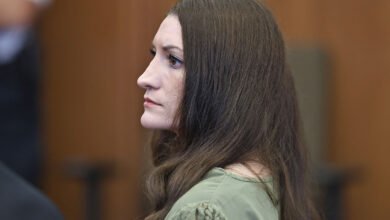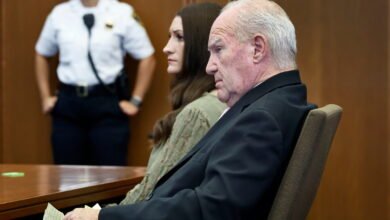

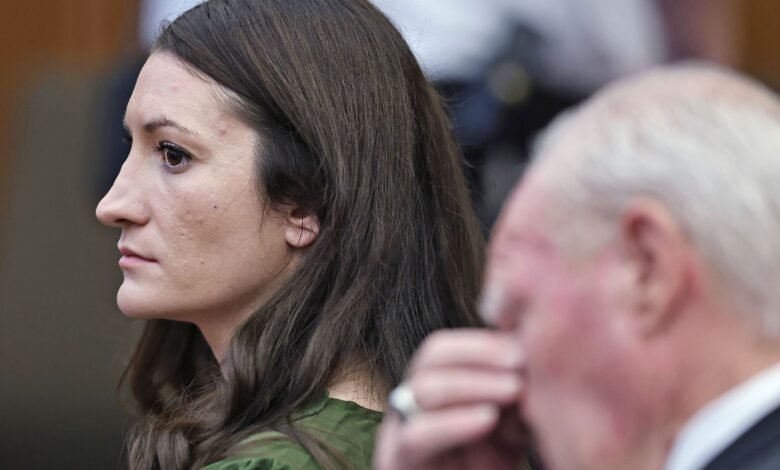
It should come as no surprise that the jurors had trouble reaching unanimity. Five weeks of nationally televised testimony, from more than eighty witnesses, did not settle the central question: What was going through the defendant’s mind when she killed her kids? The prosecution and the defense never disagreed about the case’s basic facts. One evening in January of 2023, after sending her husband out to pick up dinner, Clancy fatally strangled Cora, who was five, Dawson, who was three, and Callan, who was eight months old, in the basement of the family’s home in Duxbury, Massachusetts; then she cut her neck and wrists and jumped from a second-floor window.
The jury was asked to determine whether Clancy, a labor-and-delivery nurse who’d been in the midst of a well-documented mental-health crisis, should be exempt from criminal responsibility under Massachusetts law, either because she lacked the capacity to understand that what she was doing was wrong or because she was unable to stop herself from doing it. Day after day, Judge Sullivan ordered jurors to ignore press coverage and commentary on social media, where self-appointed sleuths combed through testimony, diagnosed Clancy from afar, and seized on minor inconsistencies to construct a baseless theory that her husband was the culprit.
The jury could hardly have missed the divisive displays outside the courthouse. Pink-clad Clancy supporters gathered by the dozens, holding up placards that read “COMPASSION BEFORE JUDGMENT” and “LISTEN TO MOTHERS,” while a smaller counter-presence carried signs of its own: “REMEMBER THE REAL VICTIMS”; “KIDSLAUGHTER.” As testimony came to a close, the judge granted a request from the defense to include involuntary manslaughter as a possible verdict, giving jurors an option in between convicting Clancy of murder and finding her not guilty by reason of insanity.
In the end, though, there was apparently no
In the end, though, there was apparently no compromise to be found. In most states, defendants bear the burden of proving their insanity. In Massachusetts, it falls to prosecutors to prove criminal responsibility beyond a reasonable doubt. Leading the prosecution were Jennifer Sprague and Shanan Buckingham, a pair of stolid assistant district attorneys in structured suits and dark rectangular glasses.
During opening statements, Buckingham, who wore her hair pulled back with the sort of bow that she said Cora had loved, promised to reveal an “extremely controlling, meticulous, and manipulative” version of Lindsay Clancy, a sinister inverse to “pictures you’ll see of the doting mother, the dedicated nurse.” But in the course of the trial this portrait never materialized.
Many of the state’s own witnesses—a pediatrician, a preschool teacher, a colleague of Clancy’s, a local friend—supplied favorable character evidence for the defense, sometimes even before Reddington rose to cross-examine them. Elaine Rossi, the family’s nanny, repeated what she’d told the state police: “I observed a wonderful mom who loved her kids.”
No witness complicated the prosecution’s case more than Clancy’s ex-husband, Patrick, who spoke of his former wife with the same sympathy that he has maintained since their children’s deaths.
He recalled Clancy inventing songs for them
He recalled Clancy inventing songs for them and cooking green eggs and ham for Cora, who adored Dr. Seuss. “She was very dedicated,” Patrick said. “She did everything.” During his testimony, the prosecution produced a spiral notebook in which Clancy had left instructions for caretakers on when to put down the baby, which vegetables to prepare for dinner, how to cut up the sweet potatoes.
Was all this meant to conjure an insidiously controlling mother? Patrick testified, “I would’ve done the same.”
To supply a motive, the prosecutors tried to assemble evidence that Clancy had simply soured on family life. They got Christopher Clancy, Patrick’s father, to allow that, at Thanksgiving, she’d grown “a little frustrated” when one of her children wouldn’t be seated for dinner.
They introduced a much discussed Facebook post, written a year and a half before the killings, in which Clancy had called Dawson, who was then nineteen months old, “the most difficult human I have ever encountered.” More than once, though, the prosecutors appeared oblivious of where their own lines of inquiry would lead. They confronted Patrick with text messages about an anniversary trip that he’d arranged a month or so before the killings, as if to contest his account of the family’s crisis, only for him to clarify that the plans were scrapped because Lindsay was too unwell to go.
They held up prescription bottles still filled
They held up prescription bottles still filled with pills, to suggest that she hadn’t been taking the medication she blamed for her deterioration, just for Reddington to haul out a bag containing empty bottles that the police had overlooked in a nightstand drawer. Sprague seemed most self-assured when she pulled on latex gloves to lift the grimmest exhibits out of evidence bags: the clothes that the children were found in—Cora’s pink robe, Dawson’s dinosaur underwear, Callan’s snowflake-printed onesie—and the exercise bands that their mother had used to strangle them.
But even the urge to keep jurors trained on the brute horror of the killings could get the better of the prosecution. While cross-examining Sue Clancy, Patrick’s mother, about the deaths of her grandchildren, Buckingham established that Sue was an active member of the Catholic Church, then asked, “So you’re aware that murder is considered a mortal sin?” Before Sue could answer, the defense objected, Judge Sullivan banged his gavel, and the question was stricken from the record.
The haphazard trajectory of Clancy’s treatment does leave one to wonder how she might have fared with regular talk therapy and earlier inpatient care—both of which her providers had recommended—or with fewer prescriptions, better coördination among hospital systems, and a safety plan that accounted for the small but real risk of filicide. Three weeks before the killings, Clancy voluntarily admitted herself to McLean Hospital, a renowned psychiatric facility outside Boston.
After five days, she asked to be discharged
After five days, she asked to be discharged so that she could attend her daughter’s birthday party. Keeping her there against her will would have been a drastic intervention, permissible by law only if doctors believed that she was likely to cause serious harm. But Clancy’s medical providers had a limited view of the danger. She’d told them that she was having suicidal ideations but consistently denied having a plan to kill herself, and though she’d told her mother and Patrick about thoughts of harming her children she never disclosed those thoughts to a doctor.
Reddington had to talk around this impasse, badgering Clancy’s providers about matters such as their use of telemedicine, as though this wasn’t standard practice. “So you couldn’t give her a hug, could you?” he asked Tufts, apparently trying to brand her as callous. She replied, coolly, “That’s not actually something that psychiatrists typically do.”
Clancy’s trial has generated the most intense national conversation about postpartum mental health in recent memory.
Many commentators have, fairly, lamented that it has taken such a horrific tragedy to raise awareness of the issue; they point out that the kinds of struggles Clancy experienced are both common and underdiagnosed (roughly one in eight new mothers reported symptoms of postpartum depression in a recent survey), even if the actions she took are exceedingly rare. That Clancy was universally thought of as an excellent mother and an authority on infants—not to mention that her family was white, photogenic, and comfortably suburban—made her a potent symbol.
If this could happen to a woman so
If this could happen to a woman so seemingly with-it and well redical expertise, a husband who worked from home, supportive in-laws a few towns over, and parents ready to drive in from out of state—then what hope was there for other troubled mothers? In the courtroom, though, the general impression of Clancy’s togetherness cut against the defense’s argument that she had lost control
Reddington struggled to marshal legible proof that she was experiencing psychosis, because none of the providers who treated her before the killings had observed signs of it. Instead, he had to account for evidence that she appeared cogent on the day in question: that she’d taken her daughter to a pediatrician’s appointment in the morning; that she’d sent Patrick to pick up dinner from a relatively distant restaurant from which they’d never ordered takeout, then added on a last-minute stop at CVS, which kept him out of the house longer; that she sounded lucid when he called from the store and she picked up, possibly in the middle of the killings; and that one of her first questions, when she awoke in the hospital, was whether she had a lawyer.
The defense would have benefitted from calling a specialist in postpartum mood disorders to explain how easily psychotic symptoms can be missed in high-functioning new mothers. That testimony was expected to come from the leading perinatal psychiatrist Margaret Spinelli, who’d attended portions of the trial, but on the afternoon that she was to take the stand Judge Sullivan dismissed jurors early, citing an “unforeseen circumstance.” (Later, Spinelli was dropped from the witness list without explanation.)
Much of Reddington’s case turned on Clancy’s claim that she’d hallucinated a male voice commanding her to kill the children.
The defense’s most helpful witness on this front
The defense’s most helpful witness on this front was the forensic psychiatrist Phillip Resnick, who has spent more than half a century studying maternal infanticide. Two decades ago, Resnick helped secure a verdict of not guilty by reason of insanity in the case of Andrea Yates, a Texas woman who drowned her five children in a bathtub. In Clancy’s case, Resnick testified that she’d been “frankly psychotic” in the moment of the killings, experiencing what he called a “delusion of influence”: “It was almost like she was a puppet,” he said, “and someone else was pulling the strings.” But what Clancy didn’t have, and Yates did, was a medical record documenting years of unmistakable psychotic symptoms.
Although Clancy had repeatedly complained of intrusive thoughts, some about harming the children, she had never described hearing voices before the killings; nor has she reported them since. Kirk Heilbrun, a forensic psychologist who assessed Clancy for the prosecution, testified that he is “always very careful” with symptoms that emerge only during the commission of an offense, because they provide “a convenient way of lessening your own culpability.” He added that the voice Clancy described had arrived without the kinds of delusions that usually accompany so-called command hallucinations.
(Yates, for instance, was convinced that drowning her children would save them from Satan.) As prosecutors pointed out, even Resnick has written that command hallucinations are easy to fabricate, and Clancy’s own accounts of the voice were inconsistent. She told a hospital chaplain the voice had warned her that neither she nor her children would be safe unless she obeyed; she told forensic examiners that the voice had said to kill the children so that she could kill herself.
She told one evaluator that the voice came
She told one evaluator that the voice came on only after Patrick’s phone call from CVS, while she stood at the refrigerator preparing to make chicken nuggets. This claim, however, became a distracting point of dispute: Patrick had testified that Dawson was already eating chicken nuggets when he left the house. Such discrepancies would matter less if the voice were not so central to Clancy’s defense.
But the prosecution was able to frame the voice as a mark of her unreliability rather than a sign of her illness. If that is true, and Clancy chose to kill herself and take her children with her, was her act rational? Experts for both sides invoked the idea of “altruistic filicide,” a term that Resnick coined for parents who kill their children in the hope of sparing them real or imagined suffering.
In his closing arguments, Reddington might have done more to follow the logic, or illogic, of that concept: Could a loving mother see strangling her children as a form of “altruism” unless her illness had substantially distorted her sense of reality? He might have sidestepped the fraught topic of the voice altogether, emphasizing instead the story of a mentally ill woman who fought horrific impulses, hallucinatory or otherwise, until they overtook her.
Throughout the televised trial, the jurors were kept
Throughout the televised trial, the jurors were kept off camera, but earlier this week, as the fourth day of deliberations ended, a fifty-six-year-old Clancy supporter and self-described “crime junkie” was arrested for allegedly filming them leaving the courthouse. Any jury considering this devastating case might have struggled to reach agreement, but it’s hard to imagine that the surrounding spectacle didn’t intensify divisions, making consensus more elusive.
If prosecutors decide to retry Clancy, assembling an impartial jury will only be more difficult the next time around. As the case remains in the headlines, so will postpartum mental illness, but will Clancy’s story ultimately encourage women to report disturbing symptoms, or simply deepen the terror and stigma around them? Roughly two dozen countries have statutes that classify maternal infanticide as less culpable than ordinary murder; the United States recognizes no such distinction, forcing cases like Clancy’s into the contentious framework of the insanity defense.
This mistrial is one measure of how poorly that framework fits. Some people will continue to see Clancy primarily as a mother who killed her children; many others will see, above all, a woman who suffered a profound psychiatric crisis. The lingering dilemma, which may prove no easier for a future jury to resolve, is what the law should make of someone who was both.♦
Source: www.newyorker.com