
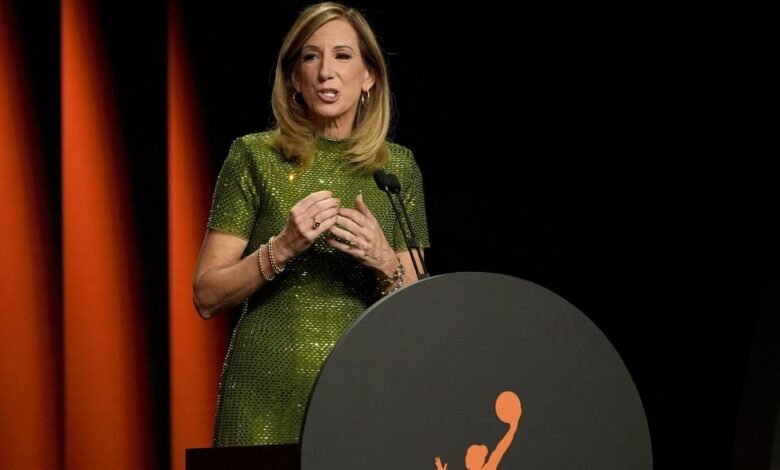
Cathy Engelbert will retire as WNBA commissioner at the end of the calendar year, the league announced Friday.
Her retirement will be effective as of Dec. 31, the league said. The process to find Engelbert’s replacement will start later this month if not sooner, multiple
“Over the years, it has been amazing to watch WNBA players thrive and lead the massive cultural surge around women’s sports,” Engelbert said in a statement. “I retire knowing we have built something bigger, stronger and more enduring than we could have imagined. I am grateful to the WNBA and NBA team owners and staff, players, investors, fans and the powerhouse league office staff, who believed in what this league could become.
I retire with immense gratitude and tremendous optimism
“I retire with immense gratitude and tremendous optimism for the future of the WNBA, with the best yet to come.”
Multiple high-ranking teamwould likely be Engelbert’s last. While Engelbert, 61, has ushered the WNBA into what she has called “hypergrowth” mode, transforming the league into a significantly more prominent sports and entertainment property, her leadership had come into question over the past year
Prominently, Minnesota Lynx star Napheesa Collier said in an explosive end-of-season interview last year that Engelbert was “negligent” in her governance and that the WNBA had the “worst leadership in the world.”
Shortly after Collier’s remarks — which received widespread
Shortly after Collier’s remarks — which received widespread support from players — Engelbert vowed to address any concerns and do better, buter has still struggled to develop sufficient relationship equity, not just among players but also with owners and upper-level management
There was increasing discontent in league circles, according tong to emerging crises, such as continued officiating problems as well as vitriolic behavior and harassment directed toward players. Engelbert’s style and approach have been cited as problematic, while others believe that accessibility and communication between the league and teams have been hurdles
In an interview with The Associated Press, Engelbert insisted that the decision to leave was solely her own and that she did not feel any pressure to step down from NBA or WNBA stakeholders.
When I first came to the league I
“When I first came to the league I intended to do this for 3½ years,” she said. “The 7½ years exceeded that time. This is a really good time given the financial transformation journey we’ve been on. Getting the collective bargaining agreement done, getting a long-term media rights deal done, getting expansion done.”
She said she has been working on a succession plan over the past few years. While she didn’t give any specifics on who might be considered for the position, Engelbert did say there are both internal and external potential candidates on the league’s radar.
Addressing league issues, Engelbert said the online attacks of players are unacceptable and that she backs league initiatives to protect players. She also said there should be no confusion on the transgender question and that there are “no current eligibility issues in the WNBA.”
Tabbed the WNBA’s first commissioner in May 2019
Tabbed the WNBA’s first commissioner in May 2019 — the previous leaders served as presidents — Engelbert has overseen a dramatic transformation of the WNBA’s business model. The league’s media rights deals are worth $3.1 billion, the season will increase to a record 50 games, and 18 markets will have teams by 2030 after nearly two decades at 12 franchises. In 2019, the average value of a WNBA franchise was $10 million; in 2026, it is about $460 million.
Engelbert also led a $75 million capital raise in 2022, what was the largest-ever investment round in women’s sports; the move, which involved selling a 16% stake in the WNBA, has been lauded by some for infusing the league with cash and helping further its business transformation, while others have critiqued it for further complicating the league’s already messy ownership structure. She also introduced a full-time charter program in 2024, a first for women’s professional team sports in the U.S., to replace the league’s typical commercial travel footprint.
She also helped navigate two collective bargaining agreements, the first in January 2020 and the second this March. The newest CBA, secured after a tense negotiation between the WNBA and players’ union, features the league’s first $1 million salaries and the first comprehensive revenue-sharing model in women’s professional sports.
While there was a strained partnership between
While there was a strained partnership between the commissioner and players during the CBA negotiations, Engelbert insists she has a good relationship with them.
In a letter to the WNBA players that was obtained by ESPN, Engelbert thanked them for “helping to lead this league through a remarkable period of transformation.”
“I am grateful for your advocacy and your willingness to challenge us to be bold, listen more closely, and think differently,” she wrote. “Those conversations were not always easy, but they were essential. You made this league stronger, and you made me a better leader.”
New York Liberty forward Breanna Stewart, vice president
New York Liberty forward Breanna Stewart, vice president of the WNBA players’ union executive committee, said Friday that she was happy for Engelbert.
“What she’s done for the league is incredible,” Stewart said. “Obviously, the CBA negotiation was a tough one, but the way that both sides continue to have a huge win is really important. So really happy for her and hope that she continues to remember that and reflect on that.”
Engelbert was also credited with ensuring the league held the 2020 season amid the COVID-19 pandemic. The season was played in a bubble environment in Bradenton, Florida, and Engelbert has since called that an “existential” moment for the league.
WNBPA president and Los Angeles Sparks forward Nneka
WNBPA president and Los Angeles Sparks forward Nneka Ogwumike, in a statement released by the union, praised Engelbert for guiding the WNBA through extraordinary changes during her tenure.
“Leading through this much change is no small undertaking, and I have great respect for the commitment Cathy brought to the role,” Ogwumike said. “We appreciate all she has given to the WNBA and the stronger foundation she leaves for the league and the players.”
The next commissioner will be the sixth leader of the WNBA, which is in its 30th season. Barring a change in leadership structure, the commissioner would continue to report to NBA commissioner Adam Silver.
“Cathy has presided over the WNBA through the most significant period of growth in the league’s 30-year history,” Silver said in a statement. “We are grateful for Cathy’s leadership and unwavering commitment to the advancement of women’s basketball.”
Source: www.espn.com