Shine Bright: One New York Museum Exhibit Is Exploring Queer Identity Through Blingy, Beautiful Baubles

Walk through most museum jewelry collections, and you’re largely looking at fashion history through a female lens. “Jewelry is donated by women, for the most part, so what we see in museums is the taste of women,” says Barbara Paris Gifford, senior curator of jewelry at New York’s Museum of Arts and Design. “Which is great, because that’s rarely the case!”
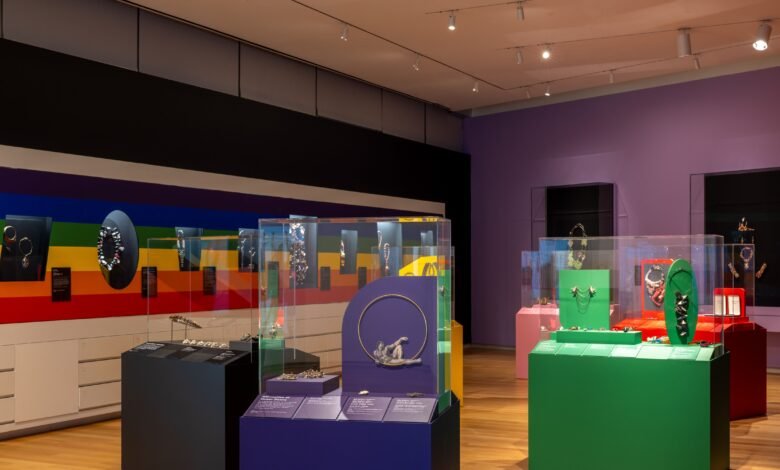
But with OUT of the Jewelry Box, on view through October 4, Gifford spotlighted queer perspectives that define boundary-pushing adornment.
Through 78 pieces, the exhibition uses jewelry as an intimate vehicle for storytelling, as physical and metaphorical extensions of the human body and queer identity. “The exhibit is important because it takes a close, focused look at queer voices through the medium of jewelry,” Gifford says. At the heart of the exhibition are the voices and donations of Ron Porter and Joe Price, prolific collectors whose love affair with art jewelry began, fatefully, on a 1986 trip to MAD, then known as the American Craft Museum.
Inspired by the unconventional materials and craftsmanship of studio jewelry, the couple fell in love with art jewelry as collectible material culture. Decades later, they gifted a significant group of works to the institution. Gifford worked with them to select 56 pieces that honor their taste and voice, but their perspective is only one part of the story. “They represent a certain experience within the gay male community—but that’s not the only kind of queer experience,” Gifford says, noting that she coupled their collection with 22 pieces from the museum’s preexisting collection and beyond to paint a broader portrait of queer adornment.
The jewelry stretches from Art Smith’s sinuous brass
The jewelry stretches from Art Smith’s sinuous brass neckpieces of the 1950s to works made in 2023, grouped around themes including Affirmation of Queer Desire, Contemporary Events and Issues, Imaginary Worlds, and Wondrous Forms, alongside focused sections devoted to artists Bob Ebendorf and Keith Lewis. Among works by emerging jewelers and allies, the assortment features pivotal avant-garde names with a lasting influence on jewelry history who were closeted at the time.
David Webb’s 18-karat gold, ruby and diamond-adorned Monkey Brooch (1972), for example, showcases the humor and exuberance that made Webb a favorite amongst Elizabeth Taylor and Diana Vreeland. “Webb was their close friend but never publicly came out,” Gifford recalls. “So we wanted to honor his legacy in the context of celebrating queerness today.”
Gold, silver, diamonds, and pearls appear alongside avant-garde materials including seashells, sand, paper, toy railroad tracks, vodka bottle shards, dominoes, and animal remains.
Robert Ebendorf’s 2010 Untitled Daguerreotype Brooch combines a daguerreotype with copper, plastic, and a crab claw, while his Birthday Necklace incorporates repurposed jewelry and toy railroad tracks. Anna Johnson’s 2015 Betulina Brooch, meanwhile, combines an egret skull with rainbow moonstones, raw diamonds, mica, shelf mushrooms, and silver. “But we didn’t feature that many gems,” Gifford notes, “because they were almost a distraction from the story we wanted to tell.”
That idea of jewelry as a vessel for reinterpretation and connection between different wearers also runs throughout the exhibit.
Felieke Van Der Leest designed her fantastical 2005
Felieke Van Der Leest designed her fantastical 2005 Rainbow Moose (sculpture with necklace), a plastic moose embellished with glass beads, gold, and silver, as a vision of the pot of gold at the end of the rainbow. But Porter and Price saw the moose as a different member of the horse family, with the rainbow signifying pride. “Objects collect meaning,” Gifford says. “A maker can make things for particular reasons, but when someone else sees it, they see something different in it, so it continues to collect meaning and relevance.”
One of the most poignant pieces is Keith Lewis’s 1993 Dead Souls Neckpiece.
A pivotal, chemist-trained contemporary jeweler who came out amid the AIDS crisis, Lewis became involved with ACT UP as friends around him began dying, turning to jewelry to commemorate those losses. In Dead Souls, birdlike heads begin large and become progressively smaller around the necklace, ending beside a clasp representing the AIDS virus. The scale traces the epidemic as Lewis’s community suffered and dwindled.
Near the end of his life, he wanted to see Lewis, but Lewis never made it to him. In the piece, a figure representing Lewis holds his friend’s skeleton, commemorating Johnson’s life while grappling with the guilt of not seeing him before he died. At a time when LGBTQ+ rights are increasingly threatened, Gifford sees jewelry as a means for representing their voices. “The more we are able to represent their voices and see their vision, the more allies are created,” she says.
“At the end of the day, this exhibit is an exhibit of empathy. It’s about telling stories about and representing all kinds of people through jewelry.”
Source: www.vogue.com