

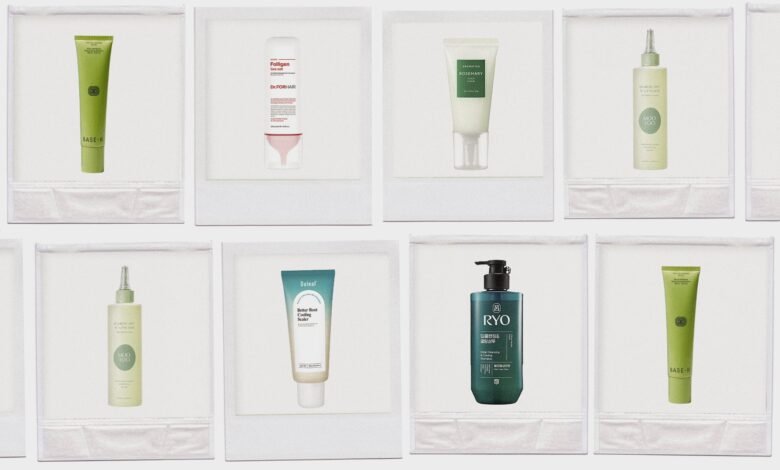
If you’ve ever been to a Korean head spa, you know it’s less of a hair wash and more of an entire reset. Before anyone touches a shampoo bottle, there’s usually a close-up look at your scalp on a magnifying camera, followed by a treatment that loosens all the oil, dead skin, and product reside that a regular wash leaves behind. It’s the step that makes your hair feel impossibly light afterward, and it’s called scaling.
Best Overall: Dr.FORHAIR Folligen Sea Salt Scaler, $26
Best for Acid Exfoliant: MOO100 AHA BHA Scalp Scaler with Salicylic Acid & Panthenol, $28
Best Two-In-One: RYO Deep Cleansing Shampoo with Korean Ginseng & Caffeine, $19
Best for Hair Quality: Aromatica Rosemary Scalp Scrub, $19
Best for an Oily Scalp: Daleaf Korean Scalp Scaler, $24
Best for Color-Treated Hair: BASE-K The Rice Powder Detox Korean Scalp Scrub Shampoo, $48
You don’t need a spa appointment to get the same effect, though. Scalp scalers bring that deep clean home, whether that’s an acid-based treatment you leave on before shampooing or a salt scrub that lathers up in the shower. They’re especially useful if you lean on dry shampoo, work out often, or have fine hair that goes flat a day after washing.
Below, experts explain what a scalp scaler actually does, who should use one and how to keep from overdoing it, plus the formulas worth trying.
The name actually comes from the dentist’s office. “In Korean, ‘scaling’ is the same word we use for dental cleaning,” says Dr. Ellie Byun, a doctor of Korean medicine and licensed acupuncturist. “Plaque builds up on your teeth even when you brush, and in the same way, oil and dead skin build up on your scalp even when you shampoo.” For many Korean women, it’s a routine they’ve had for years. “I’ve been using scalp scalers since high school,” says Kristin Lim is the founder of Base-K.
What sets a scaler apart from a regular wash is time. “A clarifying shampoo only cleanses during the short time it’s on your scalp,” says Dr. Byun. “A scaler stays on for several minutes and chemically dissolves dead skin and oil with acids and enzymes, the same principle as an exfoliating toner for your face.” That said, plenty of Korean scalers, including several below, use salt granules instead of acids, or a mix of both. “A scalp scaler focuses on loosening dead skin and buildup, using acids, physical exfoliants or a combination of both,” says Lim. If you go the gritty route, keep it gentle. “A scrub physically buffs the surface with grains, and if you use it too often, it can make the scalp barrier sensitive,” says Dr. Byun.
“It’s especially good for oily scalps, flaking caused by buildup, fine hair that goes flat quickly, people who use a lot of dry shampoo and styling products, and anyone who sweats a lot,” says Byun. Flaking is where it gets tricky, though. “It can also help loosen surface flakes, but persistent flaking and itching deserve a closer look,” says Lim. “Dandruff and other scalp conditions may need targeted treatment rather than more exfoliation.”
The first thing most people notice is how light their hair feels afterward. “Removing that residue can leave the scalp feeling cleaner and the hair feeling lighter,” says Lim. With regular use, it can help with oil and flaking, too. “In a four-week study of a salicylic acid formula, researchers examined the scalp with a magnification camera and found that flaking, itching, redness, and oiliness all decreased,” says Dr. Byun. A calmer scalp may also mean better hair over time. “Studies show that when scalp health declines, hair quality declines too, and when the scalp recovers, hair quality recovers with it,” she says.
The biggest risk is doing too much. “Over-exfoliating weakens the scalp barrier and can cause irritation, dryness, and even a rebound increase in oil,” says Dr. Byun. It’s not the right fit for every scalp, either. “Individuals with sensitive or irritated scalps should approach exfoliating treatments cautiously,” says Joe Cho, team lead of media relations at Medicube. Even a mild label doesn’t change that. “Even a gentle formula may not suit a scalp that’s actively inflamed,” says Lim. If something feels off, don’t push through it. “If you notice sudden heavy shedding, pain, or lesions, see a professional,” says Dr. Byun.
“Some scalers go onto a dry or damp scalp before shampooing, while others are used on wet hair as part of the wash,” says Lim. Either way, the product needs to reach your scalp, not just your hair. “Part your hair in sections about an inch apart and apply it directly to the scalp along each part,” says Byun. “Then massage with your fingertips, never your nails, for two to three minutes, pressing slowly on the crown and the base of the skull.” Then rinse it out on time. “Leaving it on longer or scrubbing harder won’t improve the result,” says Lim.
Less is more with frequency, too. “I recommend once a week for oily scalps, and once every two weeks for normal or dry scalps,” says Byun. Your scalp will tell you when you’ve gone too far. “Signs you’re overdoing it include tightness, stinging, redness, or tenderness, more flaking instead of less, new itching, or a scalp that feels oilier than before,” she says. Lim also recommends sticking to one exfoliant at a time and avoiding combining several scalp exfoliants in the same wash.
Afterward, think of your scalp the way you’d think about your face after an exfoliating toner. “Korean care follows a simple idea: clear first, then nourish,” Dr. Byun says. “Use a mild, low-pH shampoo, then a lightweight scalp serum with niacinamide, panthenol, or centella, and apply conditioner only from the mid-lengths to the ends.”
Not directly. “While scalp health plays an important role in overall hair care, there’s currently limited clinical evidence that scalp exfoliation alone can directly stimulate hair growth or prevent shedding,” says Cho. Dr. Byun sees it as groundwork. “A scaler doesn’t grow hair on its own, but it does have a real, research-backed role,” she says. “So I see scaling as the first step in creating an environment where healthy hair can grow.” Lim is just as clear: “Promising that a scaler alone will regrow hair or stop shedding would be over-promising.”
Usually, scalp scales are safe for colored hair as long as you keep it where it belongs. “It’s generally fine on color-treated hair as long as you apply it to the scalp, not the hair itself,” says Byun.
Why We Love It: Dr. ForHair’s formula
Why We Love It: Dr. ForHair’s formula is the kind of scaler you’d find at a Korean head spa. It’s packed with 45 percent salt (a mix of Dead Sea salt and natural sea salt) that buffs away oil and flakes as you massage it in, followed by a blast of cooling peppermint. That balance is typical of the category. “Korean scalers combine ingredients that dissolve buildup with ingredients that cool and calm,” says Dr. Byun. “Clearing and soothing at the same time is very much the Korean way.” This product also includes caffeine and zinc pyrithione (the ingredient oft used to treat dandruff), and since it lathers like a shampoo, it can also replace your regular wash on scaling days.
Why We Love It: If you’d rather skip the grit, this one exfoliates with acids instead. Salicylic acid works its way into oil to loosen buildup around the follicles, while glycolic acid breaks down the dead skin sitting on the surface, so it’s a good pick if your scalp gets greasy fast. Panthenol, allantoin, and betaine keep it from feeling stripped, and a little menthol leaves a cool, clean tingle after you rinse. It lathers like a shampoo, so it’s easy to work into a regular wash day.
Why We Love It: Not everyone wants a separate scalp step, and this is an easy way to ease in. RYO’s formula is made for oily scalps, with tea tree and mint to cut through grease and a slightly acidic formula that cleans without leaving your scalp tight. It’s more of a deep-cleansing shampoo than a dedicated treatment, so it’s gentle enough to use more often. Korean ginseng and caffeine round out the formula, and the big bottle lasts a long time.
Why We Love It: Rosemary is everywhere
Why We Love It: Rosemary is everywhere in hair care right now, and this salt scrub uses plenty of it, at just over 10 percent rosemary leaf extract. It’s also made with caffeine, which Dr. Byun says can help the scalp in more ways than one. “In clinical studies, antioxidants like niacinamide, panthenol, and caffeine improved both the scalp barrier and hair quality,” she says. Plus, the formula is vegan and about 97 percent plant-based so it’s a more universal product that works well across hair types.
Why We Love It: Oily, itchy scalps often feel hot, too, and Korean medicine has a name for that. “In Korean medicine, we believe stress, lack of sleep, overwork, and rich food send heat up to the head,” says Dr. Byun. “When that heat settles in the scalp, it becomes oily, itchy, and congested.” This scaler is made to cool things down. Fine sea salt granules gently loosen buildup, and apple mint leaves the scalp feeling cold and clean for a while after you rinse.
Why We Love It: This scaling shampoo comes from Lim’s own brand, and it was built to cut a step from the routine. “Our Rice Powder Detox combines rice powder and glycolic acid with a lather technology that took us two years to perfect,” says Lim. “It exfoliates the scalp, clears buildup, and thoroughly cleanses the hair while rinsing clean, so you get both steps in a single wash.” It’s also sulfate-free, which she says is worth looking for if your lengths are lightened. “A sulfate-free option can be a good choice, especially for bleached or dryness-prone lengths, but check the product’s color-safety guidance too,” she says.
Source: www.vogue.com