My Favorite Airbnb: A Beautifully Restored Watchtower on a Secret Slice of Sicily

Everyone seems to be searching for the same thing right now: an Italian hidden gem untouched by the algorithm. It’s the summer of social feeds filled with striped parasols, nonnos playing cards, and sun-bleached port towns captioned with phrases like, “this is how Italy feels.” After all, what’s not to love about capturing this country’s particular brand of romance? Over the last few years, I’ve noticed travel editors, influencers, and online enthusiasts proudly showing off their Italian discoveries, proving themselves as connoisseurs of la dolce vita.
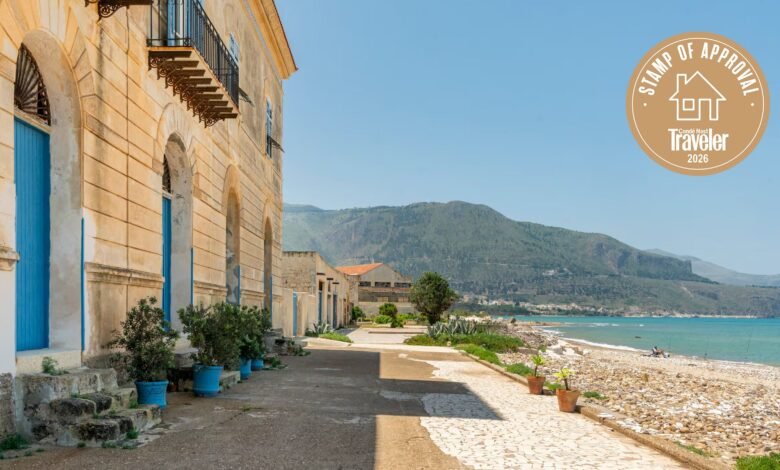
And, ragazzi—this summer, it’s my turn. Sitting on a seemingly forgotten beach along northwest Sicily’s Alcamo coastline is an early 20th-century tuna fishery. Crafted from golden stone, it rises proudly from the seafront, spanning three floors, characterized as a watch tower jutting upwards from the center and looking out to water. Though the building is clearly old (it was built in 1913), its shutters are a curiously contemporary shade of blue, sitting brightly next to the terra-cotta roof.
This flash of color feels like a playful wink—there’s something just a little Wes Anderson about it. This area has been known for tuna fishing for thousands of years, with fisherman dwellings surviving along this stretch of coastline from the 1600s. From the late 1800s, a prominent Sicilian family controlled the tuna industry here with multiple factories and fisheries, thriving until the 1960s.
This building, Tonnara Foderà di Magazzinazzi, acted
This building, Tonnara Foderà di Magazzinazzi, acted as their headquarters—an impressive Art Nouveau villa with storage facilities, space for the family to reside, and offices, as well as a working watchtower for keeping track of active fishing boats. Today, an impressive six generations later, this stunning building remains in the family. There was a chance it would fall into disrepair, but with careful renovation and redecoration, it’s found new life as a guesthouse and soon-to-be wedding venue, too.
I flew into Palermo airport and rented a car, which is a must when staying at this secluded spot. It’s an an easy 35-minute drive, where you pull into a beachside parking lot. Everything is quiet here—no houses are nearby, just a remote stretch of sand. Walk towards the palazzina, and you’ll be accompanied by none other but the sound of gentle waves hitting the sand. I found my way through a small, lush garden with twirling seating and tables.
There’s no obvious reception or lobby because this isn’t a hotel. The owners—husband and wife team Leonardo and Rosa Maria—stress this fact from the jump. Don’t expect daily housekeeping, breakfast, or a reception. But do expect an authentic experience: one with historic features, artful decoration, and unique quirks you simply won’t find anywhere else. The building is split into four apartments, all of which you can book separately or group together, which I did).
One spans two spacious bedrooms, while another has
One spans two spacious bedrooms, while another has its own kitchenette, and the largest includes a living room. The owners want guests to think of it as a “private residence” and enthusiastically welcome you to share the common spaces including a dining room, lounge, and kitchen. Once you wrap your head around the arrangement that this isn’t a totally private house, it’s easy to settle in and make yourself at home.
I first booked Tonnara Foderà di Magazzinazzi (the most spacious option) based on the pictures, and the details were as stunning as I’d hoped. The lofty ground floor with soaring ceilings and flagstone flooring quickly gives way to the aforementioned shared spaces on the floor above, which is the heart of the property. There’s an adorable, pink-hued kitchen with mauve-colored wall tiles and vintage dressers, piled high with silverware, old milk jugs, and rustic, wooden cutting boards.
Countertops are decorated with jars of fresh fruit and crates of freshly-picked runner beans. Terra-cotta flooring leads you to the living room where French doors open up directly to the water. The decor has been carefully curated with a nostalgic romanticism, pairing well-worn velvet sofas and collected artifacts. There’s a miniature sailboat mounted on a wall, a marble plinth bearing a pile of seashells.
It’s all oh-so whimsical
It’s all oh-so whimsical. My first few nights were spent in the watchtower, where climbing to the top floor was a precarious business with a mix of suitcases, weekender bags, and totes, but it’s absolutely worth it. Up there, the wind is your neighbor, whistling through the walls and frail window panes. While you might not choose this soundtrack for your everyday life, it’s atmospheric in this setting—especially as the waves vividly lap just steps away, too.
A vaulted ceiling is punctuated by a red Murano glass light, while artful swirls of blue paint highlight the building’s quirks, swiping over a door frame or outlining an alcove. I loved the Art Deco headboard which, as you’ll find all over this guesthouse, puts contemporary shapes and colors next to century-old features. There’s a small kitchenette and landing with a dining table, nice for a morning coffee or simply the feeling of having a little more space.
The kitchen itself, though, feels fairly unused—one tap wasn’t working, the cutlery was slightly rusty, and the whole setup had a ramshackle quality. For me, it wasn’t a huge issue, but it’s worth noting if you plan to cook. My other warning would be that while the watchtower is remarkable in many ways, the bathroom is located on the floor below (and it’s the most outdated of the four rooms).
Small and slightly dark, without a proper window,
Small and slightly dark, without a proper window, it feels oddly detached from the room itself. Reaching it means climbing down the tower steps and padding past other guests’s doors late at night. After two nights, I switched things up and moved to one of the first floor mini-apartments. While the watchtower has its own special magic, I did prefer this room for ease. Two huge bedrooms lead into each other with massive, throw-open windows and high, light-filled ceilings.
Even though I didn’t need both bedrooms—both included day beds, chairs, writing desks, and wardrobes—it was nice to have my own apartment. I adored the vintage look of the checkerboard flooring and quaint details, like framed old-fashioned film posters and mint-green bedside tables. What’s more? The bathroom is lovely with deep red marble tiling, a large tub, and views over the beach.
The space is gardenside, so you won’t fall asleep to the sound of the sea, but I didn’t mind. I felt an instant calm wash over me and immediately adapted to this being my new home, like my own little Sicilian apartment. As the owners say, this isn’t a hotel. You’re on your own for breakfast and things to do, meaning you’ll need to familiarize yourself with what’s around locally.
Luckily, there’s plenty
Luckily, there’s plenty. Less than a 10-minute drive away is Castellammare del Golfo, full of eateries, stores, and bars. Down by the marina, restaurants sit along the seafront so you can enjoy an Aperol Spritz and watch the boats bob. I’d recommend walking the central street, Corso Giuseppe Garibaldi, where you’ll find cafés (perfect for an arancini), small boutiques, and more bars.
You can easily spend all day here pottering around—and come dusk, pink light fills the streets and fairy lights glow above you. One of my non-negotiable recommendations is Tonnara di Scopello, another historic tuna fishery turned into a tiny museum and protected cove. (Buy a ticket online for less than 20 euros.) And while the museum is sweet, with tours in English several times a day, people also love coming here for entry to the cove itself.
Picture paradise and you’re close enough: aqua water sloshes and froths around an idyllically craggy coastline with deck chairs lined up around the water’s edge. Your ticket entitles you to a seat, where you can spend the whole day dipping in and out of the water and fetching Campari Spritz and polpo salad from the cafe. My experience was heavenly; in early May the site was well under capacity and I bought my ticket the day before, but Instagram is making this place a tourist hotspot, so book as early in advance as you can.
Another day trip option is the hilltop town
Another day trip option is the hilltop town of Erice, where there’s a medieval fortress that’s over 2,500 years old. It was a hairy journey driving up a winding mountainside, 2,464-feet above sea level. But trust that the views are worth it. There’s parking at the top (or, you can get a cable car) and plenty to see with ancient churches, cobblestone streets, gelato spots, restaurants, and a famous pastry shop.
One of my favorite moments was seeing Castello di Venere (which means the Castle of Venus), built in the 12th century. It literally clings to the cliffside and looks like a scene out of Games of Thrones. There are bed-and-breakfasts up there, but I don’t think you need to stay the night—three to five hours should be enough time to wander around and get lunch. But, please, learn from my mistake and bring a jacket—the wind up there had me cowering behind walls and shopfronts.
Add to all this that Palermo’s vibrant city center is only half an hour away and you soon realize that, although this lonely building sits almost forgotten on the seafront—part of a bygone era when tuna tycoons ruled the roost—there’s plenty to see and do nearby. The irony, of course, is that when you’re here, you don’t really want to: Grab a takeaway pizza from the family-run pizzeria next door, sit on the sand, and watch the sky turn purple.
(That’s what I did, anyway.)
This article was originally published on Condé Nast Traveller UK.
Source: www.cntraveler.com