
For something so fundamental, sleep has become surprisingly complicated. We track it, optimize it, travel in search of it—fueling a fast-growing sleep tourism industry built on blackout blinds, circadian lighting, and AI-calibrated mattresses. And yet, for all this innovation, the most effective reset often lies in something far simpler: stepping outside, and more specifically, sleeping under canvas.
I’ve felt it myself, in ways no hotel room, however luxurious, has ever quite managed to replicate. From bedding down to the lullabies of the bush in fly camps across wild corners of Africa, to a WiFi-free ranch in Wyoming with a what-dreams-are-made-of glamping meadow: the steady rush of a snow-melt creek just beyond my tent, a constant thread of white noise that softened everything around it.
After days spent entirely outdoors, moving my body, with almost zero screen time—whether on safari or in the saddle, moving through vast landscapes, syncing to the sunset and the stars—the effect was the same. I slept more deeply, woke more easily, and felt, for once, properly rested. Sleep science has long pointed to the same conclusion. Our circadian rhythms—the internal clocks that dictate when we feel awake or tired—are governed primarily by light, yet modern life has pulled us almost entirely indoors.
As Dr. Rebecca Robbins, Sleep Scientist at Brigham
As Dr. Rebecca Robbins, Sleep Scientist at Brigham and Women’s Hospital and Assistant Professor at Harvard Medical School, explains, “our fundamental ability to know when we should fall asleep or wake up is tied to the pattern of the sun,” yet most of us now spend over 90% of our time inside. When that same group is exposed to outdoor conditions—even briefly—light exposure increases dramatically, and the body recalibrates: melatonin begins to rise earlier, shifting sleep timing closer to its natural state.
“When comparing individuals in their typical modern environments under electrical lighting compared to a typical day camping, researchers found that melatonin secreted approximately two hours earlier in the camping environment when participants were more in-tune with the natural light-dark cycles as compared to their typical electrical lighting environments,” continues Dr. Robbins.
This references Dr. Kenneth Wright’s landmark research at the University of Colorado, which demonstrated that even a short period camping—without artificial light—can reset the circadian clock, bringing it back into alignment with the natural day-night cycle. More recent studies suggest that the shift can happen in as little as a weekend, nudging sleep patterns earlier and improving overall rest.
What distinguishes sleeping under canvas from simply being
But what distinguishes sleeping under canvas from simply being outdoors is the quality of that exposure. A tent creates a threshold rather than a barrier—filtering the environment without fully shutting it out. “There’s a thinner boundary between you and the natural world when sleeping under canvas,” says Florence Williams, author of The Nature Fix: Why Nature Makes Us Happier, Healthier, and More Creative.
That permeability matters. Without artificial light, the body responds to darkness as it’s meant to, triggering melatonin release earlier; without enclosed, recycled air, breathing becomes deeper and less disrupted; without the constant stimuli of modern life, the nervous system settles. Crucially, these environments also remove many of the modern disruptors that delay sleep—no signal, no late-night scrolling, no ambient glow from devices— removing the habitual delays that push sleep later into the night.
“People typically go to bed about an hour earlier when they’re camping,” claims Williams, “and that’s important because we tend to get our deepest sleep and our best rest in the early parts of the night.”
There is also something less easily quantified but no less important: the psychological shift that comes from being immersed in nature, day and night. Williams points to the role of “awe dosing”—those small, expansive moments of looking up at a star-filled sky or watching light fade across a landscape—which have been shown to lower stress hormones such as cortisol and promote a more relaxed state.
When we experience awe, we feel more connected
“When we experience awe, we feel more connected and a greater sense of belonging, in the knowledge that there’s a world that exists outside our own,” observes Williams. “All of this shifts our mood into a happier place, which makes for more restful sleep.”
The cumulative effect is difficult to replicate indoors. After a day spent outside—moving, breathing fresh air, adjusting to natural light—the transition to sleep feels more instinctive.
Surveys of campers consistently report improved sleep quality, often attributed to the sounds of nature and the absence of artificial disturbance. In a world where one in three adults in the US report insufficient sleep, according to the CDC, that kind of reset feels less like a novelty and more like a necessity. Which is where luxury tented stays come in—not the damp, uncomfortable tents many of us might associate with childhood camping trips, but an evolution of what it means to unwind in the wild.
From high-altitude Andean retreats and desert encampments in India to mobile riding safaris in Spain, these thoughtfully designed, already-pitched-for-you stays are remote places where the canvas becomes a conduit: blurring the boundary between indoors and out. If you like the sound of your sleep being shaped by the environment more than the mattress, read on for the canvas-cocooned retreats which might just boost your bedtime routine beyond check-out.
Paintrock Canyon Ranch, Wyoming At Paintrock Canyon Ranch
Paintrock Canyon Ranch, Wyoming
At Paintrock Canyon Ranch in northern Wyoming, sleeping under canvas takes on a rhythm shaped by the working traditions of the American West—recalling a time when cowboys moved with the herd, getting shuteye on their saddle pads or simple canvas bedrolls between wrangling. Along the banks of Paintrock Creek in the jaw-dropping foothills of the Bighorn Mountains, the ranch’s safari-style tented camp is arranged across a sweep of grassland, within earshot of the fast-moving water that runs through the valley.
This is the headquarters of Ranchlands, a conservation-led, family-run operation built on the belief that working landscapes—through regenerative grazing and careful livestock management—can actively support biodiversity rather than deplete it, and that guests should be folded into that system rather than kept separate from it. Daylight hours are dedicated to riding and hiking through 80,000 acres of sandstone canyons and high-country ridgelines, moving cattle and fishing the creek, before returning to camp as the temperature drops and the light softens to feast beside the fire.
The tents themselves are simple but deeply comfortable, with proper beds, heavy blankets and lantern light, their openings framing the sky sequined with stars and the surrounding peaks. What lingers most, though, is the sound: the constant flow of the creek, combined with a dawn chorus of birdsong as your natural alarm clock. Wilderness Mara, Kenya
There is, perhaps, no purer expression of sleeping under canvas than the East African safari, where the very concept of the tented stay was born out of necessity.
Long before luxury camps entered the frame, explorers
Long before luxury camps entered the frame, explorers and conservationists bedded down in the bush, lulled by the low hum of the wild: a distant rumble of thunder on the horizon, the roars of prowling lions, the soft rustle of grasslands shifting under grazing herds. At Wilderness Mara—formerly Little Governor’s Camp, one of the first permanent luxury tented camps in Africa—which opened in June 2026 after a complete overhaul in Kenya’s coveted Mara Triangle, that elemental connection has been distilled into something deeply restorative.
Set along a marsh teeming with birdlife, the camp comprises just 12 elevated canvas suites—each positioned for privacy, with indoor-outdoor showers and decks that draw the outside in, whether it’s the first light of dawn or the inky vastness of the night sky. What distinguishes Wilderness Mara is not simply its design, but its unfenced setting at the base of the Oloololo Escarpment and direct access to both sides of the Mara River.
This is a lesser-trodden pocket of the Masai Mara, where carefully managed tourism and strict anti-poaching protocols allow for slower, more respectful wildlife encounters, and the Great Migration still unfolds with visceral drama at nearby river crossings. Days are spent watching wildebeest mass at the banks, or walking the suspension bridge into Musiara’s lion-dense plains before returning to camp as elephants and warthogs grunt through the marsh at dusk.
That constant movement and fresh air, followed
That constant movement and fresh air, followed by evenings without artificial noise or light, resets your internal clock—so when you’re back under canvas, sleep comes quickly and holds. Andean, Peru
Unlike East Africa, where tented camps evolved from practicality, Peru has no deep-seated canvas tradition, making Andean’s approach feel more like a contemporary reworking of expedition travel.
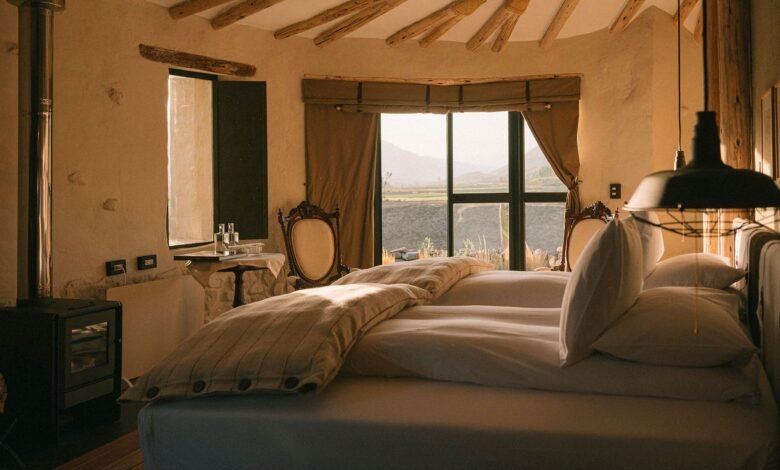
These light-touch, design-led camps were inspired by the original canvas tents of pioneering Andean explorers, placing you directly in rugged landscapes where exposure to altitude, light, and silence does as much for rest as any spa. Across the country, each of their six properties is built around complete immersion, from Puqio in the Colca Valley to Tinajani in the high-altitude altiplano.
At Puqio, a small-scale tented camp set deep in the Colca Valley, the experience is structured around movement through a lived-in landscape. Days start early, often tracing pre-Inca terraces still in use, or heading out toward Cruz del Cóndor where thermal winds lift condors across the canyon. Back at camp, the setup is intentionally pared back but precise: just a handful of canvas tents and adobe rooms positioned across the valley, each with wood-burning stoves, outdoor bathtubs, and terraces oriented to the surrounding volcano-strewn grasslands.
Cradled within a private canyon formed
Cradled within a private canyon formed by the erosion of an ancient lake, Tinajani operates as a self-contained hamlet: a restored farmhouse at its center that once sheltered shepherds tending their flocks, with a series of raised tented campamentos on stilts spaced across the Andes’ Valley of Giants. Each is deliberately minimal but self-sufficient—sleeping and lounge tents all powered by solar energy.
Suján, India
In India’s wilder tracts, Suján’s hand-stitched canvas camps draw on a different heritage—one rooted in royal hunting camps and caravanserais, now translated into conservation-led, low-impact stays that prioritize immersion as much as comfort. Across Rajasthan, their three tented properties—Sher Bagh in Ranthambhore, Jawai in the Aravalli wilderness, and The Serai in the Thar Desert—each interpret sleeping under canvas in response to distinctly different terrain.
At Sher Bagh, the original camp, white canvas tents are pitched beneath a canopy of trees planted over decades of rewilding, overlooking the tiger-rich forests of Ranthambhore. Days are structured around twice-daily game drives tracking tigers, leopards and sloth bears, before retreating to tents that open directly onto the jungle—canvas walls, open-air showers and verandas blurring any real separation from the wild.
Enveloped by billion-year-old granite outcrops, Jawai sits within
Enveloped by billion-year-old granite outcrops, Jawai sits within a rare coexistence zone where leopards roam between temples and Rabari herders’ settlements. The tented suites are deliberately open—canvas walls, wide decks, and minimal visual barriers—so you remain attuned to the ancient Aravalli Range, scrubland, and seasonally shifting riverbeds at all times. Deep in the golden dunes of the Thar Desert, The Serai’s tented forms look to Rajputana’s historic caravan routes for inspiration.
Here, tents are dotted across a 100-acre private estate, each with shaded verandas, canvas walls and, in many cases, private plunge pools lit softly by candlelight. George Scott Riding Safaris, Andalusia
Long before tented stays became destinations in themselves, they were designed to move—pitched, packed down, and carried onwards. George Scott Riding Safaris returns to that original rhythm, building an experience where the camp moves with you—and where sleep becomes part of the journey, not separate from it.
In Andalucía’s Sierra Morena—one of Spain’s last truly underexplored regions—you ride in the company of expert caballeros, following old cattle-driving routes and bridleways carefully mapped out by George Scott himself. These are paths he grew up riding as a child, exploring the hills around his family finca, Trasierra, long before they were formally traced again. In recent years, he has made great efforts to restore many of these routes, some untouched for decades, with the permission of local landowners.
The result is access to a landscape
The result is access to a landscape that feels genuinely off-grid—no roads, no foot traffic, just hours in the saddle passing through cork forests, wildflower meadows, and undergrowth that hides wild boar and the incredibly rare Iberian lynx. Where you sleep shifts along the route, from George’s own family home to old cortijos, and tented camps pitched along the trail. The Rajasthani camp, inspired by the richly layered tents of northern India’s royal encampments, is a fully realized setup reached only on horseback, where canvas interiors are kitted out with proper beds, oil lamps, carpets and draped textiles, and private bathrooms with hot-water bucket showers.
Hot drinks orders are taken before bedtime and delivered to your tent at sunrise. On other nights, the mobile camp pushes further into the hills—bell tents assembled in remote clearings that open up parts of the Sierra Morena that remain otherwise inaccessible. Lighter in structure but no less considered, they offer the same essential comforts under canvas, including power banks and hot water bottles tucked into your sheets.
Source: www.vogue.com