

Why Reading Egyptian Hieroglyphics Is Easier Than You Think | Open Culture
Why Reading Egyptian Hieroglyphics Is Easier Than You Think
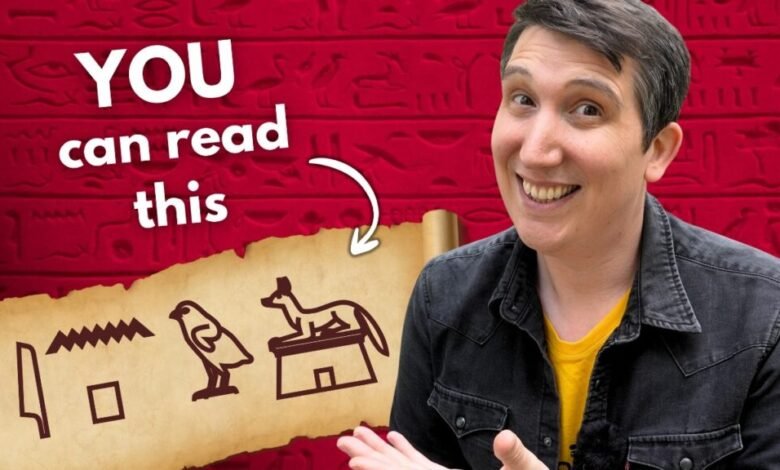
We’ve featured Egyptologist Ilona Regulski here on Open Culture a few times before.Once, she explained how to read ancient Egyptian hieroglyphs; another time, she told us what the Rosetta Stone actually says. It was, perhaps, inevitable that she would cross paths with Rob Watts, creator of the YouTube channel RobWords, whose videos we often post. When he made the journey to Berlin’s Neues Museum, and specifically to its Egyptian Museum, Regulski was the expert he sought out to tell him — and us — all about how hieroglyphs, literally “sacred carvings,” actually make words.
Faced with a stone chiseled full of hieroglyphs, where do we start? Ancient Egyptian texts are all read from top to bottom, but some go left to right, and others right to left. To know which way, Regulski says, we must first look for symbols with a clear front and back, such as those in human or animal shapes.
Some names are written in blocks, themselves read
Some names are written in blocks, themselves read from top to bottom — unless they contain a sign referring to a god, which, of course, gets customarily elevated to the top. But even if we understand the exact order in which we should read a given string of hieroglyphs, the question remains: how do we actually do that reading?
Though many hieroglyphs do appear to be figurative, with their recognizable forms of birds, bugs, arms, legs, and such, only sometimes are they meant to represent what they look like. Regulski explains that some of these signs are letters, and can be pronounced in much the same way as our own alphabet.What looks like a mouth sounds like an r; a highly abstracted bread loaf, t; a horned viper, ph; an owl, m.There is, of course, more to it. Signs can be combined not just to indicate sound, but also to disambiguate meaning. As you may have noticed, hieroglyphic writing is also what Watts calls a “vowel-free zone.” Exactly which of those sounds go where is, like certain other unresolved aspects of hieroglyphs, a matter of ongoing expert inquiry. But Egyptologists, as seeing Regulski in action reminds us, are a dedicated bunch.
How to Read Ancient Egyptian Hieroglyphs: A British Museum Curator Explains
How to Carve Hieroglyphs Just Like the Ancient Egyptians Did
You Could Soon Be Able to Text with 2,000 Ancient Egyptian Hieroglyphs
An Animated Introduction to the Rosetta Stone,
An Animated Introduction to the Rosetta Stone, and How It Unlocked Our Understanding of Egyptian Hieroglyphs
What the Rosetta Stone Actually Says
What Ancient Egyptian Sounded Like & How We Know It
Based in Seoul, Colin Marshall writes and broadcasts on cities, language, and culture. He’s the author of the newsletter Books on Cities as well as the books 한국 요약 금지 (No Summarizing Korea) and Korean Newtro. Follow him on the social network formerly known as Twitter at @colinmarshall.
Source: www.openculture.com