
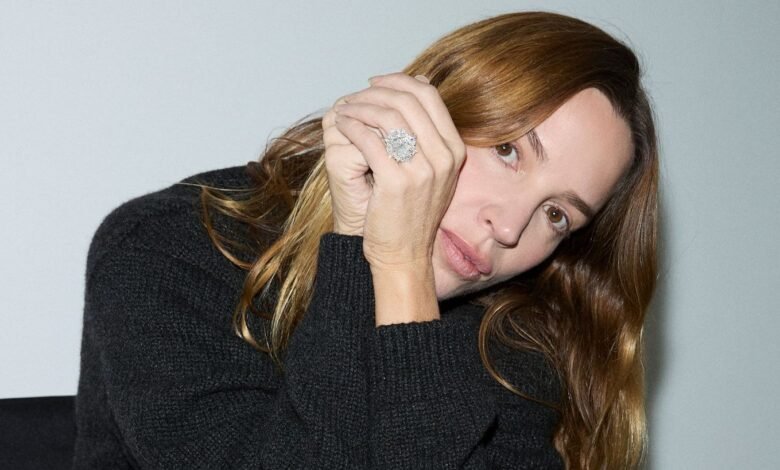
Dorsey CEO Meg Strachan’s best marker of success for her six-year-old lab-grown diamond brand is recognition. “That’s all we’re trying to achieve as a company: that when someone sees a beautiful piece of jewelry, the idea that they would say ‘is that Dorsey?’”
Since launching her brand at the end of 2019, Strachan has carved out a design niche for pared-back, sparkling lab-grown diamond pieces that are simple yet identifiably Dorsey, from the best-selling Rivière necklace to the brand’s classic Georgian-era-inspired latchback hoop Lucien earrings.
Brand fans have spotted the pieces on everyone from colleagues to Hailey Bieber and Taylor Swift, and Dorsey is now an eight-figure business, according to the company. Strachan has achieved this growth by filling a gap she saw coming for fine jewelry priced below incumbent legacy brands, thanks to innovations in lab-grown diamonds. Dorsey uses solid gold (as well as sterling silver), meaning its pieces are not classified as demi-fine, but a Dorsey diamond tennis necklace will set you back up to $20,000, rather than upwards of $30,000 to $40,000 for a natural diamond version.
Most pieces range from $345 for a pair of moissanite huggie earrings to $5,598 for a diamond, yellow gold tennis necklace. Many products are available across different price tiers based on stone and material (gold or sterling silver). Dorsey’s best-selling Rivière necklace in 3mm sapphire in sterling silver costs about $645; moissanite (also in sterling silver) is $949; and diamond (in 14-karat white gold) is $9,064.
The lab-grown market has evolved dramatically since Dorsey’s
The lab-grown market has evolved dramatically since Dorsey’s early days. The lab-grown industry has grown from being worth under $1 billion in 2015 to about $40 billion by 2025, per diamond industry analyst Paul Zimnisky’s estimate. In 2025, 61% of 10,000 US couples surveyed opted for lab-grown engagement rings, a 239% increase since 2020, according to a 2026 study by bridal platform The Knot.
And by 2030, lab-grown diamonds are expected to account for half of all diamond jewelry unit sales it was natural diamond companies like Brilliant Earth and De Beers (under Lightbox Jewelry) that launched lab-grown offerings. Lab-grown-only brands such as Grown Brilliance (launched 2021) and Clean Origin (2017) soon followed suit, at a similar time to Dorsey
For these brands, lab-grown is in the name, and their styles are more akin to traditional natural diamond brands. Dorsey was founded lab-grown, always marks its products as lab-grown, but has never marketed around the concept, Strachan says. On the flip side, the diamond industry has gone to lengths to minimize the perceived cachet of lab-grown gems. In 2025, for instance, the National Diamond Council ran a series of controversial ads labeling natural diamonds as “the OG”, and lab-grown gems as “the dupe”.
Asprey chair John Rigas told Vogue Business
Asprey chair John Rigas told Vogue Business that lab-grown diamonds, “which have flooded the market”, have altered the perception of perfection and “made natural uniqueness more precious”. This has benefited lab-grown, Strachan argues, because of the exposure it has generated for the lower-priced gems. But she still rejects the notion that ‘lab-grown’ can make or break a brand, hence why she doesn’t tap into this marketing angle.
“My hope is that when someone is buying from Dorsey or discovers Dorsey, that their third or fourth thought is, ‘Oh, it’s lab-grown’ — not their first thought,” Strachan says. “I feel pretty strongly that it’s the company with brand integrity, design integrity, who’s forward-thinking and who can meet the market and the consumer currently where she is today that is going to do really well.”
Careful build
Dorsey’s method to growth is slow and steady — a departure from the strategy deployed by most direct-to-consumer (DTC) brands of the 2010s era that Strachan worked for before launching her company.
“I was a pretty big part of the DTC heyday, when there was a ton of venture capital entering businesses pre-launch and a lot of enthusiasm around how to build a company to sell it,” Strachan says. “I was the person who was tasked with how to grow a company once you have a tremendous amount of VC funding. And I saw, first and foremost, that you cannot build a reputable brand with staying power in four years and sell it.”
Instead, Strachan looks to brands that have been around since before the social media era; the ones with staying power.
In the jewelry industry, it’s often a matter
In the jewelry industry, it’s often a matter of 100-plus years: brands that have built slowly over many decades, without any sort of financial ‘exit’ in mind. That doesn’t mean Strachan is shunning VC. After bootstrapping Dorsey’s first few years, Strachan raised a small seed round in 2022, followed by a series A in 2024. But fundraising isn’t something she’s keen to speak about.
“What you fundraise has absolutely nothing to do with the health of your business or the trajectory of your company,” Strachan says. “It’s certainly helpful fuel, and for the right companies, that’s great, but it comes with a lot of downsides too.”
It wasn’t until after Dorsey’s first funding round in 2021 that Strachan quit her full-time contractor position at activewear label Girlfriend Collective.
It was also then that Dorsey hit $1 million in sales. Dorsey has been profitable every year it has been in business, and the founder has been intent on maintaining that. Since then, Dorsey’s funding has been used to fuel the brand’s careful growth by investing in the development of new stones and styles. Strachan likes to control Dorsey’s narrative and believes her ability to editorialize the brand has driven growth.
The jewelry industry has traditionally leaned
“The jewelry industry has traditionally leaned on the size of the stone and the type of metal that it’s set in, but I don’t think that that’s how people generally ingest things that they love,” Strachan says. “When I see an editorial image, and there’s an earring, or there’s a sweater or something I love, the reason why is the context that it’s put in. It’s the way that the hair is draping over the drop earring, the way that the turtleneck is folding.
It creates a lifestyle.”
She’s been able to steer the vision so carefully thanks to her commitment to direct-to-consumer. While the founder and CEO is hesitant to say never, she’s not planning to dip her toes into wholesale anytime soon. Instead, Dorsey’s next point of sale will be physical retail. Though the timeline is still in the works, Dorsey’s high percentage of New York-based customers makes the city the strongest market to introduce Dorsey IRL, she says.
This context creation (or world-building, as many founders call it these days), Strachan believes, is key to growing a successful consumer business in 2026. “You grow a business because you have the right product and the right context and you’re meeting the consumer where she is,” she says. Brands in the DTC boom, she argues, didn’t do this; it was growth at all costs, resulting in a sea of similar aesthetics.
Now out the other side of this era,
Now out the other side of this era, the brands that lead with an editorial lens will be best positioned to grow, Strachan says. “Creative drives revenue and revenue decisions should inform creative,” she says. It’s this blend, she says, that underpins her approach to building Dorsey as “a new heritage company”. Branching out
Dorsey may have started with diamonds, but now, the brand sells lab-grown sapphire, moissanite, and colored gemstones as well.
Each sits at a different price point, and was a way for Strachan to broaden out Dorsey’s consumer base. The most recent introduction is the moissanite, which debuted in September 2025, and is proving popular among customers keen to level up from sapphire, who aren’t yet in a position to make a diamond purchase. “Within the lab diamond space, we’re really excited that we have collectors coming to us now,” Strachan says.
“And then we also have someone who’s purchasing a pair of moissanite and sterling silver earrings, who is maybe just starting to buy their own jewelry.”
That Dorsey works in lab-grown makes this growth possible. “The beauty of the lab-grown industry and what’s really exciting about it when it comes to building a business is that you can do anything lab-grown,” Strachan says.
We can do any cut, any color,
“We can do any cut, any color, and that’s what our focus is at this point going forward. We have expanded the collection and our stone offerings tremendously.”
This week, Dorsey is launching its fall collection, made up of earth-toned diamonds. (Which were, for a time, deemed ‘impossible’ to create in a lab. This is a misconception; colored lab-grown diamonds are produced by introducing the same trace elements and minerals that turn natural diamonds a certain color.) “It’s always interesting to hear, ‘Oh, I didn’t know you could do that’,” Strachan says.
It’s not just the colors and stone types Dorsey is expanding on. Strachan is getting more creative with the designs, too. At launch, Dorsey sold its simple Rivière necklace, a classic tennis necklace with a distinctive box clasp. Five-plus years in, Dorsey is in what the founder regards as the “best” factories — the ones that weren’t accessible at founding — which makes this innovation level-up possible, she says.
Now, Dorsey is expanding its offering of cuts and stones, Strachan says: the goal is to develop what she calls “true heritage design” that will be passed down through families, just as her grandmother, Dorsey (the brand’s namesake) did for her. To date, this has meant more drops of more styles. Now, Dorsey releases about 20 collections a year. The product isn’t seasonal like fashion, but Strachan leans into seasonality with pops of color, leather and cord in summer, and more classic white and yellow gold in cooler months.
This summer introduced colorful enamel and moissanite necklaces
This summer introduced colorful enamel and moissanite necklaces and anklets, as well as floating emeralds and ‘golden’ diamond necklaces. “It’s a great time to get out of our own zone — that’s what keeps us a current company.”
Now, as the weather cools, she’s getting back into what she calls Dorsey’s ‘archival pieces’: vintage-inspired wears made fresh with modern silhouettes — and materials.
Today’s launch offers a glimpse of what’s to come: $7,750 3-inch drop diamond earrings in a bezel-and-prong setting; or a pair of $7,990 2.5-inch earrings, suspended from a huggie in an eight-prong setting. Warm-toned, square huggie diamond earrings are available in a range of sizes, and a selection of seven different shapes of solitaire rings add to Dorsey’s small but growing collection of engagement-friendly rings, as lab-grown proposals continue to surge.
“My view on the next five to 10 years is that we’ll be able to redefine a category,” Strachan says. “That’s the plan: to reinvent a new way to build a heritage company.” She pauses. “Which, by the way, is probably doing it the old way — it’s not the way that we all thought we could in 2017 to 2023.”
More from this author:
Which Summer Breakout Stars Will Be Front Row This Fashion Month?
Why Diptyque Is Making a Bigger Bet on Bodycare
In Luxury’s New Resale Era, Everyone’s a Fashion Expert
Source: www.vogue.com