
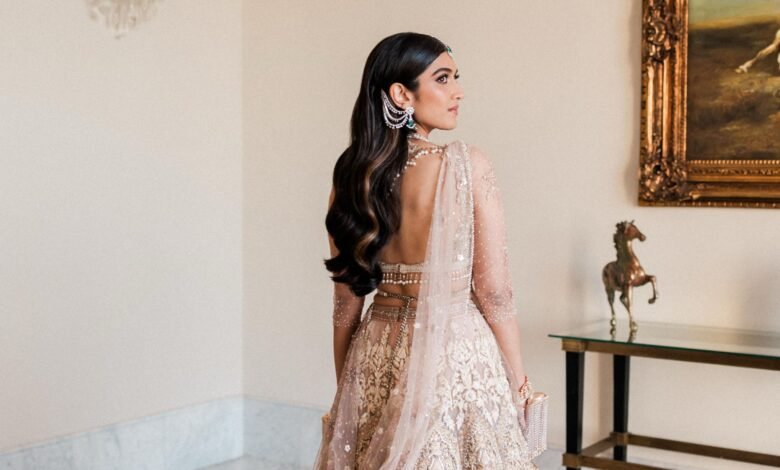
The $130 billion Indian wedding market is one of luxury’s biggest opportunities. It’s estimated that Indians spend almost twice as much on weddings as they do on education, with eight to 10 million weddings taking place each year, according to a 2024 Jeffries report. So it makes sense, then, that luxury brands are always on the lookout for ways to capture the attention — and spend — of the Indian wedding.
Bvlgari, for example, created a mangalsutra, the traditional Indian wedding necklace, reimagined through the Italian jeweler’s codes. Elie Saab uses platforms like Vogue India’s Wedding Atelier to speak directly to the luxury wedding customer. And Mac Cosmetics’s newly released Indian bridal campaign, Forever in Mac, centers on the family portrait, featuring model and heiress Tania Shroff as the bride, alongside supermodel Ujjwala Raut as her mother, all styled by creative director Nicola Formichetti.
But if international luxury brands really want to understand where the money goes at an ultra-high-net-worth Indian wedding, the real gatekeepers are the wedding stylists. These are the stylists and personal shoppers advising India’s wealthiest families on what to wear for their big days, including which brands to discover, be it local or beyond. Calling the shots
Among the first to branch into this niche-but-lucrative business was Nisha Kundnani, who founded her boutique bridal styling company, Bridelan, in 2015 after nearly a decade in fashion journalism and editorial and celebrity styling.
What many people observe about Bridelan
“What many people observe about Bridelan is that it was a pioneering concept, way ahead of its time,” says Kundani. “It was around the time digital blogs were fading out and Instagram was taking over. The concept of bridal styling was completely novel in India. It was my editorial background that convinced me real people would come to styling as a serious professional service, and I also saw the rise of destination weddings.”
Kundnani’s company styles both grooms and brides, offers on-site services during the wedding itself, and can even extend to advising guests.
In busy seasons, she brings on extra consultants as needed, with the peak wedding period typically running October through February, dictated by auspicious dates on the Hindu calendar. Many of today’s wedding stylists come from editorial backgrounds, including Anaita Shroff Adajania, now a staple of India’s fashion scene. “Even during my magazine years, we were constantly doing big wedding and bridal shoots.
Indian couture was essentially weddingwear, so every season was an opportunity to create a new world around it. We would think about how to photograph it, how to style it, how to make it feel fresh, and ultimately, how to make a bride feel excited about what was possible for her own day,” Shroff Adajania explains. “I think that naturally became part of my language as a stylist.
People I had worked with started noticing
People I had worked with started noticing that and began asking me to style their weddings.”
Following more than a decade at Vogue India, and designing costumes for the Indian film industry, Shroff Adajania styled Isha Ambani for the much-publicized wedding of her brother Anant Ambani, executive director of the family conglomerate Reliance Industries. “Working with Isha Ambani for her brother’s wedding was truly magical,” says Shroff Adajania.
“We had the freedom to look at wedding dressing through a completely fresh lens, taking familiar codes and giving them a new language. We worked with Schiaparelli on a sculpted custom couture sari, a Chanel couture gown paired with Indian jewelry, and with Miss Sohee, we took the familiar silhouette of a lehenga and transformed it through extraordinary embroidery and drape.”
Ami Patel is another in-demand wedding stylist, having worked in fashion magazines for years before becoming a celebrity stylist and eventually transitioning to weddings.
A career highlight was working on actor Alia Bhatt’s intimate nuptials to actor Ranbir Kapoor, as well as Priyanka Chopra, another regular client, during her wedding to Nick Jonas. Patel believes the choice of wedding stylist today carries as much cachet as the wedding dress label itself. “A beautiful label can give you an extraordinary garment, but the stylist creates the complete point of view,” she says.
At this level, access is not necessarily
“At this level, access is not necessarily the challenge. What they are looking for is discernment: which piece, why this piece, how it should be customized, what it should be worn with, and how it fits into the larger story of the wedding.”
How international brands can get involved
Shroff Adajania notes that while Indian designers still dominate what’s worn for the wedding ceremony and other religious festivities, there’s plenty of opportunity for international houses to become part of an Indian bride’s wardrobe.
“I remember when we launched Vogue India, gowns were hardly ever part of an Indian wedding wardrobe,” she explains. “We had international advertisers who specialized in Western eveningwear, and we brought those pieces into our fashion stories. Today, whether it’s a reception, a sangeet, a sundowner or an afterparty, Western silhouettes have become completely natural to wedding dressing.”
To cut through, Patel believes international brands would benefit from working closely with stylists who understand better than anyone what Indian brides are actually looking for.
“I would be interested in a brand that came with flexibility rather than a fixed global template,” Patel adds. “Give me access to the atelier, the fabrics, the archival references and the people who can make decisions, and a willingness to adjust a neckline, a color, a silhouette, or create something that works with Indian jewelry.”
Both independent stylists, Aastha Sharma founded The Wedding Style Project with Mohit Rai six years ago, after meeting at Harper’s Bazaar India.
I think the biggest misconception is that Indian
“I think the biggest misconception is that Indian weddings are only about traditional clothing,” Sharma says. “They’re not. There is huge luxury spend across accessories, shoes, handbags, eveningwear, resortwear, pants, even the smaller details around the wedding.” Bridelan’s Kundnani notes that footwear is nearly alwaysy Choo and Christian Louboutin
But stylists feel international brands need to be more collaborative. “I would love for brands to come in as collaborators rather than simply looking at it as product placement or selling something off the rack,” says Sharma. “Customization is a huge part of Indian weddings; brands and families want exclusivity, and for that, the former should be willing to incorporate the [desired] colors, silhouettes, and styles.”
Kundani echoes this.
“The depth of customization offered by Indian designers is unmatched,” she says. “Indian designers truly offer a haute couture experience to brides, and at shorter timelines, like two to three months. International brands are not able to match the level of craftsmanship that Indian designers have to offer.” She believes international brands will need to offer the same level of customer service as an Indian label to really compete and make brides feel special.
When Christian Louboutin launched a dedicated bridal suite
When Christian Louboutin launched a dedicated bridal suite in 2014 at its Mumbai flagship, the brand engineered a feeling of exclusivity by debuting a new capsule in the location each year and allowing brides to visit in their outfits or take the shoes away to try on the full range at their own pace. Tanya Vohra Ahuja, a former fashion editor at GQ India, launched her boutique wedding agency, Clad, in 2020, with offices in Mumbai and Singapore.
She has deliberately kept away from high volume and stays personally involved in every wedding project the agency takes on, as clients expect. “Wedding shopping here is incredibly personal and high touch,” she says. “A bride may be dressing for four, five or six different events, and for each one, she wants something distinct. There are families involved, cultural considerations, specific timelines, and a huge expectation around customization.
It isn’t enough for an international brand to bring its existing eveningwear collection and expect the Indian bride to spend simply because she has the budget.”
Ahuja suggests brands should work more closely with India’s stylists by providing them access to their design teams, archives and making custom orders a more seamless experience. “I would love for brands to work more closely with the stylists who understand these clients, give us greater access and explore custom or made-to-order opportunities specifically for weddings,” she adds.
A newer arrival on the wedding styling scene
A newer arrival on the wedding styling scene is New York-based Nolan Meader. Despite making a name for himself working with clients across the US, Meader is now breaking into Indian wedding styling with two brides so far and enquiries from several others. “Access to, and longstanding relationships with, houses across the world is imperative, and certainly a draw for clients,” Meader says, adding that Western stylists taking on Indian weddings need a genuine understanding of local designers, too.
Alongside attending Sabyasachi’s landmark 25th-anniversary show in Mumbai in January and Raw Mango’s London Fashion Week debut earlier this year, Meader also makes a point of attending Indian designer shows at Paris Couture Week, while pulling from a wide repertoire of local design when working with the country’s brides. An example of an international label he feels translates well for Indian bridal is Richard Quinn, with whom Meader collaborated on a bespoke piece.
“[Quinn’s] use of embroidery and understanding of color make his work easily translatable. He created a gown with embroidery tied into the colors of her traditional looks,” he explains. As India’s wedding stylists increasingly become the bridal industry’s gatekeepers, brands local and international need to collaborate closely with these figures to stay in the game.
Source: www.vogue.com