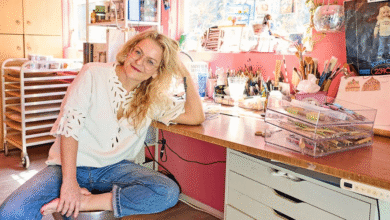

Faded, paint-spattered Carhartt jackets are a staple of the vintage resale market, but for Gretchen Valade, the great-great-granddaughter of founder Hamilton Carhartt, they represent something more important. That’s why Valade founded Wylie Welling, a brand dedicated to sourcing, repairing, and reselling chore coats, dungarees, and other select vintage Carhartt pieces. Launched earlier this spring and named for Hamilton Carhartt’s son, Wylie Welling Carhartt, the brand has released eight capsule collections so far and announced plans to open a retail location in Detroit later this year.
Valade’s themed drops are both a celebration of Carhartt’s heritage and a means of extending the life of its famously durable products even further. While Collection 7 consisted solely of late-’90s vintage deadstock painter pants cut from Carhartt’s signature woven drill fabric, the most recent drop, Collection 8, is organized around a late-summer-coded palette of earthy browns, purples, tans, and blues.
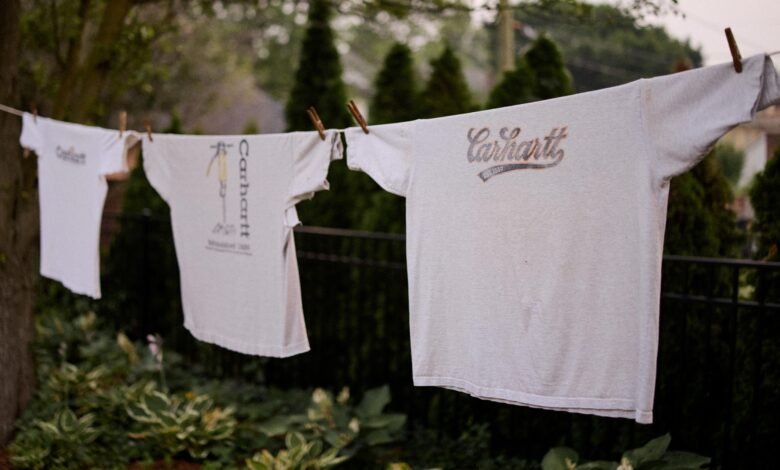
Consisting of 36 pieces, mostly from the ’90s and ’00s and ranging from bomber jackets to flannels to jorts, it’s among the best selections of vintage Carhartt to be found online, and certainly the most lovingly curated. Collection 9, which focuses on graphic tees from the 1990s and 2000s, drops on Thursday. We got a hold of Valade to ask her about her concept, how vintage workwear is like art, and the benefits of growing up Carhartt.
GQ: What can you tell me about your
GQ: What can you tell me about your most recent drops? Gretchen Valade: Wylie Welling’s Collection 8 is a drop inspired by color. Mauves, and violets that are paired with some really beautifully faded denims and tans. Purple isn’t what most people immediately picture when they think of Carhartt, and a lot of these shades come from this short, experimental period in the ’90s when Carhartt’s color story got a bit unexpected.
Because they were produced in smaller runs, these colors are increasingly difficult to find. As the collection started to come together, it felt like it was a perfect palette for these last few late-summer nights. Wylie Welling’s Collection 7 was a fun one. Typically we restore or repair archival and worn vintage pieces, but every once in a while we’ll come across really special, never-worn deadstock.
That’s what 7 was. Sixteen pairs of off-white single-knee drill painter’s pants that were discontinued in 2004. Wesorting through the full inventory and selecting pieces that best represented the era, fabric, and condition we were looking for. Like all our collections, we want the clothes to continue being worn, so each pair was laundered and pre-shrunk to give us accurate measurements for its next wearer
Collection 7 was also our first that wasn’t
Collection 7 was also our first that wasn’t one-of-one. How do you source these pieces? Do you have a team out there trolling eBay and sifting through Goodwill bins? We have an in-house sourcing team who work with a network of dealers and independent sellers we’ve built relationships with over time. Vintage is such a relationship-driven business. A lot of the people we work with have their own networks of pickers and sources, and we’re often seeing things before they ever make it to a flea market, thrift store, or online.
On any given day, someone might text us photos of what they’ve just found, and we get to cherry-pick the pieces that feel right for us. That’s a really fun part of it; you never quite know what is going to turn up. What makes a piece right for a Wylie Welling collection? There are a few things I look for. Age is certainly one, but I’m also looking at color, fabrication, rarity, and character.
I think about fading and wear almost as artistic elements. These garments were made to be incredibly durable, so seeing how they’ve changed through years of actual use is part of what makes them so beautiful. I also like finding unexpected chapters of Carhartt’s history. Collection 8 is an example of that. By focusing on purple and mauve pieces from the ’90s and early 2000s, including a plum color called damson that’s become quite hard to find, we get to show people a side of Carhartt they may not immediately associate with the brand.
Are there any particularly rare pieces you’re always
Are there any particularly rare pieces you’re always on the hunt for? The Wylie Welling team is all vintage-obsessed, so generally the older and rarer something is, the more excited we get. Anything from the 1980s or earlier immediately gets our attention. I always love finding pieces from Carhartt’s 100th anniversary in 1989 with the special anniversary patch. Then there are the oddities and short-lived styles that collectors get excited about—things like vintage shorts in unusual variations, or the ’90s-era Western and Southwestern jackets with interesting lining and details.
Those are the pieces where you realize just how deep the Carhartt archive goes. The wear on some of these pieces is so remarkable, and sometimes so specific. Do you ever find out the stories behind these garments? It’s difficult to know the real story of the work that was done and life that was lived in garments before we meet them; however, you can sometimes read the way someone worked in a jacket or a pair of pants through its wear patterns.
One thing we’re working toward is documenting what we do know about each piece we select. It’s history through style, color, hardware, but also through the repairs made before or by us. How do you decide what to clean and repair, and what to leave as-is? At the very least, we want to ensure the garment has the structural integrity to survive continued regular wear. So, if we find a piece with a broken zipper, we’re replacing that hardware; if we find a pair of pants with a hole in the pocket lining, we’re patching that up.
If the holes are in more inconspicuous places
If the holes are in more inconspicuous places and add to the character of the piece, we will leave it as-is. All of the garments we sell are laundered as part of our review process, so some stains will fade or disappear at that time. Otherwise, we’re often leaving the garments as-is because we don’t believe in covering up the story they help tell. I love pre-thrashed workwear, but I also sometimes feel like it’s a kind of stolen valor.
What are your thoughts on that dichotomy? That is a super relevant question. I think there’s an important distinction between artificially creating the appearance of a life lived in a garment and appreciating the evidence of the life that an actual vintage garment has already had. Our focus is on seeking out the beauty in wear, and restoring when necessary, so that each garment can continue for another life.
The way that we think about each piece and the history it holds is out of respect for not only the durability of the garment, but the life it lived with the person before, which for Carhartt, was likely a hard-working person who used this product as functional gear. There is so much nostalgia attached to Carhartt. Customers tell us about a jacket their dad or grandfather wore or a style that was popular in their youth.
Other people respond to these garments almost
Other people respond to these garments almost as pieces of art. Either way, I think wearing vintage is less about borrowing someone else’s identity and more about appreciating the object’s unique personality and allowing an incredibly well-made garment to keep living. What was it like growing up around the family business? How do you think it shaped you? It can sometimes be hard to separate work and life in a family business—I’ve heard it called the “kitchen table boardroom” and that concept totally resonates with me.
I’m lucky that my family truly loves the business we are in and the people we work with. With a 135-plus-year-old company and being part of the fifth generation, there can be a lot of pressure. But that pressure, for me, drives innovation and a forward-thinking mindset. Although a role at the company isn’t completely a given for family members, I am grateful that I have felt secure in my professional life, and that feeling of security has allowed me to constantly question the way things are done and remain curious, which, in my opinion, is crucial for a brand to evolve and continue on for the next five generations to come.
Source: www.gq.com