
How Sophie McIntosh Wrote ‘Benevolent,’ One of the Most Bracing Plays of the Year

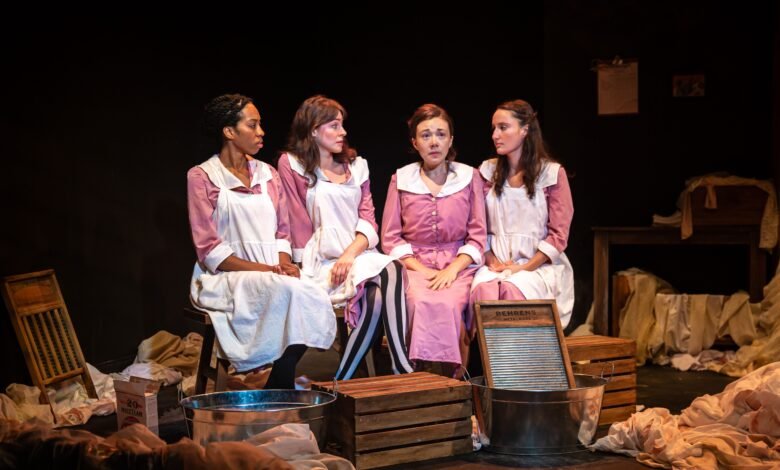
Benevolent, the latest work from playwright Sophie McIntosh (Macbitches), tells the story of four young women at Inwood’s Benevolent Home—a reformatory house for fallen and friendless girls—in 1917. Directed by McIntosh’s longtime collaborator Nina Goodheart, the play’s action unfolds in a basement laundry room, where the wards endlessly scrub at the most sickeningly soiled sheets on their washboards, with more laundry coming down the chute, located at center stage, at regular intervals.
The four residents have found themselves in the Benevolent Home for different reasons. There is the spoiled, 17-year-old Abby (Livvy Marcus), the youngest; the far more mature Emma (Mia Fowler), a Black sex worker at a “50-cent joint”; the brash Margaret (Chani Reese), whose whiteness has afforded her work at some of the more lucrative $10 brothels; and Sarah (Rachel Ravel), the most buoyant of the bunch, who has been panhandling on the Coney Island Boardwalk (or “Sodom by the Sea,” as Abby has heard her father refer to it).
Over the course of the play, we see the women confront challenging truths about themselves and each other, bridging the gaps in their ages and experience. McIntosh and Goodheart cofounded Good Apples Collective, a theater incubator that focuses on stories about hierarchy, complicity, power, and abuse from queer and gender-marginalized storytellers. “Even more than that, I think the most defining feature is the idea that you can make high-quality art without treating people badly,” McIntosh explains.
We are really just trying to make art
“We are really just trying to make art with people we love in a way that is mutually supportive and sustainable.”
A few days after Benevolent’s opening night, Vogue spoke to McIntosh about New York’s real reformatory homes, why she still believes in content warnings, and what it means for a play to be “political.”
Vogue: I wanted to begin asking you about when you started writing this play.
How did you learn about the New York reformatory homes? What was the development process like? Sophie McIntosh: I started writing this play in the fall of 2024. It was my thesis project at grad school. We did a round-table reading of the first draft of it and it was a very different play. To backtrack a little bit, I first heard about the institutions that were the basis for this play from a local historian named Cole Thompson who lives up in Inwood.
He works in real estate and also has a very strong passion for local history and he has blog articles on the Magdalen Benevolent Society, later renamed Inwood House, and the House of Mercy. They were similar institutions in Inwood starting in the late 1800s through the 1910s. I was really fascinated and it was so specific to this progressive era. Reform was the zeitgeist and everybody was trying to fix every single social ill through a scientific process.
They were categorizing these women using sociological data
They were categorizing these women using sociological data and surveys to be like, “Okay, this proves scientifically that you are a bad person,” even though the methodology that they were using wasn’t actually very effective at all. Most of the time the girls or women who were there would end up getting sent right back again because they would “relapse” and go back to the work that they were doing before, because they didn’t really have an interest in being reformed.
There was this idea that we’re gonna teach the women how to do laundry so they don’t have to be prostitutes. Most of them had their own reasons for going into sex work. So then you brought this draft to your thesis class? Yes, I brought it to a class I had with David Henry Hwang, who is a wonderful teacher and playwright. The first draft had twice as many characters and there was a very involved plotline around spiritualism and ghosts, which was a concurrent religious movement.
It emerged after the Civil War in part because so many women and so many people had lost loved ones in the Civil War. And so the original draft of this play had an abortion and a séance and they are two very different kinds of, for lack of a better word, spectacles. But I sort of wanted the play to live in the more grounded, human plane. And I wanted them to be doing manual labor for the whole play to reinforce the drudgery that is their lives.
From there, I was able to hone
From there, I was able to hone it down to four characters and the trajectory was very clear. We did a reading of it last spring at Theater Row and I learned a ton. I’d say the big change that came from there was that I did not specify race in the first draft. I knew that I didn’t want to have an all-white cast but I was scared to go there. But we decided that we were going to do it with Good Apples and cast our company member Mia Fowler in the role that became Emma.
I had this feeling watching it that by getting so specific about class and gender but not talking about race at all, we were undermining the play itself and cheapening the story. I was curious about this, because one of the characters hurls a racial slur at Emma in the first act. How did you go about adding the racialized element to the story? I’ve had some really great conversations with Mia about this.
When you don’t touch on race, especially in a period piece where it is so pronounced, and has such a strong impact on the dynamics, it just results in a flattening of everyone’s character and circumstances. I was working with Mia, working with our dramaturg, and with our associate director on making that dynamic part of the show, and part of the four-way relationship between the characters.
You know, I am a white girl—this company
You know, I am a white girl—this company is led by two white women. We wanted to make sure that at any point in rehearsal, nobody was the only person representing their identity. So we were very intentional about hiring a Black dramaturg and a Black stage manager so that we had a room of people who could have those conversations. And I am really grateful for Mia because she never let me off the hook, in a really useful way.
That can be a challenging thing when you are an actor, given the power dynamic. On your note about this being a period piece, how did you study or prepare to write in the language of the early 1900s? When I chose this as my thesis project, I wanted to challenge myself to do a period piece, which is not something I’d really done before. I had done something set in the ’60s, but there’s such a difference between a time period in which you can watch videos of people versus [when there was only the] phonograph.
They had just started inventing recording equipment [when Benevolent is set], so it was a challenge. One of the things that was most useful for me, actually, was I read a lot of court record transcripts of women who had been arrested for prostitution and larceny and all sorts of different things. I also read a lot of newspaper clippings and interviews from the time. And I had this book from the Columbia library about the history of Inwood House.
It’s a lot of propaganda about the institution
It’s a lot of propaganda about the institution and the point of view is so funny. I also loved going to the Tenement Museum and getting inspiration from there. When I started writing it I was living in Washington Heights and I would walk up and stand on the grounds of Inwood House and look out at the Hudson. It’s very woo-woo, but it was very helpful for me. This is a minor spoiler, but I was struck by the scene in which what I would probably call a medical abortion is performed onstage.
I’d never seen that before, and relatively little has changed in this realm in the last century. Do you see your work as political? You’d be surprised, but [Ruby Rae Spiegel’s] Dry Land is a play that exists out in the world and we are very much paying homage to it. The last point you made is really interesting. I think that as long as we in the American theater system are beholden to ticket buyers in order to create art and are stuck in that capitalistic system, I don’t think that any art can truly be political.
It always comes down to how many seats do we have and how do we pander to fill the seats and keep the show going and pay our actors and make sure that we don’t fold. With that said, I do think this play is more political than some, and that is something I was very aware of going in. I knew it wouldn’t be pleasant or easy and we are very careful to make sure that we have clear content warnings on the website.
I feel like there was a moment when
I feel like there was a moment when content warnings were normalized, and now their purpose and efficacy are debated. Why do you still feel that they are important or necessary? I feel like it’s important to give people the option to look for them if they want them. We went back and forth for many years. It was only last year when we kind of figured out our ideal content warning situation, which is a drop down menu on our website that you have to click on so you don’t get the content warnings if you don’t want them.
And we have two different tiers. We have a broad-strokes option and a detailed one. I think it’s always nice and useful in the case of a play with the specific content like this to make that available to people. But we try to let it be their choice about how much they engage with the content warnings and the spoilers, as it were. I was thinking a lot about a piece a mentor of mine, Naveen Kumar, wrote for the New York Times about how Broadway is afraid of making theatergoers uncomfortable.
While this isn’t Broadway, commercial appeal is still something most theater makers are thinking about. I wondered how much that is a consideration for you when putting on a play with such charged subject matter. I feel really lucky. We’ve just opened, but we’re already getting to have a life downtown and we are really fortunate with the press that we’ve gotten. We are starting to be like, what would it look like to continue to move this play elsewhere and continue running?
The math of that is definitely different than
And the math of that is definitely different than if [the play] had slightly different subject matter. This downtown indie theater scene is my bread and butter and is something that I love. But I would also love to have better health insurance and get my partner on my health insurance. I hope it gets to see more life—it felt surreal to see abortion dealt with so plainly onstage, especially right now.
It’s quite surreal. Nina pointed out to me, because she used to be an escort volunteer at the Manhattan Planned Parenthood, that now it is shuttered, and we walk past it every day on our way from the train to the theater. We also walk past the Sheen Center, which is owned by the Archdiocese and will not put on plays about abortion because of the Catholic Church. It’s a really interesting double whammy to consider the environment that we are making this play in.
I have a really distinct memory of having COVID when the Roe decision came out. I was trapped in my room, watching it happen on my phone screen while everybody I knew was out in the streets screaming about it. I think I am still trying to get my hollering out all these years later. This conversation has been edited and condensed. Benevolent runs at the IATI Theater in the East Village through September 5.
Source: www.vogue.com