

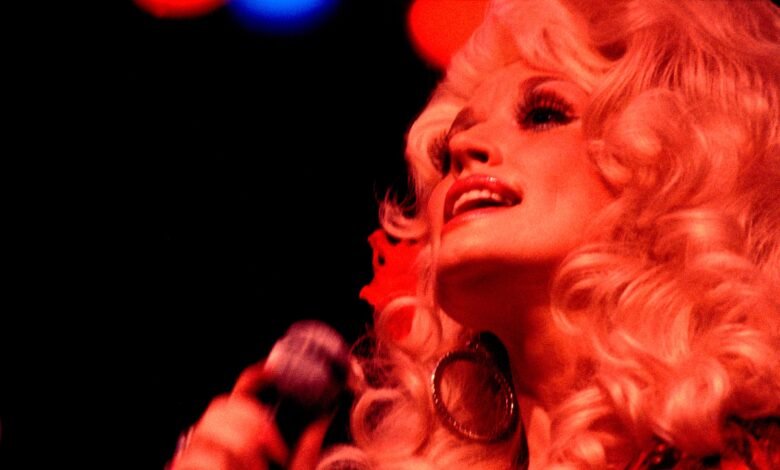
Dolly Parton seemed closer to God than just about anyone. (The hair helped.) One of the most beloved humans on the planet, Parton—who we all seemed to believe would be the first person to live forever, but passed away yesterday at 80—seemed to float through decades of pop culture on a cloud of good humor and joy, and the world already feels like a more bitter place without her.
She has joined the ranks of good-hearted, genius celebrities who seemed eternal—David Lynch comes to mind—whose passing has left us with the question: How are we supposed to keep the world going without them? There were countless reasons to love Dolly Parton: the songs, the low camp, the wise-cracking sense of humor, the down-home charm, the sheer vitality and kindness. And she returned that love in such abundance that her fame appears to have been literally universal, even transcendent: When news of her passing was publicized on August 25, both Donald Trump and Zohran Mamdani paid tribute.
Parton has influenced public health, literacy, children’s publishing, and tourism in the South. Just her breasts alone — and I know journalists shouldn’t write about an artists’ breasts, but I’m confident Parton would want them included in her tributes — influenced science and architecture. A sheep cloned from a mammary-gland cell was christened “Dolly” in honor of its namesake; the General W.
K. Wilson Jr. Bridge in Mobile, Alabama,
K. Wilson Jr. Bridge in Mobile, Alabama, is informally known as the “Dolly Parton Bridge” because of its distinctive arches; the Soviet/Russian T-72A tank’s distinctive frontal armor has been nicknamed “Dolly Parton” for reasons you can imagine. But far above all of that, Parton was a peerlessly rigorous songwriter. Raised in Locust Ridge, Tennessee, as one of 12 children in a poor family of Dutch-Irish heritage, she started playing guitar before she even learned how to hold a pencil.
She graduated school in 1964 and packed up for Nashville the very next day. From there, she embarked upon one of the most illustrious careers in country music history (and music at large), recording some 49 studio albums and she was credited with writing around 3,000 songs—several of which can easily be considered standards. Here are 10 of the best from that deathless catalog.
10. “Gonna Hurry (As Slow As I Can)” (1962; released 2009)
Co-written with her uncle Bill Owens—one of the first people she ever wrote with as a child—“Gonna Hurry (As Slow As I Can)” is a demo recorded in 1962 that finally saw the light of day in 2009 as part of a legacy box set. Parton was a genius of vocal variety, but here she plays it almost straight, sending an arrow straight to the heart with a kind of controlled weeping.
Well, I’m gonna cry / Cry myself
“Well, I’m gonna cry / Cry myself to death,” she sings with uncharacteristically simple dejection. The piano nudges her vocal line, trying to hurry Parton along, while she resists, stretching and slowing the syllables. It has the buoyancy of country music with the ache of a ’50s slow-dance doo-wop ballad. There is so much brightness here, and so much ache. No one has ever managed to make a lover stay by pleading, but Parton might have come close.
9. “Backwoods Barbie” (2008)
Almost as indelible as her “It takes a lot of money to look this cheap” mantra are the lyrics to her 2008 bluegrass track “Backwoods Barbie”—chief among them: “I might look artificial, but where it counts I’m real.” It’s an essential song for understanding Parton’s vision: the way she dresses like a six-year-old’s idea of a princess, rendered with a millionaire’s renius
Parton sings with the genial, conspiratorial ease she had perfected decades earlier. The song, like Parton herself, keeps seesawing between opposites that turn out to be the same thing: high and low class, authenticity and artifice, virtue and vulgarity. It’s one of the very best examples of a classic Parton subject: the glamorous woman carrying some old wound from childhood loneliness and poverty, and the adult fear of being misunderstood.
Even backwoods Barbies get their feelings hurt
Even backwoods Barbies get their feelings hurt. 8. “Silver Dagger” (1999)
Parton turns “Silver Dagger,” a traditional ballad that wandered across the Atlantic, into something vivid and literary, a story rendered with the clarity of television. A girl lies beside her sleeping mother while a man outside tries to woo her. She tells him to stop singing because he might wake her mother.
Her mother, she explains, has warned her about men: they are good-for-nothing liars. The man outside, brandishing a silver dagger, proves her point. Parton sings all this as though it were the most natural thing in the world. She can put a little smile into lines about violence; without making them cute, she makes them beautiful, bringing Celtic-influenced Appalachian music into the present and reinventing the traditional in real time.
7. “Daddy Come and Get Me” (1969)
Spend a day listening to Parton’s catalog in one sitting, and “Daddy Come and Get Me” is the song that will undoubtedly jump out. Written sometime between 1969 and 1970, it may be one of the few songs in popular music written from the point of view of a woman committed to an asylum by her cheating ex-husband, who has dismissed her heartbreak as hysteria.
Over organ-like pedal steel, Parton delivers the opening
Over organ-like pedal steel, Parton delivers the opening line with unnerving literalness: “In this mental institution, looking out through these iron bars…” Parton drew its subject from real life, co-writing the song with her aunt Dorothy Jo Hope, who supposedly experienced the events it describes. You expect, or at least hope, that a song like this will bring its anguish to some great, satisfying outburst, but Parton withholds it, staying locked in with the song, eerily calm.
Only at the end does her voice begin to break: “But Daddy I can’t come to you / You’ll have to come to me.”
6. “9 To 5” (1980)
One of Parton’s most unshakeable songs also happens to be one of the best working-class anthems ever recorded. It’s got a rousing beat that’ll make you want to clock out and unionize, and a chorus that disrupts the drudgery of the verses it describes.
The song’s most incriminating lyric — “It’s a rich man’s game no matter what they call it” — could easily have been written by the group of Boston secretaries who inspired the film of the same name. The song’s comedically upbeat composition recalls the fast meters of the East Tennessee folk Parton was raised on, transplanted here into ’80s corporate America, chintzy and fabulous.
Unlike the acoustic labor ballads of the mid-20th
Unlike the acoustic labor ballads of the mid-20th century, Parton disguises her class struggles with tongue-in-cheek play, the sound of a typewriter clack providing the track’s cartoon-like momentum, in tune with the measure: nine to five, nine to five, nine to five. By the song’s end, you feel as pumped up as beer hour at the office on a Friday, only for the clock to start ticking and the typewriter to start rattling again, and there you are, back in the grind.
5. “The Bridge” (1968)
It took a lot of money for Parton to look so cheap, and surely a lot of darkness to make her appear so bright. Plenty of Parton’s songs, especially in her earlier catalog, are populated by sick children, poverty-stricken mothers and abandoned lovers, but “The Bridge,” taken from her 1968 album Just Because I’m a Woman, is exceptionally bleak. Its harsh twists and turns — including one of the most artfully cruel endings I’ve ever heard in a song — far outbleak the Appalachian murder ballads of Parton’s childhood.
At first, Parton puts us on a bridge: “so high, so tall,” she says, deducting tenses. Then, by the next verse, we realize we’re in a memory: young lovers who had their first kiss above rolling waters; it became their favorite place. From the bridge, they saw a meadow and hooked up. The narrator got pregnant. Then we’re in the present day. She’s on the bridge, Parton upping and upping the scales and stakes, singing right on the cusp of a major and a minor note.
The boy who impregnated her has left
The boy who impregnated her has left her. We think she’s returned to her favorite place. But no: the waters are rushing, the bridge still “so high, so tall,” and Parton sings, with clear decision: “This is where it started / And this is where I’ll end it.” And then the song stops. Just like that. 4. “The Bargain Store” (1975)
One of Parton’s stranger songs, built on a seemingly simple premise: a woman compares herself to a secondhand shop and offers herself to a lover at a discount.
It smacks of the class consciousness we’re subtly used to with Parton. “The bargain store is open, come inside!” she sings, as backing voices that sound like shopgirls join her. From there, the conceit becomes increasingly complex, sophisticated and maudlin, full of sexual shame and ground-level self-esteem. It starts off a little jaunty, then, as so often with Parton’s ingenuity, develops into a darker palette.
The melody lacks her usual harmonic complexity, sounding, if you will, almost transactional: a confession delivered through the language of a sales pitch. It’s a remarkably sophisticated synthesis of class and gender, and Parton at her severe prime. 3. “Coat of Many Colors” (1971)
Parton is not only a brilliant storyteller, but also an exceptional publicist (at least for herself).
In Coat of Many Colors, she spins
In “Coat of Many Colors,” she spins her life into lore. Drawing on her own formative memories, Parton takes listeners back to the time her mother proudly stitched her a coat while telling her the Biblical story of Joseph’s many-colored coat. The song is warm and buoyant, but also sounds like a memory, with its sentimental guitar line. Parton’s words take the cadence of storytelling, each line ending on a note of giddy suspense.“I recall a box of rags that someone gave us / And how my momma put the rags to use,” she sings with sweet, hopeful girlishness.
In the song, her mother is a resourceful woman which is another term for a Southern hero. The song is seamless (don’t pardon the pun) in its stitching-together of the personal and the Biblical. Then it turns Disney-sad, as Parton wears the coat proudly to school, only for the kids to mock her. It is crystalline storytelling that impresses on every valve of the human heart. Her childhood memories patched together, like the titular coat—that now hangs in Parton’s Chasing Rainbows Museum in Dollywood.
2. “Jolene” (1973)
Not long into Parton’s marriage to Carl Dean, she realized her husband was making frequent trips to the bank, where he’d taken a liking to one of the women behind the counter. Parton told him to cut it out, and then she wrote this. Within half a note, I’d wager a majority of America would know exactly what’s to come: one of the all-time greatest songs to sing four beers in.
Every sound in Jolene remains unforgettable,
Every sound in “Jolene” remains unforgettable, from the taut, vaguely haunted fingerpicked riff to the drums that sound like they’re chucking themselves for wood to Parton’s mounting plea to the title character not to take her man. Though it belongs to a lineage of jealous “Other Woman” country songs, “Jolene” is emotionally complicated and elevated by a kind of trademark grace and maturity: Parton sees the best in someone, believes in her ability to empathize, even in the least empathetic of situations.
As she turns her worst nightmare into a fantasy object, she describes Jolene’s “beauty beyond compare” and “flaming locks of auburn hair.” Unbelievably, “Jolene” never climbed higher than No. 60 on the pop charts, but it remains a touchstone of Parton’s iconography. It has been covered to death—from Beyoncé to the White Stripes—and butchered in many a sticky karaoke room, but nothing compares to that voice and the mere 200 words Parton sings.
1. “I Will Always Love You” (1974)
Parton’s genius lies, in part, in possessing the entire deck and knowing precisely when to pull each card. Sometimes it’s the joker; most often, a heart. She knows how to play them all. But here, she knows exactly which one will break us open. She plays the final card in her hand. Every single note of “I Will Always Love You” cuts as close to the immediacy of heartbreak as music can get.
There is no distance between the emotion
There is no distance between the emotion and the song; you feel one as immediately as the other. She whips out every trick, but none of it feels like sleight of hand. Here is Parton’s love in its purest form. One of the best-known pieces of Parton trit the speed with which she wrote it belies the enormity of what she was saying
The song was for Porter Wagoner, the man she had dueted with for six years and who had helped launch her career. It is a parting, but also a thank you. I can’t put it better than Parton herself: it is “bittersweet.”
Where another person might turn away from the pain of the situation, Parton walks straight toward it, and somehow finds grace there. “I wish you lots of joy and happiness,” she says, in a rare moment of Sprechgesang, “and above all this, I wish you…” Even writing out the next word feels difficult.
Our own grief is still so fresh. For now there’s only this to say: We will always love you, Dolly Parton.
Source: www.gq.com




One Comment