

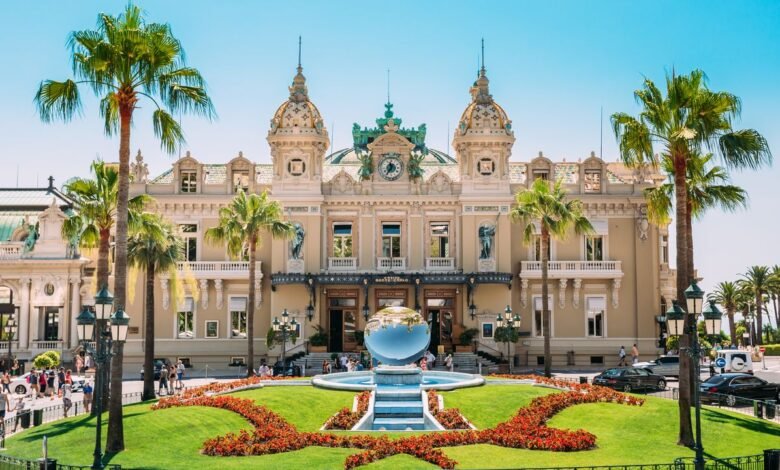
“Europe has one Eldorado—Monte Carlo! It is nothing but a rock, yet it is a realm where Illusion is queen. The skies and sea, there, are blue more often than elsewhere, and time suspends its flight, for roulette turns much faster than the hands of a watch.” So began a dispatch from Monte Carlo in the May 1936 issue of Vogue.
Monte Carlo has also proved irresistible as a backdrop for fashion. Helmut Newton returned to it repeatedly, including for two extraordinary Vogue shoots a decade apart, in 1979 and 1989. It is easy to understand the attraction. Few places come with such ready-made mise-en-scène: Belle Époque hotels, palace terraces, casino tables, convertibles, diamonds, bathing suits, yachts, and the startling blue of the Mediterranean, all compressed into a principality barely larger than Central Park.
Monte-Carlo poster by Roger Broders. c. 1930Photo: Getty Images
Monte Carlo poster by Michel Bouchaud. c. 1930Photo: Getty Images
Of course, glamour here has never necessarily meant restraint. Writing for Vogue, Alan Jolis once described Monte Carlo as “vulgar, both nouveau riche and old rich, classy and totally déclassé,” before conceding that somehow its “fairy-tale princesses and princes manage to outweigh the sleaze, the coarseness, the hype.” That contradiction remains part of its appeal. Monte Carlo can be flashy, even absurdly so, but it also possesses a depth of history that is easy to miss amid the supercars and superyachts.
Look beyond them, and you find the Monte Carlo that has fascinated Vogue for more than a century: Diaghilev and Puccini, the Grimaldis and Grace Kelly, Charles Garnier’s opera house and casino, grand hotels that have been receiving guests since the 19th century—and, increasingly, ambitious new additions reshaping the coastline. The illusion, in other words, is still very much intact. A guide to the municipality, below.
What to See
Photo: Getty Images
There would be no Monte Carlo as we know it without the Casino. In the mid-19th century, Monaco was in dire financial straits, having lost Menton and Roquebrune—and with them much of the agricultural land that had supported the principality. Prince Charles III, the great-great-grandfather of today’s Prince Albert II, turned to gambling to revive the economy.
In 1863, he brought in François Blanc, the casino impresario behind Germany’s Bad Homburg, and the transformation was swift: the Casino flourished, the Hôtel de Paris followed, and in 1866 the new district was christened Monte-Carlo—“Mount Charles”—in the prince’s honor.
The Casino grew into an extraordinary Belle Époque confection, glittering with Bohemian crystal chandeliers, stained glass, frescoes, and sculpture. Charles Garnier, architect of the Paris Opéra, designed its great 1879 expansion and the opera house attached to it. Even the roulette tables merit a closer look: their numbers are still handmade in Monaco from ebony, rosewood, and palisander. And unlike an American wheel, Monte Carlo’s European roulette has just 37 pockets—0 through 36, with no double zero. There is history in its quieter corners, too: Winston Churchill used to gamble discreetly in the Salon Anglais, slipping in and out through a hidden door that connected the room to the cabaret and the outside.
You don’t need to gamble to go inside: visit in the morning, before the gaming rooms open. And don’t miss the Place du Casino outside, the grand stage upon which the fantasy of Monte Carlo has played out for more than 150 years.
Photo: Getty Images
Attached to the Casino, just behind the famous square, is one of Europe’s most spectacular little opera houses. In 1878, Marie Blanc, widow of Casino impresario François Blanc, commissioned Charles Garnier—architect of the Paris Opéra—to build the Salle Garnier. (Her husband, incidentally, had helped finance the completion of Garnier’s Paris opera house three years earlier.) More than 2,000 workers completed the Monte Carlo theater in just over eight months.
Facing the Mediterranean, its façade is crowned by a copper cupola with steelwork designed by Gustave Eiffel; inside are crimson velvet, frescoes, five different shades of gold, and a five-ton bronze-and-Bohemian-crystal chandelier.
For such a small theater, its cultural footprint is extraordinary. Puccini’s La rondine premiered here in 1917; Ravel and Colette’s L’Enfant et les Sortilèges followed in 1925, with Serge Diaghilev’s Ballets Russes performing the dances and a young George Balanchine creating the choreography. The Ballets Russes became deeply entwined with Monte Carlo, a legacy carried on today by Les Ballets de Monte-Carlo. Check the calendar when you’re in town—the theater still regularly hosts opera, concerts, and performances.
Photo: Getty Images
Before there was Monte Carlo, there was Le Rocher—“the Rock,” the dramatic promontory rising above the Mediterranean, with the old town of Monaco-Ville perched on top. The Grimaldis first took it in 1297, when François Grimaldi is said to have disguised himself as a Franciscan monk to gain entry to the Genoese fortress before letting in his armed men. Look at Monaco’s coat of arms today and you’ll still see two sword-wielding monks flanking the shield.
Walk upLa Condamine toward the Palace. It’s steep but relatively short, with stairs and terrific views over Port Hercule and Monte Carlo along the way
Photo: Getty Images
The Prince’s Palace and Monaco-Ville
At the top of Le Rocher is the Prince’s Palace, still home to Prince Albert II and the Grimaldis, one of Europe’s oldest reigning dynasties. The private residence remains just that, but the State Apartments open seasonally, so it’s worth checking what’s on before you go. Temporary exhibitions often draw on the Grimaldi archives and collections, but the palace itself is worth seeing for its recently restored Renaissance frescoes.
Time your visit for 11:55 a.m., when the Changing of the Guard takes place outside, then wander the narrow streets of Monaco-Ville, the old town surrounding the Palace. The Cathedral, Oceanographic Museum, and Jardins Saint-Martin are all within an easy walk from here.
Photo: Getty Images
Opened in 1910 by Prince Albert I—a passionate oceanographer and explorer—the monumental museum is built dramatically into the side of Le Rocher, some 80 meters above the Mediterranean. Jacques Cousteau served as its director for more than 30 years, and today its historic collections sit alongside aquariums filled with Mediterranean and tropical marine life. If you have kids in tow, the Oceanographic Museum is worth a stop.
Photo: Getty Images
Monaco’s cathedral is best known as the place where Grace Kelly became Princess Grace. On April 19, 1956, the Hollywood star married Prince Rainier III here before some 600 guests, wearing the now-iconic Helen Rose gown made from antique Brussels lace, silk, and thousands of hand-sewn pearls. An estimated 30 million people watched on television.
The Romanesque-Byzantine cathedral itself was built from pale stone quarried in nearby La Turbie and consecrated in 1911. Grace and Rainier are both buried here, their remarkably simple tombs lying side by side behind the altar. It’s an easy stop while you’re already wandering Le Rocher and Monaco-Ville.
Photo: Getty Images
For all its concrete and superyachts, Monaco is remarkably garden-filled. Three are particularly worth knowing—and all are free, with no advance tickets required. On Le Rocher, the Jardins Saint-Martin, Monaco’s first public gardens, opened in 1816 and wind dramatically along the cliffs between the Cathedral and Oceanographic Museum. Near Larvotto and the Grimaldi Forum, the Japanese Garden was created at Prince Rainier III’s request by landscape architect Yasuo Beppu, with a koi pond, waterfall, tea house, and Zen garden. And over in Fontvieille, the Princess Grace Rose Garden was created by Rainier in 1984, two years after his wife’s death, as a memorial to her; today some 6,000 rose bushes surround a bronze statue of the princess. The first is easiest to fold into a day on Le Rocher, the second into a walk around Larvotto, and the third is worth the detour for Grace devotees.
Photo: Getty Images
Monaco has been finding ways to make more Monaco for decades, and Mareterra is its most ambitious land grab yet. Opened in late 2024, the new six-hectare neighborhood was built entirely on land reclaimed from the Mediterranean—no small addition to a country measuring barely two square kilometers. It’s worth going simply to walk around: the new waterfront promenade and marina are joined by gardens, public art, restaurants, and a growing collection of shops. Architecture is part of the attraction, too: Renzo Piano Building Workshop designed the sail-like Le Renzo residences overlooking the sea, while Tadao Ando created a small meditation space.
Photo: Getty Images
Continue along the water from Mareterra and you’ll eventually reach Larvotto, Monaco’s main public beach. The waterfront was completely reimagined by Renzo Piano Building Workshop and reopened in 2021, with a shaded promenade, restaurants and shops running alongside the pebbled beach. Unlike the private Monte-Carlo Beach Club, Larvotto is free and open to everyone—come for a swim, a walk along the water, or simply to see the more relaxed side of Monaco.
Photo: Getty Images
Monaco’s Solarium Beach is a beach in the loosest sense of the word: a series of concrete terraces built into the seawall near Port Hercule, with ladders leading directly into the Mediterranean. There’s no sand, no beach club, and not much else—which is precisely the appeal. Bring a towel, find a spot on the steps, and swim when conditions allow; access to the water is closed when the sea gets rough.
For something decidedly more local, head to the Marché de la Condamine, just uphill from Port Hercule. A neighborhood fixture since 1880, the market is open every day: come in the morning, when the outdoor farmers’ market fills Place d’Armes with fruit, vegetables, flowers, and local produce. Inside, the Halle Gourmande is lined with small food counters serving everything from pasta to barbagiuàn, Monaco’s traditional fried pastry stuffed with Swiss chard and ricotta. It’s an excellent spot for an unfussy lunch.
Photo: Getty Images
Technically outside Monaco in Roquebrune-Cap-Martin is E-1027, the extraordinary seaside villa Eileen Gray designed with Jean Badovici between 1926 and 1929. Everything was carefully considered, from its white modernist façade and ribbon windows to Gray’s ingenious built-in furniture; even the cryptic name combines their initials and the numerical positions of their letters in the alphabet.
The house also has one of modern architecture’s great dramas attached to it. Le Corbusier, who was a frequent guest, painted a series of murals directly onto Gray’s pristine walls—apparently without her permission—and later built his tiny Cabanon just steps away. Both are now part of the Cap Moderne site. Visits are by guided tour and advance reservation, so book ahead; from Monaco, it’s an easy excursion and especially worthwhile for anyone interested in architecture and design.
Where to Dine

Le Louis XV.Photo: Courtesy of Monte-Carlo Société des Bains de Mer
Start with Le Louis XV-Alain Ducasse à l’Hôtel de Paris, inside the Hôtel de Paris. Alain Ducasse arrived here in 1987, when Prince Rainier III and SBM set him an audacious challenge: create a restaurant that would earn three Michelin stars within three years. He succeeded, making Le Louis XV the first hotel restaurant ever awarded three stars. The food is rooted in the Riviera, but the room is pure Monte Carlo grandeur: soaring ceilings, gilding, chandeliers, and windows looking onto the Place du Casino.

Photo: Courtesy of Monte-Carlo Société des Bains de Mer
At the Hôtel Hermitage, Pavyllon Monte-Carlo is Yannick Alléno’s Michelin-starred Riviera outpost—and considerably more relaxed than the gilded dining rooms nearby. The best seats are outside on the vast terrace, where lunch comes with a panorama of Port Hercule and Le Rocher. Inside, the restaurant wraps around Alléno’s signature long counter facing the open kitchen. Come for lunch, when the view is really the point, and expect modern French cooking with plenty of Mediterranean influence.
Also at the Hôtel de Paris, Em Sherif Monte-Carlo is the Monegasque outpost of Lebanese chef and restaurateur Mireille Hayek’s Beirut-born restaurant. Go with a group: the menu is built for sharing, with a parade of mezze followed by grilled meats, fish, and Lebanese specialties. In summer, ask for a table on the terrace overlooking the Mediterranean—the restaurant sits on the hotel’s eighth floor, making this one of the better dinner-with-a-view options in Monte Carlo.
.jpg)
Photo: Courtesy of Monte-Carlo Société des Bains de Mer
For a decidedly newer flavor of Monte Carlo, there’s Amazonico, which opened in 2024 just off the Place du Casino. The restaurant is maximalist in every sense—tropical foliage, Latin American-inspired food, live music, and a rooftop terrace that stays lively well after dinner. It’s also about the scene: book late, dress up, and stay for a drink when the restaurant begins to feel more like a club.
.jpg)
Photo: Courtesy of Monte-Carlo Société des Bains de Mer
For lunch by the sea, La Vigie Monte-Carlo occupies a secluded rocky promontory at the Monte-Carlo Beach, reached by a path through the pine trees. The restaurant sits almost alone above the Mediterranean, with tables spread across a breezy terrace and the water on three sides. It’s an especially good long-lunch address: order simply—grilled fish, vegetables, something cold to drink—and stay longer than planned.

Photo: Courtesy of Monte-Carlo Société des Bains de Mer
Also at Monte-Carlo Beach is Elsa, named for Elsa Maxwell, the American society columnist and indefatigable party-giver who was a fixture of Riviera life. Today, chef Marcel Ravin oversees the restaurant, with a menu that draws heavily on Mediterranean produce and the flavors of his native Martinique. The setting—a pale, airy dining room and terrace overlooking the sea—is especially lovely at lunch.
.jpg)
Photo: Courtesy of Monte-Carlo Société des Bains de Mer
Maona is new again, but its name goes back to 1960s Monte Carlo. The original nightclub opened in 1962 and was named for two of the era’s most glamorous Monaco regulars: “Ma” for Maria Callas and “Ona” for Aristotle Onassis. The revived Maona leans happily into that history, with a waterfront setting, live music, and a menu inspired by old Monegasque and Mediterranean recipes.

Photo: Courtesy of Quai des Artistes
On Port Hercule, Quai des Artistes is Monaco’s answer to a grand Parisian brasserie: red banquettes, white tablecloths, seafood platters, sole meunière, steak tartare, and a terrace facing the yachts. It’s been here since 1999 and is reliably bustling—a good choice when you want something classic and convi
For something considerably less formal, stop at Santo Gelato, a small artisan gelateria in Monaco-Ville—particularly convenient after a morning on Le Rocher. The gelato is made in-house in small batches, with flavors ranging from pistachio and stracciatella to seasonal fruit sorbets. Get a cone and eat it while wandering the old town.

Photo: Courtesy of Monte-Carlo Société des Bains de Mer
Inside the Casino de Monte-Carlo, Le Train Bleu is a faithful recreation of a Belle Époque dining car, complete with carved wood, brass, tufted leather, chandeliers, and ornamental panels by Lalique. Opened in 1901 and named for the famous luxury train that carried wealthy travelers from Paris to the Riviera, the tiny restaurant is all carved wood, gilding, stained glass, and painted panels. The menu is Italian—think vitello tonnato, pasta, and risotto—but the real reason to book is the wonderfully theatrical setting. You’ll need to meet the Casino’s entry requirements to get there.
For a drink, Le Bar Américain at the Hôtel de Paris is hard to beat. The wood-paneled room—all leather armchairs, low lighting, and polished brass—has the air of a particularly glamorous old hotel bar, with live jazz most evenings. Order the American Beauty, the house signature since 1929, or simply a martini, and take a seat on the terrace overlooking the Place du Casino.
Photo: Getty Images
For the full Monte Carlo night-out experience, there is Jimmy’z, the legendary nightclub that has been around since 1974. Built around a Japanese garden with a floating summer bar, it has hosted everyone from Grace Jones and Michael Jackson to Bono and Leonardo DiCaprio over the decades. The crowd—and the bottle service—can be unabashedly flashy, but that’s rather the point.
Where to Stay
To understand where to stay in Monte Carlo, it helps to understand the Société des Bains de Mer, or SBM. Founded by François Blanc in 1863, the company behind the Casino de Monte-Carlo still owns and operates an extraordinary amount of the Monte Carlo universe: its grand hotels, the Casino, and many of the restaurants, bars, beach clubs, and nightclubs mentioned in this guide.
Staying within the SBM family comes with its perks. Guests at the Hôtel de Paris, Hôtel Hermitage, and Monte-Carlo Beach receive seasonal access to the Monte-Carlo Beach Club, as well as complimentary Casino entry and SBM shuttles. And the whole thing operates rather like one sprawling resort: at many SBM restaurants and bars, you can simply give your room number and have the bill charged back to your hotel room.

Photo: Courtesy of Monte-Carlo Société des Bains de Mer
If you want the full Monte Carlo fantasy, stay at the Hôtel de Paris. François and Marie Blanc opened it in 1864, just a year after the Casino, and its grand Belle Époque façade still presides over the Place du Casino.
The hotel emerged in 2019 from a massive four-year renovation that restored the historic façade and public rooms while essentially rebuilding much of what lay behind them. The 1904 lobby was refreshed with new marble floors and restored ceiling decoration, but its wonderfully old-school details remain—including the equestrian statue of Louis XIV whose horse’s polished knee guests rub for gambling luck. A new open-air courtyard, Le Patio, was also carved into the center of the hotel.
There are 206 rooms and suites, 90 percent with balconies or terraces, and even the entry-level rooms start at 34 square meters. Interiors range from light, contemporary rooms with Calacatta marble, Murano glass, and gilded brass to more classical rooms mixing velvet and antique mirror with Louis XVI-style furniture. Book a room overlooking the Place du Casino or the Mediterranean if you can. And ten meters underground are the hotel’s enormous 19th-century wine cellars, where staff famously hid some 20,000 precious bottles behind a false wall during World War II.
.jpg)
Photo: Courtesy of Monte-Carlo Société des Bains de Mer
If the Hôtel de Paris is the grandest address in Monaco, the Hôtel Hermitage may be the prettiest. Opened at the turn of the 20th century just a few minutes’ walk from Place du Casino, it has a slightly more intimate, residential feeling: a pale Belle Époque façade facing the Mediterranean, winter gardens, marble columns, frescoes, and, at its center, a soaring glass-and-steel cupola designed by Gustave Eiffel.
The hotel recently emerged from a major renovation that refreshed its rooms and suites while leaning into that Belle Époque character rather than erasing it. The 277 rooms and suites are now divided between several wings, with interiors mixing toile de Jouy, patterned fabrics, parquet floors, marble bathrooms, and a soft Riviera palette; many have balconies or terraces overlooking the sea, Le Rocher, or the city. If you can, book a sea-view room in the historic part of the hotel.
It’s also an exceptionally easy place to stay. Pavyllon Monte-Carlo is downstairs, the Hôtel de Paris and Casino are a short stroll away, and guests have direct access to the enormous Thermes Marins Monte-Carlo spae Monte-Carlo Beach Club. It has all the privileges of the SBM universe, but feels just a little removed from the spectacle outside the Casino—which may be exactly the appeal
.jpg)
Photo: Courtesy of Monte-Carlo Société des Bains de Mer
For something entirely different, stay at Monte-Carlo Beach, the intimate, seasonal seaside hotel just beyond the center of Monaco. Opened during the Riviera’s 1930s beach-resort boom, its curving Art Deco building hugs the rocky coastline, with pine trees behind it and the Mediterranean directly in front.
It’s also tiny by Monte Carlo standards: just 40 rooms and suites, all facing the sea. Designer India Mahdavi reworked the interiors in her characteristically playful way, riffing on 1930s Riviera style with pale woods, bold geometric forms, maritime colors, and porthole-like windows. Some ground-floor rooms even have terraces with steps leading directly onto the Promenade de la Vigie.
The real reason to stay, though, is the setting. It feels much more like a proper Côte d’Azur escape than a city hotel—and is particularly appealing if your idea of Monaco involves spending as much time in a bathing suit as at the Casino. The hotel is seasonal, generally opening from spring through October.

Photo: Courtesy of Monte-Carlo Société des Bains de Mer
For more of a proper resort—and especially if you’re traveling with children—there’s the Monte-Carlo Bay Hotel & Resort, set on four landscaped hectares at the eastern edge of Monaco. Opened in 2005, it has 332 rooms and suites, most with balconies overlooking the Mediterranean or gardens.
The big draw is the sprawling pool complex, including an enormous sandy-bottom lagoon surrounded by gardens and waterfalls, plus a heated indoor-outdoor pool and direct access to the sea. Unlike the Hôtel de Paris, Hermitage, and Monte-Carlo Beach, stays here don’t include Beach Club access—you have the lagoon instead. It’s slightly removed from Place du Casino, but SBM shuttles make getting into the center easy.
Source: www.vogue.com