

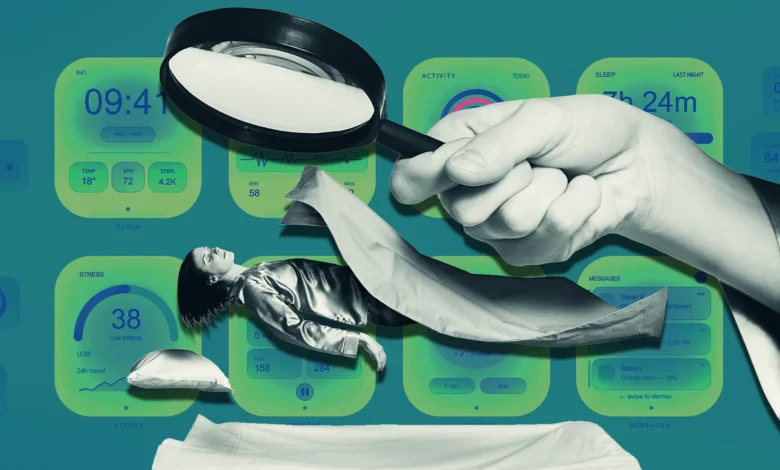
There’s a relatively new buzzword for our very modern obsession with sleep hygiene: orthosomnia. Experts say to just relax.

We’re maxxing everything these days—looks, tokens, fiber, why not sleep?
The very practice of sleepmaxxing, or optimizing for sleep, could be ruining it. And the proliferation of biometric tracking and wearables that promise to help users achieve perfect sleep is taking things even further, contributing to the rise of a distinctly modern ailment called orthosomnia.
If orthosomnia sounds familiar, that’s because it shares the same Greek root (“orthos,” meaning “correct”) as its counterpart, orthorexia. Both indicate fixations with health that tip into the unhealthy. One of them refers to eating, and the other refers to sleeping. Neither are formally recognized by the American Psychiatric Association as standalone diagnostic categories.
Even so, discussions about orthosomnia, or an obsession
Even so, discussions about orthosomnia, or an obsession with achieving perfect sleep hygiene, are gaining traction, according to a report from the BBC. And professionals say the biometric-tracking wearables—like smartwatches, smart rings, and screenless trackers from companies like Garmin and Google—that are driving that obsession are quite possibly having the opposite of their intended effect.
Weekly roundup of the latest in tech news
An Inc.com Featured Presentation
The term “orthosomnia” was first coined in a 2017 paper published in the Journal of Clinical Sleep Medicine by researchers affiliated with Northwestern University and Rush University Medical School. They pointed to “a growing number of patients” who were seeking treatment for sleep disruptions they had self-diagnosed, based on data from wearable devices. At the time, researchers estimated about 10 percent of U.S. adults were using wearable fitness or sleep tracking devices.
“The patients’ inferred correlation between sleep tracker data and daytime fatigue may become a perfectionistic quest for the ideal sleep in order to optimize daytime function,” the study notes. “The challenge for clinicians is balancing educating patients on the validity of these devices with patients’ enthusiasm for objective data.”
As of 2024, the number of U.S. adults using wearable devices has ballooned to as much as 41 percent, according to a survey study, published earlier this year. Also in 2024, a cross-sectional study attempted to estimate the prevalence of orthosomnia in the broader population. The study had a number of limitations, but concluded that about 2 percent of the population could be suffering from it.
Source: www.inc.com