
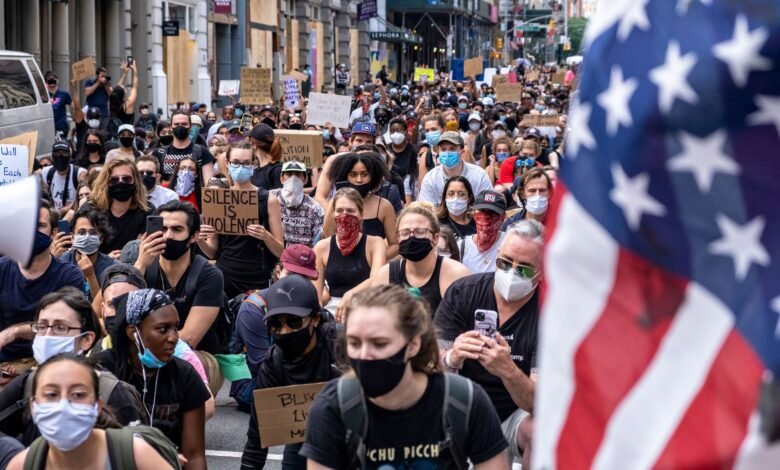
Today we are in a paradoxical moment. “Defund the police” has become a kind of political kryptonite: liberal, progressive, and left-wing candidates alike flinch when asked about it. In a recent interview, Representative Alexandria Ocasio-Cortez said, “I have a local city councilman that has this saying: ‘Woke 1 was crazy.’ ” (She went on to explain that, during COVID, “the doors were really open in trying to entertain any and every policy that was going to get us to a better place.
And I actually think that the discussions that were had in that time were quite fruitful.”) New York City’s mayor, Zohran Mamdani, who, in 2020, posted, “Defund it. Dismantle it. End the cycle of violence,” broke from those ideas during his campaign in 2025. When later asked about Ocasio-Cortez’s retreat, he said, “Sometimes what you believe can change. . . . I’ve made very clear that I do not believe in defunding the police, that I will not be defunding the police.” Leaders of left-wing organizations have also criticized the call to defund the police.
Typically, the campaign is held up as an example of how so-called woke politics was out of touch with more genuine expressions of working-class political thought, or derided as simply unrealistic. These disavowals have been made with consequential midterms on the horizon. Almost everyone can see that Democrats have an opportunity to break the G.O.P.’s destructive grip on power if certain candidates win their races.
There remains widespread debate among Democrats about
But there remains widespread debate among Democrats about the reasons for the Party’s failure in the 2024 Presidential election. The left flank of the Party believes that Kamala Harris failed to articulate how she would rein in inflation, which was driving what Mamdani identified, in his campaign, as the crisis of affordability. For many on the left, articulating this problem would have involved embracing universal health care, lowering housing costs, and subsidizing child care, as a start.
Centrists had the exact opposite impression: that Harris was too far to the left, because of her support for transgender people’s rights and other forms of identity politics, positions that, they claimed, turned off working-class voters. The conflict sharpened as progressive and left-wing candidates—many of them members of the Democratic Socialists of America—continued to win political races.
Perhaps the biggest upset was in the primary, earlier this month, to determine who will run to fill Marco Rubio’s U.S. Senate seat. Angie Nixon, a Florida state legislator who recently joined the D.S.A., beat the retired Army lieutenant colonel and former National Security Council staffer Alex Vindman, despite having raised a million dollars to his sixteen million. Nixon won by twelve percentage points.
In June, 2026, centrist House Democrats helped launch
In June, 2026, centrist House Democrats helped launch the Promise to America campaign, which was explicitly intended to counter the D.S.A.’s growing popularity. Representatives Tom Suozzi, of New York, and Adam Gray, of California, urged Party candidates to sign a pledge beginning with the words “We are capitalist, not socialist.” The pledge also endorsed fiscal discipline, border enforcement, public safety, and “confident patriotism” as Democratic Party values.
In one sign of the left’s growing strength, by late August, only six members of the House, along with a handful of local representatives, congressional candidates, and political consultants, were listed as signatories. Suozzi described their position bluntly: “We disagree with MAGA. We disagree with socialists. We don’t want this extremism. We want mainstream.”
Though “defund the police” continues to be characterized as the height of “woke” excess, the D.S.A.’s core ideas around enhancing social services and redistributing wealth remain highly popular.
In late 2025, sixty-four per cent of Americans said that the federal government should insure health coverage for everyone, Gallup’s highest figure for that question since 2007. According to recent Pew reports, fifty-five per cent of poll respondents believe that assistance to poor people does more good than harm. Pew also found that fifty-two per cent favor more aid to the needy even if it increases federal debt, and that a majority of Americans supported higher taxes on large businesses and corporations and those with household incomes above four hundred thousand dollars.
At least among Democrats, these favorable attitudes toward
And, at least among Democrats, these favorable attitudes toward redistribution are accompanied by an interest in socialist politics. According to a recent poll by CBS News, fifty-eight per cent of Democrats view socialism positively, whereas only thirty-two per cent feel positively about capitalism. Half also view the more specific label “democratic socialist” positively; the rest are largely neutral.
When it comes to defunding the police, activists have largely achieved the first part of what they imagined to be a two-part process: a significant majority of Americans now believes that robust funding for social programs can help bring down crime rates. In 2025, Gallup asked about different approaches to lowering crime, and nearly seventy per cent of respondents preferred directing more government money and effort toward social and economic problems; only twenty-nine per cent preferred allocating more resources toward law enforcement.
Indeed, one could argue that the passage of Joe Biden’s nearly two-trillion-dollar American Rescue Plan, in 2021, contributed to the historic drops in crime by the end of his term, in 2024. But agreement that social spending can help bring down crime doesn’t necessarily answer the question of what to do about the institution of policing. And this is the sticking point that left-wing politicians want to avoid.
The new century began with the then governor
The new century began with the then governor of Illinois, the Republican George Ryan, declaring a moratorium on capital punishment; thirteen men on the state’s death row had been exonerated in the previous thirteen years. Three years later, Ryan reduced all standing death sentences in Illinois to life without parole; by 2011, the state had abolished the death penalty, in response to a decade-long grassroots movement.
Not long after, Michelle Alexander’s “The New Jim Crow” became a best-seller, capturing and amplifying a growing backlash against mass incarceration. Even some Republican lawmakers, particularly fiscal conservatives, began reconsidering decades of law-and-order policy. In 2011, the former Republican House Speaker Newt Gingrich co-authored an article in the Washington Post titled “Prison Reform: A Smart Way for States to Save Money and Lives.” The article introduced an initiative called the Right on Crime campaign, as a path toward “common-sense left-right agreement on an issue that has kept the parties apart for decades.” The piece observed, “We spent $68 billion in 2010 on corrections—three hundred percent more than 25 years ago.
The prison population is growing 13 times faster than the general population. These facts should trouble every American.” Democrats were drawing similar conclusions. In 2015, during the Presidential race that pitted Donald Trump against Hillary Clinton, Bill Clinton was singing a different tune than he had during his Administration. At an N.A.A.C.P. gathering in Philadelphia, he said of his role in the infamous 1994 Violent Crime Control and Law Enforcement Act, “I signed a bill that made the problem worse, and I want to admit it.”
Eventually, with the rise of the Black Lives Matter movement, policing became the focal point of growing demands for changes to how justice was dispensed in the United States.
The killing of Michael Brown, Jr., in Ferguson,
The killing of Michael Brown, Jr., in Ferguson, Missouri, and the ensuing uprising touched off a wave of investigations into local law enforcement across the country. In May, 2015, Barack Obama’s Task Force on 21st Century Policing convened in response to the events in Ferguson, and released a report that made fifty-nine recommendations for reform. Among them were proposals to address issues underlying confrontations with police, such as poverty, and lack of education or health care.
But, as with many similar reports and recommendations, the document did not include a plan for funding the reforms, or enforceable obligations. By early 2017, law enforcement in sixteen counties and cities—including Memphis, Milwaukee, Philadelphia, and San Francisco—had entered into voluntary arrangements with the Department of Justice, agreeing to external assessments of their police departments and accepting federal assistance in implementing suggested reforms.
Yet, even as the D.O.J. appeared to be constructing a substantial architecture of commissions, training programs, and oversight mechanisms, the annual number of people killed by police remained virtually unchanged. The possibility always remained that another egregious killing would be captured on video, go viral, and once again ignite public outrage. A report from the Chicago Police Accountability Task Force—a commission of law-enforcement officials and outside experts that had been formed in 2015, in the aftermath of the murder of a Black teen-ager, Laquan McDonald—summed up its findings with the following observation: “CPD’s own data gives validity to the widely held belief the police have no regard for the sanctity of life when it comes to people of color.”
These findings were not contradictory.
Many Black respondents wanted protection from violence while
Many Black respondents wanted protection from violence while also favoring changes in what police did and how public money was spent. The Gallup survey found that fifty-eight per cent of Americans—and eighty-eight per cent of Black adults—believed policing required major changes. Seventy-four per cent supported ending stop-and-frisk, and half favored no longer enforcing certain nonviolent offenses.
Though people may have been skeptical of the “Defund the police” slogan, there was substantial support for limiting the reach of policing and expanding social provisions. The challenge for the campaign’s organizers, then, was to move those with ambivalent sentiments about policing toward a durable commitment to limit the reach of the cops. And it is here where the limits of the Black Lives Matter movement may have been felt most acutely.
Activists celebrated the movement as decentralized and “leaderful,” a quality that allowed protests to sprout up anywhere in response to local circumstances. But what was a blessing for widespread protests could be a curse for the prospect of launching a disciplined and coördinated campaign. Activists and organizers often toggled back and forth between calling to defund the police and calling to abolish the police, as if the two were interchangeable.
National leaders within the movement drafted a legislative
National leaders within the movement drafted a legislative proposal called the BREATHE Act, which brought together several proposals to divest from policing and invest in communities. But, though they found two members of Congress to support their bill (Rashida Tlaib and Ayanna Pressley), the act was never formally introduced in Congress. The Democratic Party, instead, focussed its efforts on the George Floyd Justice in Policing Act, which was more of the old wine in the old bottle of failed police-reform proposals.
Orienting the movement around the passage of the bill and convincing the Democratic Party to embrace it would have required a well-organized political operation. Yet for all of the bipartisan disparagement aimed at the defund campaign, it has had some lasting impact. Among its successes are landmark bail-reform legislation including in New York, and California—which has been rolled back but not fully retrenched—and the “care, not cops” model, in which mental-health professionals respond to crisis calls instead of law enforcement.
In 2024, a review of municipal budgets and websites identified some form of alternative emergency response in forty-four of the country’s fifty largest cities, in which care specialists were, at minimum, partnered with the police. After years of bipartisan attacks on the slogan “Defund the police,” the left cannot just plow ahead as though it were the summer of 2020. But that is not the same as saying that reducing the role and presence of police in working-class communities is wrong or unrealistic.
Consider the comments of Angie Nixon, the newly selected Democratic candidate to represent Florida in the Senate. Nixon recently joined the Democratic Socialists of America, and in an interview following her primary win she was asked about defunding the police. She said, “I don’t support defunding the police. I do support comprehensive criminal-justice reform to make sure we are addressing some of the root causes of people leading into a life of crime.” If Nixon and other insurgent candidates are able to avoid the rancor that comes with the defund slogan, while still advocating for alternatives to policing—including public services that are both popular and drive down crime rates—then, instead of calling “Woke 1” crazy, you might call it successful.
Source: www.newyorker.com