

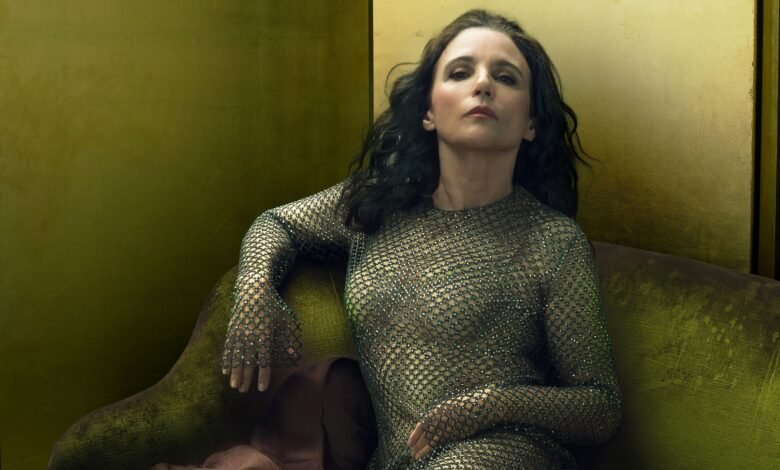
Julia Louis-Dreyfus has reached a point in her career where she doesn’t need to do anything for the first time. But on a bright summer afternoon, over a late lunch of pea soup and sashimi, she’s describing not one but two new experiences: preparing for her Broadway debut and attending the Tonys. The latter was a couple of nights ago. “I don’t mean to sound corny,” Louis-Dreyfus says, obviously moved.
“But there’s sort of an earnestness to the theater community that’s beautiful. Everyone knows what the task is. And it’s a mighty task.”
Louis-Dreyfus’s current task is becoming Polly Wyeth, the matriarch of a prominent Palm Springs family, in the revival of Jon Robin Baitz’s 2011 play Other Desert Cities, directed by John Benjamin Hickey and opening at the Hudson Theater in October.
At our lunch, in a breezy blue-and-white-striped top and white pants, Louis-Dreyfus has the warmth, charm, and ease that will serve her well as Polly—even if Polly wields these qualities with a scalpel. Louis-Dreyfus had been looking for the right stage project for years when Other Desert Cities came across her desk. It’s a highly literate play—Baitz’s language is intelligent, witty, and caustic, in the tradition of Edward Albee—and Louis-Dreyfus was captivated.
It didn’t hurt that Polly is one
It didn’t hurt that Polly is one of modern theater’s most formidable creations, a country-club conservative with highly trained manners and fortress-like charm. Short synopsis: It is Christmas Eve 2004, and Polly and Lyman Wyeth’s daughter, Brooke, a writer, has returned home to Palm Springs after six years, joining her sardonic younger brother, Trip, a TV producer, as well as Polly’s sister, Silda, a proud lefty uncertainly attempting sobriety.
Having recovered from years of depression—treatment managed and paid for by her parents—Brooke is bearing a hand grenade: the manuscript of her forthcoming memoir (publisher: Knopf; excerpt: The New Yorker). It concerns her brother Henry, who, according to the family story, died in the ’70s by suicide after joining a radical anti-war cult. The memoir is Brooke’s reckoning with that catastrophe (Henry participated in a bombing that killed a man).
But some things about the official story still seem incoherent; she doesn’t have all the pieces…and isn’t even sure what the pieces are. Polly is the custodian of the family narrative, and she and Lyman consider Brooke’s memoir a supreme act of betrayal, disrupting their carefully calibrated equilibrium. Ultimately, though, the play isn’t entirely what it seems, and Baitz saves his most lethal move for the end—a trapdoor that reframes everything that has come before.
This is all wonderfully, wickedly funny
This is all wonderfully, wickedly funny. Louis-Dreyfus—beloved as the iconic characters Elaine Benes and Selina Meyer—will be attempting a more dangerous strain of comedy here: intimidating, elegant, poisonous, and entirely emotionally defended. Polly’s humor sits atop tragedy. The role rang all sorts of bells for Louis-Dreyfus, who grew up in New York and Washington, DC, ground zero for grande dames of the Polly Wyeth sort.
“This is a woman who has her hair done a couple times a week. And her nails, the whole deal.” She smiles. “I know these women.”
She is the mother to two grown sons with her husband, Brad Hall, and has been thinking about the weight of parenting a child through crisis. Her own parents—her American mother, Judith (known to listeners of Louis-Dreyfus’s podcast, Wiser Than Me), and her French father, Gérard—divorced when she was young.
Louis-Dreyfus understands, from both sides, how family shapes us, and she knows the stakes in the play couldn’t be higher. Brooke’s memoir “is like a murder,” she tells me. “Polly sees it as a killing of what they have.”
Fifteen years after its premiere at Lincoln Center, Other Desert Cities feels ever more acutely urgent. Its setting is 2004 America, a country still raw from the September 11 attacks and only one year into the Iraq War.
References to anthrax, Donald Rumsfeld, and al-Qaida
References to anthrax, Donald Rumsfeld, and al-Qaida are peppered throughout like shrapnel. The fault lines that would fracture our politics had not fully formed; the Wyeths’ mainstream conservatism would soon have little place in the culture. This was also the period before smartphones and social media—and the last moment when the code of silence on which Polly depends could be credibly maintained.
“All of the extraordinary seeds of that national tragedy are in this play,” says Hickey. “But in an incredibly funny, familial way.”
When assembling the cast, Hickey needed actors who could bring the world of more than two decades ago into the present. The result? “The Knicks lineup,” he says. Joining Louis-Dreyfus are Ed Harris as Lyman, Allison Janney as Silda, Lily Rabe as Brooke, and, as Trip, Joe Keery (from Stranger Things, and also a popular musician performing under the stage name Djo).
“They recognize what a team sport this play is,” Hickey says. That’s also a quality Louis-Dreyfus recognized: that the play is an ensemble of vividly written characters, each deeply flawed and desperately human. By the time Louis-Dreyfus and I meet, the cast has had two read-throughs—one before she had taken the part. What Hickey heard from her—warmth fused with steel, acerbic humor combined with a deep well of grief—told him everything he needed to know.
He said, Julia, my only note is: Say
He said, “Julia, my only note is: Say yes. Say yes. Jump into this.”
Ed Harris speaks to me from Fort Worth, where he is on a break from shooting the Paramount+ show Dutton Ranch. It’s been over six years since he last appeared on Broadway as Atticus Finch in To Kill a Mockingbird, and he’s ready for a return. “I need it for my sanity,” he notes dryly. What he loves about theater is the purity.
“You come to the theater, you prepare, you do the show, and you go home. You’re not sitting around for 12 hours to be in front of the camera for two minutes.” Harris will bring an old-world masculine reticence to Lyman, whose wounds run deeper than they appear. “I think it’s perhaps more difficult for him in a way than it is for Polly,” he says. “I think it really affected him very deeply.”
Meanwhile, Allison Janney’s character, Silda, is a train wreck with a devastating quip.
When we speak, Janney is in Italy, shooting the Netflix series The Diplomat. (“I had to buy another suitcase because I went a little crazy with the shopping here,” she says.) Janney has been close friends with Hickey, who is also an actor, for 30 years—they last appeared onstage together in Six Degrees of Separation, playing husband and wife—and has long known Baitz, who wrote for The West Wing, on which she appeared for seven seasons.
Silda, with her outspokenness and history of addiction,
Silda, with her outspokenness and history of addiction, has a different operating system than Polly—her intelligence is less controlling, more observational. Silda joins a long line of indelible Janney characters who use wit as a kind of scrutiny. “I take on these strong, powerful women and just have fun with them. This is heaven to me.”
The play asks if family members can ever overcome old roles.
Hickey mentions that he recently saw Joe Mantello’s stunning new production of Death of a Salesman and recognized the shared DNA. “All the great family plays are the same,” he says. “They’re all A Long Day’s Journey Into Night. They ask, Who is my dad? Who is my mom? And the answer: I’ll never really know.”
Louis-Dreyfus puts this idea even more intimately. “Siblings have their own very isolated experience: ‘You have different parents than I have,’ ” she says.
“This is true in my family—and I say this as somebody with a lot of sisters. My husband’s family has lots of siblings. Our two kids have their own experience of us as parents.”
Before our lunch, she toured the Hudson Theater for the first time, standing on the stage, taking its measure. “It’s a great theater because it is intimate,” she says. “People aren’t super far away.
It feels personal. The intimacy is by design
It feels personal.” The intimacy is by design. The Wyeth family’s midcentury-modern Palm Springs house is a character itself. Scott Pask, the show’s designer and a great student of the era, is approaching the set like a boxing ring: This feels appropriate for a family whose native language is the verbal spar—the characters land their punches, then retreat. The boxing ring metaphor appeals to Janney too: “We all take our rounds.
‘Ding, ding, ding—I’m down for the count on that exchange.’ ”
Until Other Desert Cities opens this fall, the cast, and the Wyeths, will be trying to find each other, learning how to spar, rehearsing their entrances and exits. In a play about memory, truth, storytelling, and what we choose to preserve, Janney’s instinct is straightforwardly human. “I cherish them,” she says of her fellow actors.
“And I swear to God—to my mother—this time I will journal every day, because I want to remember it.”
In this story: hair, Matthew Monzon; makeup, Romy Soleimani; manicurist, Sonya Meesh; tailor, Jacqui Bennett at Carol Ai Studio Tailors. Produced by AL Studio. Set Design: Laïla Ibrahim.
Source: www.vogue.com