
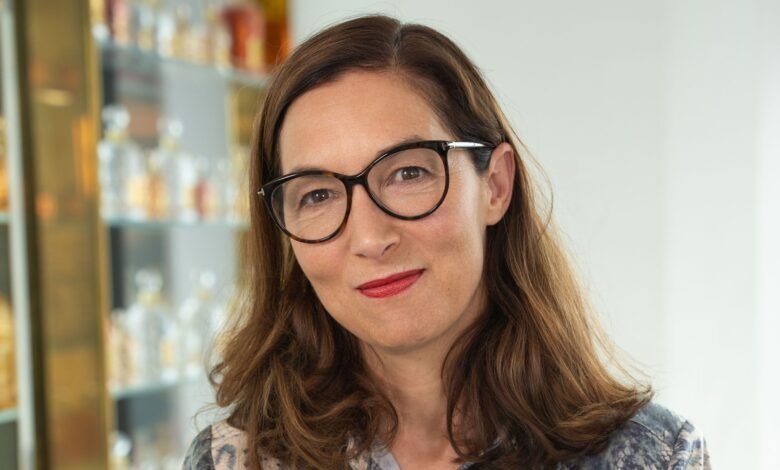
L’Heure Bleue marks Guerlain’s first major women’s fragrance launch in nearly a decade, following that of Mon Guerlain in 2017. “We take our time at Guerlain, waiting until we have something truly meaningful to offer the world,” CEO Gabrielle Saint-Genis says. “When you’re a house that has been passionate about fragrance for 200 years, you are obsessed with innovating.
And in this particular case, we wanted to pay tribute to this extraordinary creation by Jacques Guerlain.”
L’Heure Bleue is a new iteration of a cornerstone in Guerlain’s heritage: a fragrance created by Jacques Guerlain in 1912 that is still available today and is one of the house’s oldest, albeit lesser known, fragrances. “He created L’Heure Bleue after an immense emotional experience one evening while crossing the Pont Neuf, right there,” Saint-Genis says, speaking from her office, just a stone’s throw from the bridge, with a sweeping view of Paris.
“He witnessed the blue hour — a suspended moment when the whole atmosphere is bathed in blue, creating a feeling of immense peace. It’s also a moment when plants and flowers release their most beautiful fragrances,” she continues. “He was fascinated by the beauty of the scene. Afterward, he spent two years trying to recreate it. Jacques was an artist, and perfume was his way of expressing himself — capturing through fragrance this extraordinary moment he had experienced.”
As for the new L’Heure Bleue by Delphine Jelk, Guerlain’s director of perfume creation?
Delphine started with a question: if Jacques Guerlain
“Delphine started with a question: if Jacques Guerlain were here today, with access to the full olfactory palette now available to perfumers, how would he create what we call the ‘fragrance of the sky’?” Saint-Genis says. Jelk’s creation has “a slightly marine, salty, ozonic character created through Cascalone”, according to the CEO. Jelk also introduced a world first: an iris tincture, resulting in an iris “that feels luminous, light, and crystaline”.
The new L’Heure Bleue launches globally on Friday, following its earlier release in China this month. The two fragrances are going to coexist. “We’re going to cherish [the first L’Heure Bleue] like a treasure. The only difference is that it will be called L’Heure Bleue 1912, which is Jacques Guerlain’s creation, and the new L’Heure Bleue, which is Delphine Jelk’s creation,” Saint-Genis explains.
“Rather than inventing perfumes from scratch, we find it interesting to look back at our heritage. I think we’re living in an era where there’s a certain need to hold on to something solid.”
The new L’Heure Bleue is priced at €169 for 100ml, €122 for 50ml, and €86 for 30ml. “We wanted — and needed — a global flagship [fragrance] that would be ‘accessible’.
That’s why it comes in 30ml at less
That’s why it comes in 30ml at less than €100,” Saint-Genis says. (L’Heure Bleue 1912 eau de parfum is priced at €147 for 75ml.)
She continues: “Fragrance can go very far at Guerlain when it comes to sophistication. That said, our vision — and my vision, in particular — is that Guerlain is not a house of elitist exclusivity. What we wanted to do was really offer the exceptional quality of Guerlain at those prices.”
The venerable French perfume house was founded by Jacques’s grandfather, Pierre-François-Pascal Guerlain, in 1828.
In 1994, the Guerlain family sold a majority stake to LVMH. LVMH doesn’t break out sales for each house in its perfumes and cosmetics division, which generated €8.2 billion in 2025, but Guerlain contributes between €1.2 billion and €1.5 billion, per Bernstein estimates, while HSBC estimates that Parfums Christian Dior accounts for approximately €3.9 billion. The remainder is likely generated by the division’s other brands, including Maison Francis Kurkdjian, Acqua di Parma, Parfums Givenchy, Kenzo Parfums, Loewe Perfumes, Make Up For Ever, and Benefit.
Sales at the division declined 1% in the second quarter of 2026, which LVMH CFO Cécile Cabanis attributed to a focus on selective distribution and travel retail’s struggles. In its Q2 earnings, LVMH said Guerlain witnessed strong growth. Drawing on Guerlain’s heritage is also a way to reinforce its fragrance expertise and legitimacy at a time when competition is intensifying.
The fragrance market is tending to polarize between
“The fragrance market is tending to polarize between accessible prestige and very high-priced, ultra-premium collections,” says Pierre Tegnér, equity analyst at financial firm Oddo BHF. “Launching a mainstream fragrance can help respond to this trend while also testing the brand’s legitimacy at this price point.” The accessible prestige segment is a competitive one, notably with brands of the L’Oréal Luxe portfolio such as Lancôme, Valentino, Prada, and Yves Saint Laurent.
Guerlain is already very strong in the ultra-high-end segment: L’Art & La Matière, its fastest-growing fragrance collection, is priced at €335 for 100ml, rising to €550 for 50ml in its Les Extraits line. Fragrance is Guerlain’s growth category, expanding at double-digit rates, according to Saint-Genis, who previously worked at Parfums Christian Dior and served as CEO of Make Up For Ever before taking the reins at Guerlain in 2023.
(Skincare remains the biggest category, but it’ll soon be on par with fragrance in terms of size, she says.) The house has fewer than 100 boutiques and around 50 spas globally, but Saint-Genis says the company’s in no “frantic race” to open more. “Guerlain is a very high-end house. I think we need to convey a sense of rarity.”
In terms of global growth, the US is a standout opportunity as the house’s reliance on Asia lessens.
Saint-Genis says that four years ago, Mainland China,
Saint-Genis says that four years ago, Mainland China, Hong Kong, and Asian travel retail accounted for more than half of the business; that’s now closer to a third. While the fragrance industry has been propelled by new formats such as body mists, Saint-Genis says the house doesn’t need to rush in this direction with L’Heure Bleue. But she sees the budding consumer trend of fragrance layering as an opportunity.
“But you can’t layer just anything. For example, if you layer L’Heure Bleue with Mitsouko, it doesn’t work. On the other hand, Les Extraits are extraordinary layering tools. Typically, in store, if you like L’Heure Bleue, our sales advisors can explain that pairing it with the Vanille Planifolia Extrait 21 extract, or the Iris Pallida Extrait 6 extract is absolutely beautiful.”
Mostly, Guerlain is choosing to rely instead on its nearly two centuries of heritage, to reinvent and stay relevant.
“When you manage to transform tradition into modernity, it really resonates with what young people are looking for right now,” says Saint-Genis. “It’s an obvious point of differentiation. Who else has 200 years of history in fragrance? So yes, looking at what has been extraordinary in our 200 years of history — there are a lot of people who are going to be interested in that.”
Source: www.vogue.com