

Summer is nearly over. And that’s probably for the better, since the theme of the summer has been “explosive diarrhea.”
Since May 1, the CDC has logged 18,445 lab-confirmed cases of domestically acquired cyclosporiasis—a parasitic infection whose signature symptom is exactly what you think it is—across 49 states and D.C. Nine hundred and ninety people were hospitalized.
Two died, both in Michigan. In the same window last year, there were 1,180 cases. It is the worst cyclospora season the country has ever recorded. The delivery vehicle of choice for cyclospora was lettuce: 11,458 illnesses across 20 states, traced to recalled iceberg from Taylor Farms de Mexico, which is how Taco Bell ended up in the middle of a parasite story. That one appears to be over—the recalled product’s best-by dates have passed, and the CDC has started winding down its weekly updates, even if other clusters persist.
But if the recent news cycle is any proof, there’s plenty more food recalls where that came from. In just the last year and a half, we’ve been treated to sus protein powder, salmonella eggs, E. coli blueberries, Chipotle-threatening jalapeños, toxic Whole Foods guacamole, and mislabeled chocolate eyeballs. We’ve got a lot on our plate, as they say. There’s a reason it’s all landing at once.
In March 2025, HHS eliminated roughly 3,500 jobs
In March 2025, HHS eliminated roughly 3,500 jobs from the FDA, about 20% of the agency. Though Marty Makary, the FDA Commissioner from May 2025 to May 2026, promised that “no scientific reviewer or inspector was cut” they were still functionally affected, says Dr. Reshma Ramachandran, co-director of the Yale Collaboration for Regulatory Rigor, Integrity, and Transparency, which studies how the FDA actually regulates things.
She says that salaries flatlined, performance bonuses got stripped, and extra responsibilities got dumped onto whoever was left. Specialized people quit on their own. “There’s kind of a diminished workforce, and also a diminished specialized workforce,” she says. Some members of Congress, including most recently Frank Pallone of New Jersey, have been asking for a headcount of who’s actually left.
The FDA hasn’t provided one. Amidst all the bellyaching about FDA cuts, gutted inspection regimes, and whether we can trust our government regulatory systems at all—serious questions, for serious people, on some other website—we should take a moment to consider the real victims: the dudes still eating boykibble and trying to hit their macros. Because here’s the thing about boykibble, or boyslop in the larger sense.
It isn’t junk food. The whole point
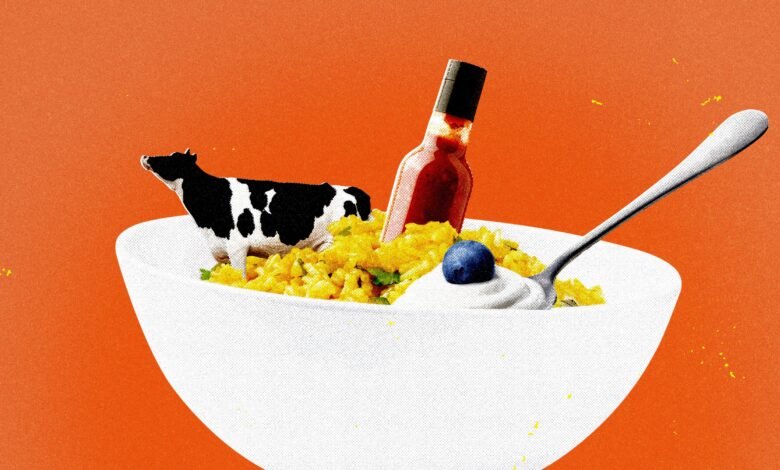
It isn’t junk food. The whole point of the thing—a bowl of ground beef or chicken, rice with some vegetables for dinner, maybe a slurry of berries and Greek yogurt with protein powder mixed in for breakfast—is that it’s the cheapest, most efficient route to a large amount of protein, sufficient nutrition, and not much else. It’s the meal you eat when you’ve decided to be responsible.
Now let’s cross-check that list of boyslop ingredients against the list of foods that got hit this summer. The eggs got salmonella, 134 cases across 18 states. The lettuce got the parasite. The blueberries got E. coli and a bump to the FDA’s highest risk tier, the one defined by a reasonable probability of death. One contaminated pepper supply out of Sinaloa took out Chipotle, Qdoba, and the refrigerators full of Whole Foods guacamole simultaneously.
Even the protein powder was mislabeled. And the beef, which didn’t get a pathogen, got something arguably worse: a supply crisis. Every ingredient in the responsible-guy bowl took a hit this year, which is upsetting for responsible guys who want to eat plainly and efficiently everywhere. Michigan, the epicenter, even sent its own native swole dude politician to yell about it. Dr.
Abdul El-Sayed—epidemiologist, former Detroit health commissioner, now
Abdul El-Sayed—epidemiologist, former Detroit health commissioner, now the Democratic nominee for Senate—spent three weeks in mid-summer working the outbreak into rallies and TV hits. In July he posted a video accusing Taylor Farms of buying its way out of a positive cyclospora test through MAGA-connected donations. (The FDA did walk back a lab result as a false positive; the agency still says traceback pointed at Taylor Farms iceberg.) By August he’d fused it into one line on CNN: “We now need to be dodging lettuce across the state of Michigan for fear of getting explosive diarrhea,” he said, “which nobody ever thought would be a consequence of electing Donald Trump.
But here we are.”
So what’s a guy with a demanding protein quota to do? Even the most serious consumers of boyslop among us don’t necessarily have an answer. Take Adam Heusinkveld, who trains at Chicago’s Quads Gym as an amateur bodybuilder. “I shoot for between 200 and 225,” says Heusinkveld, referring to grams of protein a day. That means a lot of meat. Given the food situation at large, he doesn’t have too many options that haven’t been hit by the outbreaks or price spikes.
Consider the poultry route: eggs are on salmonella watch, and the breast option amounts to eating an entire chicken every week, which costs around $800 a month. That’s just for the protein, mind you. “Trying to be conscientious about what you’re eating, and what the safest options are, is important,” he says. “But there is also that level of psychological wear and tear. If you’re scouring the internet for, like, has something else happened—it does kind of weigh you down.”
Beef isn’t much of a viable alternative.
Lean ground beef averaged $8.41 a pound
Lean ground beef averaged $8.41 a pound in July; even regular 100% ground was $6.89, up 10% from a year earlier. The American cattle herd is at a 75-year low, and attempts at importing cows from Mexico ran into a screwworm outbreak—one that took place totally coincidentally after DOGE cut USAID funding for screwworm monitoring. Heusinkveld is by his own admission more of a chicken-and-rice guy, so he’s not struggling as much as Ian Mulle, who aims for 200g a day and prefers beef.
Given that he’s in his late twenties and works remotely in the supply chain for U.S. Steel, he’s got plenty of time to meal-prep. His family also lives in the burbs, and they’ve taken to buying an entire half-cow to divvy amongst themselves. Even then, hitting his limit has gotten harder, and he’s responded the way most people respond: by eating something cheaper and worse.
“It’s the same handful of things you eat,” he says. “Rice is always good. Potatoes are cool. Chicken, eggs. It gets old fast.”
He’s also taken up what he describes as Greek yogurt sludge mixtures; he did not sound thrilled about it. He’s pretty over the whole situation, really. I asked if he had a workaround just in case the salmonella-in-eggs situation escalated, and he hit me with a deadpan.
I’d probably just die at that point, he
“I’d probably just die at that point,” he said. Lifters like Heusinkveld can’t pivot as easily. His first bodybuilding show is coming up in November, so he moved his shopping to a swankier grocery store on the theory that the standards are higher. He’s a lawyer, so he figures the organic certifications have got to mean something. But now the meat case at his store keeps ending up empty of ground beef, steak, and chicken breast.
“I either need to change my meal plans,” he says, “or I fall short.”
He also cut berries out of his diet because of the blueberry recall—part luck, part elite-level ball knowledge. Heusinkveld spent years as a produce manager at a regional grocery store. “Blueberries and strawberries absorb and hold onto everything,” he says. Ramachandran doesn’t think we’ve seen the worst of it, since the systems that would tell us how bad this got are the same ones that got cut.
“I suspect we’re actually seeing only a small portion of how bad it could be, and I fear it’s still going to get worse,” she says. So what’s a guy with 225 grams to hit actually supposed to do? I asked Bethany Doerfler, senior clinical research dietitian at the Digestive Health Institute of Northwestern Medicine, whether eating a very large volume of food—as Heusinkveld and Mulle both do—raises your odds of getting sick when so many foods are contaminated.
It mostly doesn’t. A small amount of contaminated
It mostly doesn’t. A small amount of contaminated food will infect you about as readily as a large amount. The solution is the same: cooking kills bacteria. That’s genuinely useful advice, but it’s has its limits, especially when they’re recalling things like lettuce, blueberries, and guac. “You’re not going to cook lettuce,” Doerfler admits. Her actual overarching concern isn’t this one parasite.
It’s the overcorrection—the people who get spooked and retreat into shelf-stable everything. They “have gone to eating more refined foods, they’ve cut their fruits and vegetables, and that’s the opposite of what we want.” Switching to plant-based protein powder isn’t a clean escape either: She says the concentration process means those powders tend to carry more heavy-metal risk than whey.
Which is a long way of saying the boyslop bowl is fine. Not because the food supply is fine—Ramachandran would like a word—but because the alternative of ultra-processed food is worse, and because the most effective advice requires actively paying attention. Check the recall notices. Don’t eat the specific thing that’s been recalled. Cook what can be cooked. Wash what can’t, and accept that washing isn’t much.
Doerfler is not against boyslop. She has three sons, so she knows exactly what it is. “Boyslop is okay,” she says. “Dietitians are always looking for how to make that boyslop even better for you.” Maybe one day, science will find a way—but I wouldn’t count on things getting safer anytime soon.
Source: www.gq.com