
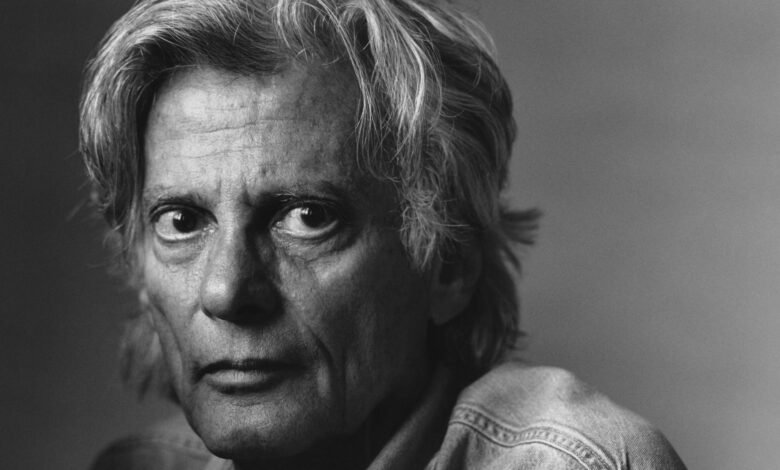
“Avedon’s Eye,” by Dodie Kazanjian, was originally published in the February 1994 issue of Vogue. For more of the best from Vogue’s archive, sign up for our Nostalgia newsletter here. Richard Avedon made four trips to Stockholm a few years ago to see Ingmar Bergman’s production of Long Day’s Journey into Night, in Swedish. He saw it seven times. “There’s no movie I could see seven times, but when a great living performance captures me, I could go every night, forever .
. . . At the Royal Dramatic Theater in Stockholm, when you go upstairs for coffee during intermission, there’s a place on the ceiling where they have the masks of comedy and tragedy—and they’re both tragedy! Because you’re in Sweden. So it’s the perfect place for me, obviously.”
There’s some irony here but also a valid point. Theater is the guiding metaphor in Richard Avedon’s life, as well as his work.
An element of drama gets into everything he does, and the last few months have certainly brought him center stage. The most famous American photographer of our time has been up to his ears in publicity (and controversy) over his recently published book of photographs—which he calls An Autobiography—and over the major retrospective of his work that opens on March 24 at the Whitney Museum.
Attention is being paid: 30 pages in Newsweek
Attention is being paid: 30 pages in Newsweek on the man and his work; appearances on Prime-Time Live, the Today show, and Charlie Rose; a black-tie gala at the New York Public Library for 300 people, thrown by husband-and-wife team Harold Evans, head of Random House (which published An Autobiography), and Tina Brown, The New Yorker’s editor, who a year ago made Avedon the magazine’s first and only staff photographer.
At the age of 70, Avedon has shifted his half-century career into overdrive, but somehow he still manages to find time to make dinner arrangements with this reporter for a gourmet meal that he cooks himself. In a manner of speaking, that is. “You call this cooking?” Dick scoffs, in his unmistakable rasp—New York accented but with other ingredients, mostly untraceable. “I’m an executive cook,” he says.
Verlie Fisher, his longtime housekeeper, made the herbed chicken that afternoon and left foolproof instructions for heating it up. We are in the kitchen and dining area of his loft, a vast and monumentally cluttered space on the second floor of an Upper East Side town house that was once a commercial laundry. The legendary Avedon studio is downstairs, the main part of it anyway; additional workspaces for his team of fifteen associates have taken root on the two floors above his living quarters.
Your first impression here is that there’s too
Your first impression here is that there’s too much of everything. There are seventeen different-size lighted candles on the long dining table, and bowls of blueberries and blackberries and nuts and cheeses, and photographs both framed and unframed, and pots of narcissus and orchids, and an out-of-control bamboo tree that brushes the ceiling, and a bright red leather boxing glove that’s just arrived from Paris.
(“Since this was a rough week for me, a French friend sent it over.”)
Avedon is in constant motion, checking the oven, darting here and there, running his fingers through his long silver-white hair, reaching under his glasses to rub his eyes. A lithe, compact bundle of nervous energy, he is wearing blue jeans, loafers without socks, and a blue shirt with ASTAIRE LIVES printed on the pocket; he had it put there because this was the shirt he was wearing when he heard that Fred Astaire, his childhood idol, had just died.
With Avedon, conversation doesn’t just flow—it runs and jumps and turns on a dime and sometimes goes in two or more directions at once. In the fifteen minutes before dinner is ready, he covers the origins of his three favorite chicken recipes (Janet Cam’s Buddhist Chicken, Marcella Hazan’s Chicken with Three Lemons, and Verlie’s own Herbed Chicken); Chekhov’s short stories— “Did you know that he wrote 300?
I’ve ordered the whole thirteen-volume set; his son
I’ve ordered the whole thirteen-volume set”; his son John’s work as a foreign relations adviser to and biographer of the Dalai Lama of Tibet; the young boxer in Phoenix, whom he photographed for The New Yorker yesterday; the three negative reviews of An Autobiography in The New York Times, which should have killed sales of the $100 book but didn’t; and the critical knives that are being whetted for his Whitney show, which was viciously attacked by Hilton Kramer in The New York Observer two years in advance of its opening.
(“This is the ultimate capitulation to celebrity, money and fashion at the expense of art.”) “Reviews no longer victimize me,” Avedon says. “Or define me, or elate me, or stop me from working.”
In The New York Times Book Review, Maud Lavin wrote, “Mr. Avedon’s close, hard stare, his emptied backgrounds and his graphically spectacular compositions do not tell us any more about the social context of napalm victims than they do about fashion models.
These techniques do not unmask the ambiguities of people’s lives. What they demonstrate is the extraordinary high degree of control Mr. Avedon exerts in all his confrontations with his subjects.” In the daily Times, Margo Jefferson said of the portraits in Avedon’s book, “By the end, I was rooting for anyone who managed to escape with a shred of self-determination intact.” Andy Grundberg’s more recent notice in the Book Review said that An Autobiography showed Avedon “at his most characteristic: controlling of his subjects and manipulative of his audience, driven to redeem himself from the taint of commerce, obsessed with the judgments of a disembodied posterity.”
Why does Avedon get attacked so savagely?
His tremendous success as a fashion photographer
His tremendous success as a fashion photographer is one obvious reason: How dare he presume to be an artist as well? Avedon has fought this dichotomy all his professional life, insisting that there is no difference between his fashion work, his reportage, and the body of portraiture that is his principal claim to recognition as an artist. “I think art history will see him as one of the great portraitists of the twentieth century,” says David Ross, the Whitney’s director, who has come in for a lot of abuse himself over his decision to present an Avedon retrospective.
“He’s spent so much of his life in analysis, and in the quest of understanding who he is—this tortured, self-driven Jewish man who is trying to understand himself by looking at other people and their lives, and looking at the way things work, and trying to see into that borderline area between madness and beauty and power and powerlessness. He’s looked hard, as all great artists do.”
Ross insists that working with Avedon on the Whitney retrospective did not involve pitched battles over who was in control.
“When we started working on this show, I said to Dick, ‘This is the show that needs to be done for you, not by you; you need to have that happen, as every artist does.’ On the design level, Dick was as directorial as ever. You would have to be a complete fool not to make use of Dick and Mary Shanahan, an amazing designer who works with him. But on a curatorial level, he really let Jane Livingston choose the show.
The primary selection of pictures, the primary story
The primary selection of pictures, the primary story that’s being told in the show and in the catalog, is Jane’s.”
The oven timer announces that the chicken is ready. He carves it deftly, serves it with his special house salad—tiny mâche lettuce leaves and shaved Parmesan. The bread is folded into the napkins to keep it fresh. The wine is a 1987 Margaux. The plates are oversize Italian faience from Siena, boldly colorful against the deep blue tablecloth.
“You mustn’t think that I care about candle colors and tablecloths and stuff like that,” he says. He does care, nevertheless. It’s all part of the Avedon performance, a never-ending engagement with the visual world in all its forms. Is it unfair to say that Avedon’s portraits are manipulative, overly controlled, and “trapped in narcissism,” as Maud Lavin charged in The New York Times?
This criticism is often heard, and to some extent it may be justified. But then, all great portraits are in a sense self-portraits, and all artists exercise manipulation and control. When Avedon takes a portrait, it is the record of an intense, indelibly personal encounter between the photographer and the subject, whether the subject happens to be a fashion model or a drifter, an actor or a napalm victim, ex-president Dwight David Eisenhower or Jacob Israel Avedon, the photographer’s 87-year-old father, dying of cancer.
If there is sometimes more of Richard Avedon
And if there is sometimes more of Richard Avedon than of the subject in this encounter, well, that’s all in the nature of the performance that Avedon demands in his life and work. But what if the subject won’t perform? Doesn’t this happen in his current avatar as The New Yorker’s staff photographer? “Oh, yes,” he says. “Of course. I’m about as interested in David Dinkins and Rudy Giuliani .
. . but that’s part of the job. I’m quite willing to do photographs that are not pure expressions of myself, like the one of Steve Martin on the wall here. He was enormously generous in the sitting, but there’s no such thing as cutting through to Steve Martin. Steve Martin uses his comic genius like a wall. There’s no penetrating it, and I respect that.” Later, he shows me the note Steve Martin sent him after the sitting: “Dear Richard, Yours was the first photo shoot I ever enjoyed .
. . . I hope we can become very close friends forsaking all others and have lunches and dinners together six days a week.”
David Ross told me a story about watching Avedon at work on his photographic series called In the American West. “One of the great emblematic West pictures is of a guy with his shirt half over his shoulders. He has a kind of S-shaped body. I remember seeing that guy on the midway of a state fair in southern Colorado.
He was the kind of guy I would
He was the kind of guy I would have crossed the street to avoid. He was tough, and angry, and on the line of being psychotic, and all my good Jewish radar tells me stay away, no eye contact, keep moving. But Dick goes right up and starts talking to him, and within five minutes he is pouring his energy out for Dick in front of a white drop cloth tacked up on a side of a shed. It was astounding to see how he communicates and puts people at ease and allows them to come through.”
Dick is slightly displeased with himself over the chicken.
“A little dry, don’t you think? It’s so nice when it’s really juicy. I think we didn’t need that last fifteen minutes.” He has another helping anyway. And he orders me to strip my wishbone clean so he can hang it on the lip of a special pitcher that holds ten or twelve others. “I still have wishes,” he says. “Being 70 doesn’t preclude that.” Dinner consists of one main course plus dessert, simple but extravagant.
Another time, you might have a baked potato smothered in beluga cad container one night from a Russian restaurant in Brighton Beach—he enriches it with piroshki. If he’s serving pasta, it will be Cipriani’s, or else mushroom pasta by his friend China Machado, who was once one of his models and now has a store in Water Mill
Long Island. He jumps up and brings over
Long Island. He jumps up and brings over a box of the Cipriani pasta from the open larder shelves on which are stacked sixteen others. “Just try one of these,” he says of the Cipriani masterpiece. “It takes about a minute and a half to cook. It’s all egg.”
A few days earlier, he had told me that I didn’t have an “Avedon face.” I ask him what he means by an Avedon face.
“It’s very varied,” he says. “One of the great Avedon faces is Michelangelo Antonioni’s. There are artists just as complicated as Antonioni, but their complexity isn’t available to my camera. Fellini’s was not an Avedon face. Roy Lichtenstein’s is. I can’t explain it exactly. It’s not about being ravaged or flawed. It’s about contradictions, dialogue, arguments.
The soul’s confusion on the face.”
Even in his fashion work he captured that confusion, as Penelope Tree attested in a letter to Avedon about her portrait in An Autobiography. “Of course I identified with being caged, isolated, and utterly bewildered, but I thought I was doing a better job of hiding it! Trust you to see right through. I guess you always did.”
The encounter between Avedon and subject is what makes the portrait, and that usually has a lot to do with what Avedon is feeling at the moment he takes the photograph.
Does this make him a monster egoist,
Does this make him a monster egoist, as some of his critics maintain? Or is he simply doing what Titian, Velázquez, Francis Bacon, or any great artist does? “Of course, of course,” he says. “Art isn’t art because someone uses a paintbrush. Photography is either good or bad, and when it’s good it’s like any art that’s good. It becomes Art. “What the subject brings to the camera and what I do with that is what makes the photograph.
In photographing my father,” he says, referring to the famous series of his father dying, “I was looking at him. and he was looking at me. The last thing he saw as he was dying was his son. It’s clear to me that he became, in that moment, in that image, what he saw. And what he saw was me.”
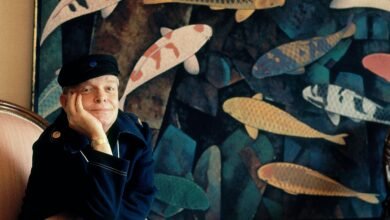
Avedon had his own portrait taken for this article. He chose the photographer: his great contemporary and rival, Irving Penn.
On the day of the sitting. Avedon had the flu and such severe stomach pains that he called his doctor, from Penn’s studio, for a prescription. “Will I be loopy if I take it?” he asked. “I have an interview with the London Times right after this, and then I’m flying to Hyannis Port to photograph Ethel Kennedy.” “No loopier than usual” was the doctor’s reply. Avedon had brought along a legendary coat from the fifties to be photographed in, a heavy old shearling that he had won in a bet with the model Suzy Parker; it had once warmed Marilyn Monroe, and Isabelle Adjani had worn it in an Avedon photograph.
Penn took some shots of him
Penn took some shots of him in the coat, but the image that won out shows him in an open-collared work shirt, looking haunted and strangely romantic. “He has a drama that we got that I don’t associate with him,” Penn said afterward. “Like something out of the French Revolution.”
Although Avedon had been photographed twice before by Penn, he tells me that this was the first time he had felt “ready” for the experience.
“It’s a wonderful picture,” he says, “the only real portrait of me by Penn. Maybe by anybody. He’s caught something. The real strength of any portrait is to go beneath the surface and into the contradictions within the life. And he’s done that so completely in this portrait. It’s about a kind of crumbling part of me that’s a cross between arrogance and suspicion.
Penn’s portrait has nothing to do with looking good, and in this case, it has very little to do with composition. It has a rawness—I mean, it’s more of an Avedon than a Penn. Ha! And yet it could never have been taken by anyone but Penn.”
What is the difference between an Avedon portrait and a Penn portrait? “I think Penn’s great strength lies in his power of composition and in the very still moment that reveals.
From the beginning, I’ve felt that any composition
From the beginning, I’ve felt that any composition that is visible in my photographs takes you away from the direct confrontation that I look for. If anyone said of a picture of mine. ‘Look at the composition in that,’ I’d be embarrassed. I’d know that I failed. “Rivalry is a funny word to use about Penn and me. It doesn’t cover or even hint at the relationship. In the years when I was at Harper’s Bazaar [ 1945 to 1965] and he was at Vogue, and we were both covering the same celebrities, I watched every move he made, and I think in some way it helped define me.
I was always excited by Penn, in awe of Penn, and wanted to top him or equal him, or be the opposite of him. I think of him as a classicist and of me as an eclectic. I was fired by him. inspired by him. pushed by his standards, his rigor, his excellence.”
I ask him which other photographers he has admired. “Certainly Diane Arbus, Julia Margaret Cameron in the old days. But Cartier-Bresson rules.
Walker Evans is a miniaturist compared to him. There are wonderful photographers—Robert Frank, for example—who have mastered small areas of the territory Cartier-Bresson laid out. The world of photojournalism is littered with Bresson babies. He is the photographic Tolstoy of the twentieth century. “Helmut Newton redefined what a fashion photograph could be. He’s the leader of the post-Avedon, post-Penn period.
He released everything
He released everything. He changed what a fashion model could look like and played with vulgarity in a really witty way. After Helmut Newton, you can’t do a certain kind of picture anymore.”
“What kind of picture is that?”
“A girl stepping out of a taxi.”
“But it’s done all the time.”
“It’s done all the time, and it’s boring! But when Helmut does it, the erotic focus shifts from the ankle and the smile to the inner thigh.”
It’s a little odd to hear Richard Avedor speak of the post-Avedon, post-Penn period.
Bruce Weber, one of today’s top fashion photographers who photographed Avedon for this article, sees his influence as being very much alive and in the present. “Richard Avedon is like this wonderful kid you meet at school, who has more energy than anybody else,” Weber says. “He really is open, he engages you in what’s going on in his life, and he makes you then think about your own.
He’s influenced a whole generation of photographers who are working now, me included, in that just simply and purely you want to take photographs and to photograph your own life at the same time. Dick’s work is not about fame. It’s really about still being a kid and not being afraid to shoe it.”
We’re heavily into dessert by this time. Dick always serves at least five—three different ice and an orange cake from Sant Ambroeus, fresh blackberries and raspberries, macaroons from Bonté, and a split of the Billecart-Salmon champagne that he discovered years ago at Chez Panisse.
He promises next time to make Mike Nichols’s
He promises next time to make Mike Nichols’s Peach Orgasm (six fresh peaches, two bananas, one and a half cups of sugar, two cups of sour cream, and the juice of one lemon: blend in blender, then put in ice cream maker). He has a file of recipes that he’s picked up from restaurants and friends in various parts of the world. It’s more than enough for a book, but it will have to wait until he’s finished the ten books he’s already under contract to do for Random House: several more collections of his photographs: four teaching books based on his master classes in fashion photography, reportage, portraiture, and the snapshot; and an autobiographical novel that he says he’ll be working on for the rest of his life.
There’s another kind of autobiography on the walls. Hundreds of photographs, clippings, postcards, notes, mementos, and reproductions of famous paintings are pinned to the soft beaverboard, some of them yellow with age. Shots of Fred Astaire dancing, and one of Astaire with the young Avedon during the filming of Funny Face, in which the great dancer played the part of a fashion photographer based on Richard Avedon.
A more mature Avedon with Audrey Hepburn, Miss Funny Face herself. The New York Post’s front page on Liz Taylor’s eighth marriage, with eight “I Do’s” in bold type. Three Avedon press cards for the year he went to Vietnam. A news photo of an unidentified man frozen to death beneath the ice of a lake in Queens, New York. Athletes in violent action. Snapshots of Evelyn, his wife, whom he hasn’t lived with for many years (he still sees her for dinner or a movie at least once a week), and one of their son, John, and John’s wife, Maura Moynihan, the senator’s daughter, with their son, Michael.
A blown-up page of The New York Times
A blown-up page of The New York Times Magazine with head shots of seventeen people whom Stalin had killed. (“They were photographed and then they were killed,” Avedon says. “Look, aren’t these the most pure and perfect portraits?”) A life-size blowup of Ruby Holden, the Nevada pawnbroker whom Avedon photographed in 1980. A poster of Goya’s Contessa Chinchón, which he considers one of the great portraits in Western art—”an infantile woman in an evening gown,” he says.
“A combination of fashion and portraiture. Most portraiture involves fashion. That’s what Penn does. That’s what I try to do.”
Fashion photographs, by Avedon or anyone else, are nonetheless conspicuously absent from this wall of memories and momentary enthusiasms. No Dovima with elephants, no Suzy Parker, no Twiggy, no Jean Shrimpton or Stephanie Seymour, his current favorite.
Other than a few isolated examples, only one room (out of fifteen) at the Whitney retrospective will be devoted to Avedon’s fashion work, and this makes you wonder about his reiterated argument that all his work, fashion included, is a part of the same seamless web. Avedon’s ambivalent relationship with the world of high fashion, which has given him the means to pursue his ambitions as an artist, was exacerbated in 1988 when he had a falling out with Vogue’s new editor.
He had photographed almost every Vogue cover since
He had photographed almost every Vogue cover since 1966 but found he disagreed with Anna Wintour about how Vogue covers should look, and she stopped using him for covers. Recently, on the occasion of this interview, he wrote Wintour a letter and signed it “Let’s bury the lipsticks. Dick.” In the meanwhile, he has not lacked for commercial outlets. Tomorrow he starts a big job for Versace—racks of dresses and underwear and tables of accessories have taken over the far end of the long room, for a weeklong shoot that will be the firm’s next major ad campaign.
The problem is he won’t be using Stephanie Seymour, who is pregnant. “I’ll never forgive her,” he says, mock-seriously. Avedon has always liked to work more or less exclusively with one model at a time. Suzy Parker, his favorite of the fifties, has vivid memories of their working relationship. “We had become so attuned to each other,” she tells me. “First of all, we shared an outrageous sense of humor.
Second, we worked to music, so we were already into movement. I mean, I was never still. Before Dick, modeling was like being crucified most of the time. They’d have tissue paper stuffed up your dress, they’d have clothespins and safety pins up and down your back. They’d have strings that wouldn’t show to hold the movement of the skirt. The whole thing was absolutely ghastly.
With Dick it was always movement
With Dick it was always movement. And I was young enough to walk out on one of the gargoyle heads of Nôtre Dame. Nobody else would do that. I was young enough to go out on high heels on one of those beams of the Eiffel Tower. I did roller-skating on cobblestones. He would set up these crazy situations.” Penelope Tree, one of his favorites in the sixties, says that “when you worked with Dick, you were so caught up in the moment, some intensely personal sort of moment.
I’ve never had that experience with any other photographer before or since. It was really like having a love affair, except it wasn’t at all physical.”
The back wall, behind the Versace paraphernalia, is crowded with images of a different sort. Above low bookshelves filled with art books are framed photographs by Baron de Meyer, Atget, Brassaï, Man Ray, Cameron, and Avedon, most of them of disturbed-looking women.
Also an Avedon portrait of his father that was the poster for his 1974 show at the Museum of Modern Art, and one of his horrific images of a grimacing Oscar Levant, which Avedon sometimes considers his finest portrait. The dark side of the Avedon psyche is in command here. (Avedon: “It is through the dark part of the eye that we see light.”) Nearby on the side wall is a huge blowup of four grimy coal miners, from the American West series.
I like that one less and less, he
“I like that one less and less,” he says. “My hand is just too strong in it. Just too much of me manipulating. The craftsmanship, the composition. It’s all too apparent. It doesn’t reach below the surface.”
He laughs and makes a sweeping gesture that somehow includes the room and everything in it. “You know what I’m going to do? Empty this place out. Put everything on the walls in boxes, or the warehouse or the fire.
I’ll just dump everything and start again, see who I become. Try to do it better, more deeply, and if I lose it, hope that my friends shoot me or at least stop me from becoming Steichen, photographing the apple tree outside my window with a new young wife kneeling at my feet.”
There’s a brick fireplace that Avedon never uses because pigeons have nested in the chimney. The mantel is cluttered with stuff, like every other flat surface here.
An empty bottle of 1923 Lafite-Rothschild, Avedon’s birth year, stands on a boxed bottle of the same vintage, undrunk, “waiting for the right occasion.” There are also three parcels in brown wrapping paper, tied in ordinary string, unopened. He knows what one of them is—a bleached-white skeleton of a bird’s wing that washed up on the beach of Antigua years ago, during a photographic shoot with Suzy Parker; Dick and Suzy both wanted it, and it became their “bone of contention,” which travels back and forth between them.
The other two boxes, he says, I hope
The other two boxes, he says, “I hope to open just before I die. They’re from someone who means a great deal to me. If I’m alone when I die, opening them—discovering what’s in there—will be like the right person holding my hand.”
It’s a quarter to twelve, way after his bedtime. He wakes up at five every morning, gets out of bed at six, turns the coffee on, and does last night’s dishes “for therapy.” Breakfast is coffee and fresh apple juice, squeezed by Verlie from whole apples the day before.
His personal trainer comes three mornings a week at 7:30 to give him a one-hour workout. When he says good night, his voice is a little raspier, but his restless energy shows no signs of flagging. It’s the next morning, 7:30, and Avedon is calling in great agitation. He says last night’s interview “didn’t work,” and we have to try again. This time he’ll invite his old and close friend Twyla Tharp, and he tells me I can be a fly on the wall while they wing it conversationally.
OK, I say, well aware that there’s no arguing with Avedon in his control-freak mood. I go, I listen, I’m charmed, I’m well fed—lamb roast and applesauce with horseradish, homemade pumpkin pie and the usual cornucopia of desserts. His son, John, is there, and John’s nearly three-year-old son, Michael. So are the seventeen candles, which almost send the bamboo tree up in flames.
It’s a warm, family sort of evening, and the conversation goes off in two dozen directions, and if it were reproduced here, we could have yet another portrait of Richard Avedon. The possibilities are endless. •
Source: www.vogue.com