

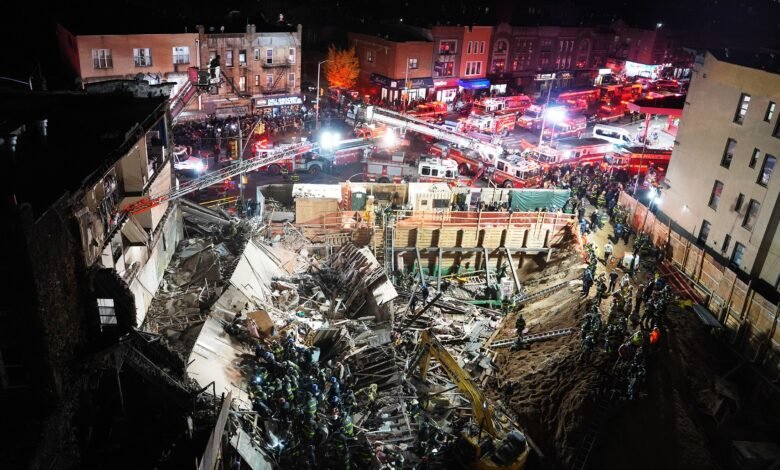
In the steady rain, lit up by N.Y.P.D. spotlights, the hushed site could have been a movie set—someone’s idea of a New York City calamity. “It looks like 9/11,” Novella Spence, a witness to Wednesday’s tragedy, told Curbed. “There was mist from the crumble, and the side of the building was gone.” 1321 Flatbush Avenue, which had stood since 1930, most recently with a façade of dusty white brick, housed a medical-uniform-and-supply store on its first floor and two floors of apartments above.
After nearly being crushed by the house-slide above them, construction workers, who had been digging the foundation of a new mixed-use development going up next door, immediately began combing through the wreckage for survivors. They were soon joined by firefighters, E.M.S., and personnel from several other city agencies, in addition to K-9 dogs from both the N.Y.P.D. and the F.D.N.Y.
“They looking for bodies, they looking for more bodies,” a d.j. named Lexx Emmanuel said in a video that he posted to Instagram on Wednesday night. In the video, shot from a high floor in a building directly overlooking the disaster area, dozens of first responders can be seen scurrying below. At least one miracle occurred: a pregnant woman was pulled from the rubble alive. As a result of the collapse, eight people died—including a nine-year-old girl and a ten-year-old boy—and nearly twenty people were injured, including four firefighters.
The hope of additional rescues was dashed
The hope of additional rescues was dashed on Thursday afternoon when heavy rains began. “Rain can flood those voids where they are still searching and destabilize the ground they are on,” Laura Kavanagh, a former F.D.N.Y. commissioner, said; she explained that the death toll was likely so high because people were home from work and school on Veterans Day. “Before all this happened, we used to feel shakes in our building, like, it used to start shaking when they was working,” Zariah Coleman, a teen-age resident of the adjacent building, told reporters at a press conference on Friday, in tears.
“I just really hope they come and get our cat, ’cause he’s inside the house right now, and they said they went inside the house to try and find him, but I don’t think they really did.”
We are in something of an era of building collapses in New York City—just this past July, the former midtown offices of Pfizer partially caved in when columns buckled during an office-to-residential renovation.
In April, 2023, a concrete parking garage near City Hall pancaked, killing one and injuring seven. Three years before that, a vacant old tenement building crumbled near the entrance to the Queens-Midtown Tunnel. “These buildings that have been around since the early nineteen-hundreds, they’re beautiful and they have character and charm in many regards,” Melanie La Rocca, a former commissioner of the city’s Department of Buildings, told me.
What’s the old saying
“What’s the old saying? They don’t make them like they used to,” La Rocca said. “Who knows what people thought back then?”
Many of New York City’s old row buildings have been standing for longer than anyone who constructed them could have imagined; many have been poorly maintained. “How do we create an environment where the housing stock can and is prepared to exist for the next hundred years?” La Rocca, now the chief operating officer of Riseboro, a large Brooklyn community-services provider, said.
Close your eyes and imagine New York City in a hundred years. Are the nineteenth- and twentieth-century row houses and tenements still standing? Is that a good or a bad thing? The construction site next door to 1321 Flatbush Avenue is owned, meanwhile, by an L.L.C. tied to developers, including Robert Fischman and Judy Swimer, known for “cutting corners” at the site
The Department of Buildings “had previously issued the stop work order at the lot during demolition of an existing one-story building in March after determining that contractors had failed to install required safety precautions,” the website reported. An engineering firm recommended “extensive excavation and bracing work to prevent neighboring buildings from collapsing, including steel, timber and concrete shoring,” and it is unclear if those precautions were taken.
The developers had initially said that they wanted
The developers had initially said that they wanted to build a three-story structure on the site but had recently told the city that they were now aiming higher: a nine-story building. Gentrification often exacerbates economic, political, and social imbalances; sometimes it contributes to structural imbalances, too. Much of the Flatbush section of Brooklyn has long been known as Little Haiti, for the immigrant community that put down roots in the area beginning in the nineteen-sixties.
More recently, glass-and-steel apartment towers have been going up, as have the neighborhood’s prices and rents. “They were digging down,” Ahmed Tigani, the current commissioner of the Department of Buildings, told reporters at a press conference on Wednesday, when asked what the workers on the construction site were doing when the collapse occurred. (Neither Falade nor the developers of the construction site could be reached for comment.)
The makeup of Little Haiti is changing in other ways, too.
Mamdani noted that the victims at 1321 Flatbush Avenue were mostly from South and Central American countries, including Mexico, Ecuador, and Colombia—in what once had been a cradle of Caribbean communities in the city. Two of the dead were Guinean immigrants from West Africa, like many who arrived in great numbers during the city’s “migrant crisis” in 2023, which the then mayor, Eric Adams, warned could “destroy the city.” But, of course, when the crisis ended, New York was still standing.
Many of the new arrivals whom Adams so
Many of the new arrivals whom Adams so bemoaned wound up living, as new arrivals in New York have for centuries, in the kind of cramped and dilapidated housing that poses more of a threat to them than they ever will to the city. Officials cautioned, as they always do, that the investigations will take time. A ballroom rises in Washington, the slums fall in Flatbush, who can blame people for not waiting patiently for the system to render judgment?
When 1321 Flatbush Avenue collapsed, it took its remaining party wall with it, exposing the apartments next door to the world like an ant farm: clothes still hanging in closets, furniture carefully arranged. “I lost everything,” one resident said, after emerging from the building with a neighbor’s child in his arms. “My computer, my clothes.” By the weekend, traffic on Flatbush Avenue was open again.
Source: www.newyorker.com