
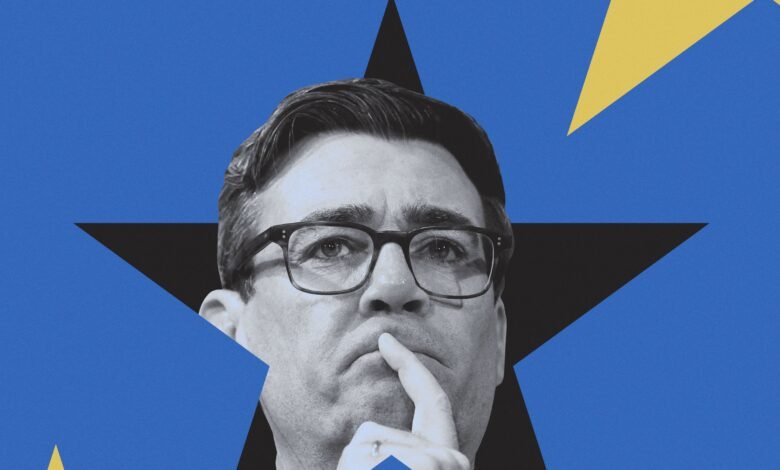
Burnham chose his words carefully, but that is what the country believes, too. According to a poll of more than eleven thousand people, only twelve per cent of British voters think that Brexit was a success. About a third think it was neither one thing nor the other, and a narrow majority believes it was either “a great failure” or “more of a failure than a success,” including about thirty per cent of those who voted for it.
Burnham’s own constituency of Makerfield, on the outskirts of Greater Manchester, voted heavily to leave the E.U., so he never quite says that it was a bad idea, per se—just that it failed to deliver the goods. Burnham calls this the Makerfield test. He used to be the mayor of Manchester and, since taking office, has adopted a decidedly local approach to talking about international affairs, measuring their impact in terms of supply chains, decent jobs, and the cost of groceries.
Most studies have found that Brexit has shrunk the British G.D.P. by between four and eight per cent, compared with what it would be if the country had stayed in the E.U. Stunted growth is the problem underlying almost all the other problems that have dogged the nation in the past decade. It has starved the government of revenue, leading to a dispiriting spiral of higher debt, higher taxes, and a persistent national feeling of Weltschmerz.
According to recent work by the Centre
According to recent work by the Centre for European Reform, the economic growth sacrificed by Brexit would have been worth about ninety billion pounds a year in taxes, which is about the same as the country’s education budget. In 2024, George Osborne, a pro-Europe Conservative former Chancellor of the Exchequer, compared the polite British silence surrounding the impact of Brexit to falsified tractor-production figures in the U.S.S.R.
“There is a kind of lie being lived by the system,” he told me. “You have to sort of pretend that this thing is working, and everyone in the system knows it isn’t.”
Keir Starmer, the previous Labour Prime Minister, undertook what he called a reset of Britain’s relationship with the E.U. But, since it was Starmer, this became a mishmash of “structured dialogues,” “deliverables,” and “milestones,” which meant that nobody really understood what he was talking about.
Part of the confusion was inevitable. Anything involving heavy-duty negotiations with the E.U.—with its twenty-seven member states and its formidable corpus of shared rules and regulations—is wildly complicated and dull. But at least part of Starmer’s opacity was calculated. For years, under Jeremy Corbyn and then under Starmer, the Labour Party was terrified of being seen as anti-Brexit, for fear of alienating working-class, socially conservative people in poorer parts of the U.K.
Who had voted to leave
who had voted to leave. Under Burnham, that calculus has changed. Brexit supporters are an older breed. Since 2016, an estimated four million of them have died. During the same period, younger and progressive voters have been drifting away from Labour to more explicitly pro-European parties, such as the Liberal Democrats and the Greens. (British voters who were too young to take part in the referendum oppose Brexit by a ratio of around five to one.) “The core of Burnham’s strategy is based on trying to reunite the left,” a former government adviser told me.
“He believes that the contest for the next election is not so much about swing voters—it’s about who can marshal their bloc and bring their bloc together. And those blocs are essentially who voted Leave or Remain in 2016.”
On November 20th, Burnham arrived in Brussels to sign a new set of agreements designed to improve the U.K.’s relationship with the E.U. Almost everything on the agenda—dropping border checks for food exports, connecting to the E.U.’s carbon market, developing closer coöperation to stop irregular migration, and starting a youth-travel program—had been negotiated during Starmer’s premiership, but Burnham framed the meeting as part of a longer journey.
A few days before he went, he likened Brexit to the emperor’s new clothes. “I do try to say things as I see them,” he said. Yet Burnham never quite says that he wants to reverse Brexit. (He has said that he would like to see Britain rejoin the E.U. “during my lifetime.”) He has promised to respect Labour’s previous “red lines”—staying outside the central structures of the E.U.—until the next election.
In the meantime, however, the Prime Minister has
In the meantime, however, the Prime Minister has said that he wants to start talking “about options for our long-term relationship.” If you are old enough to remember the enervating, epic, soul-sapping awfulness of leaving the bloc in the first place, you know that this can mean only one thing. As Nigel Farage, the Brexiteer-in-chief, told the BBC, “I’m sure many listeners to this program right now will be saying, “Oh, no.
Not again.”
At a news conference celebrating the agreements, Costa said that the E.U. was open to having “the closest possible relationship” with the U.K. Like Burnham, he was once a left-wing mayor. (Costa was the mayor of Lisbon before he became the Prime Minister of Portugal.) “We may drive on opposite sides of the road,” Costa mused. “But the most important is that we are heading in the same direction.” Von der Leyen, who helped to oversee Britain’s final departure, in January, 2020, talked about how much had changed in the past ten years, from COVID-19 to the war in Ukraine.
“What is the best way to strengthen our societies and to have our economies competitive and strong?” she asked. She referred to Burnham as “dear Andy.”
Burnham is not a polished speaker. He has a blunt, level energy. When it was his turn to speak, he read out the names of British supermarkets that had given their approval to the new food-trade rules. He talked about the cost of the weekly shop and the price of exporting “a shipment of salmon,” which anyone could see was too high.
Burnham talks in granular terms—meat and potatoes—but he
Burnham talks in granular terms—meat and potatoes—but he is a shrewd and natural politician, too. He argued that the new measures, which are estimated to increase the U.K.’s G.D.P. by half a percentage point, were as far as he could go, given the constraints of Britain’s existing relationship with the E.U. He addressed younger voters directly. “Hope is the word, and it starts now,” he said.
Burnham made it sound as though Brexit was someone else’s vanity project, inflicted on ordinary folk, and he was doing his best to clean up the mess. He proposed “brainstorming” with Britain’s friends in Europe to come up with new options. “Life has moved on in so many ways,” he said. Starting a conversation about undoing Brexit is going to be much easier than seeing it through.
There is speculation in the British media that Burnham might call a general election next year. (Under the law, he has until 2029 to do so.) But even if he does, and even if he makes rejoining the E.U. a part of Labour’s campaign, it would take years of negotiations and, almost certainly, another referendum for the U.K. to return to the bloc. Even floating theoretical new relationships with the E.U.
Is enough to incite flashbacks to the unhappy
is enough to incite flashbacks to the unhappy period, between the mid-twenty-tens and the pandemic, when British politics was condemned to being about nothing else. Back then, the various scenarios for leaving the E.U.—a “Swiss-style” option of participating in parts of the single market; joining the European Economic Area; joining the European customs union; or going for a free-trade deal—were known by negotiators as the “steps of doom,” each one indicating another remove from the benefits of full E.U.
membership. Now that “Brejoin” is being mooted as a destination, the steps have been rebranded as a “staircase” of possible futures. The sense of doom remains. Last week, I called Matthew Elliott, the former chief executive of the Vote Leave campaign, to see what he made of Burnham’s decision to revive the Brexit saga. “I’m not doubting his sincerity for one second,” Elliott said.
“I think it’s also politically quite astute.” At the end of her premiership, Liz Truss elevated Elliott to the House of Lords, where he sits on the European Affairs Committee. He conceded that Brexit hasn’t lived up to expectations. “It’s fair to say that people’s hoped-for outcomes were higher,” he said. But he blamed increased immigration under Johnson, the pandemic, and the over-all timidity of Britain’s political class for failing to grasp the opportunity that had been given to them.
I think Brexit is a process, he said
“I think Brexit is a process,” he said. Elliott could not help rehearsing some of the arguments that he would make against rejoining the bloc. The U.K. used to enjoy a discounted membership rate in the E.U., negotiated by Margaret Thatcher. That has gone. If Britain were to rejoin the E.U., it would probably have to pay considerably more. In 2016, Vote Leave’s calculation of three hundred and fifty million pounds a week in savings from dropping out of the union was one of the most maddening and sophistic—and therefore effective—statistics of the campaign.
Next time, the equivalent figure could be as high as seven hundred and fifty million pounds. Despite the polls, Elliott was confident that most voters were thoroughly sick of the subject. (Over the weekend, Theresa May said that she was “slightly aghast” at Burnham’s maneuverings.) “A lot of the bulk of the country say, ‘We don’t want to revisit the whole Brexit nightmare again,’ ” Elliott said.
He added that the British economy actually grew comparatively well in the most recent quarter—thanks, largely, to investment in A.I., an area in which the U.K. has diverged from European regulation—and pointed out the small complication of the French Presidential election next year, which could bring Marine Le Pen, the longtime nationalist and Euroskeptic, to a position of huge influence in the E.U.
If the P.M. thinks it will be
“If the P.M. thinks it will be an easy win,” Elliott said, “he’s much mistaken.”
By the time Burnham had returned from Brussels, it was like being back in 2018. British newspapers coursed with questions about the alleged merits of the new deal with the E.U. Would it really bring down the cost of food? Was it even agreed on? (There was some awkward fine print about whether European students would enjoy discounted fees at British universities and, if so, who would pay the bill.) At the annual conference of the Confederation of British Industry, earlier this week, Kemi Badenoch, the Conservative leader, said that revisiting Brexit was the last thing the country needed.
Only Nigel Farage, whose Reform U.K. Party has been flagging in recent months, after a series of corruption scandals, seemed energized by the subject. He told the C.B.I. that Burnham had “let the genie out of the bottle.”
Going back to the scene of a collective political trauma doesn’t seem like a propitious choice for a new and still popular Prime Minister. But it is possible that Burnham’s project is more transformative than it appears.
In terms of national dysfunction, the years that he spent as the mayor of Manchester—from 2017 to 2026—were excellent ones in which to observe what was going wrong in Westminster. Next month, Burnham plans to announce his ten-year plan for Britain, which, after the chronic instability and poorly imagined politics of the country’s past decade, would normally sound like a complete waste of time.
Since coming to office, Burnham’s priorities—setting up
But, since coming to office, Burnham’s priorities—setting up a national care system for the elderly, increasing public control of utilities, and challenging Brexit—are all proving to be difficult and worthwhile at the same time. It struck me that, even by airing the possibility of Britain rejoining the E.U. one day, Burnham has already reversed the essential dynamic of the 2016 referendum.
Back then, staying in the bloc meant sticking with the status quo, the daily grind, the man. Now Brexit feels like the tired choice, and finding a way back to the E.U.—flawed as it is—represents opportunity and new horizons. It might not work out that way, but it is smart politics. “Hope is the word,” as Burnham said. The U.K. has not had much of that. ♦
Source: www.newyorker.com