
Nestled inside the Kering headquarters in Milan, the Material Innovation Lab (MIL) houses more than 8,000 samples of sustainable materials from over 600 manufacturers and innovators. Director Christian Tubito and his team have carefully built this collection over 13 years, scouting, validating and piloting each material to figure out which ones have what it takes to scale. But getting designers on board has always been a challenge.
There are very small windows in the fashion calendar when designers are open to new ideas, and getting the handfeel or drape of new, more sustainable materials to match designers’ expectations can take years. Some have broken through, but most have been limited to pilots and capsules. It’s not just Kering MIL struggling with this: several high-profile, well-funded material innovation startups have faltered or closed their doors for good in the past year, unable to get the kind of brand buy-in that takes innovations mainstream.
At Milan Fashion Week in September, Kering MIL and talent incubation platform S Style will present Wardrobe Edition — its third collaboration, and Tubito’s latest attempt to show luxury designers what his roster of innovators has to offer. Developed over the past year, Wardrobe Edition comprises 10 full looks, each conjured up by a different emerging designer. Unlike some other incubation programs, designers were paid for their participation, and received marketing and business guidance from the program’s mentors throughout.
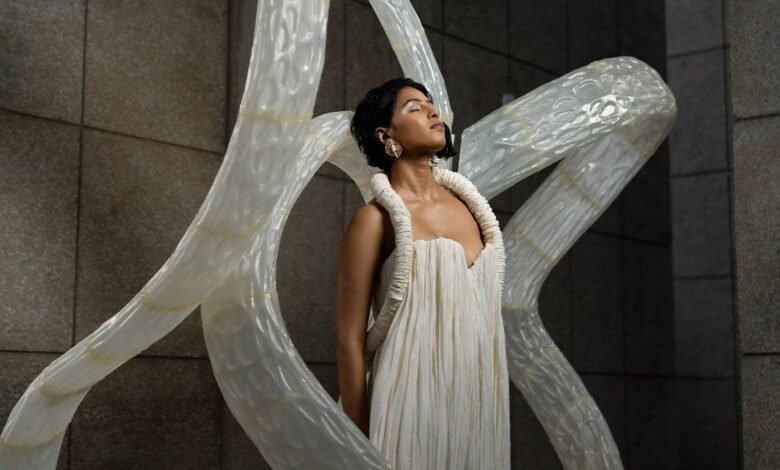
Palestine’s Ayham Hassan reimagined traditional crafts using Lunaform
Palestine’s Ayham Hassan reimagined traditional crafts using Lunaform by Gozen, and plant-based iridescent pigments from Sparxell. Tbilisi-based footwear brand Invasive Modification ventured into apparel for the first time, using a fur-effect fabric made from wool by Lanificio Becagli. India’s Srushti Patil experimented with Spiber brewed protein and Taroni silk, cultivated with organic sericulture practices.
“It’s a way to dress the innovations,” says Tubito, “to give them a shape beyond the samples we have in our archive.”
While established houses often have formal workstreams and design teams siloed into their component parts (fabrics, finishes, product development, sourcing), emerging designers have the freedom to experiment and the flexibility to incorporate innovation more easily, he explains.
To push the designers outside their comfort zone, and move from inherited ways of working into a more playful headspace, apparel designers were asked to create accessories and vice versa. Tubito says it worked wonders, flipping the design process on its head and leading to unexpected results. “Most of them didn’t start with a sketch,” he says. Instead, “they started with a lot of questions” — about how the materials worked, how to optimize them for fashion, or how to collaborate with the innovators.
An emphasis on leather The featured innovations ranged
An emphasis on leather
The featured innovations ranged from regenerative natural fibers to recycled fibers and bio-based nanocellulosics (nanoscale structures derived from plant pulp, wood, and agricultural residues), but there was a particular emphasis on alternatives to leather this year, in keeping with Kering’s new strategic objective to reduce its use of virgin animal leather by 30% before 2028.
Several of the featured innovations are like-for-like alternatives to animal leather. French knitwear brand Matho worked with Ephea, a mycelium-based alternative by Italian biomaterials startup Sqim, which Kering-owned Bottega Veneta is already selling in the form of wallets, card holders, and key chains. Meanwhile, Milan-based designer Giuseppe Buccinnà combined Planeta by Pasubio, a hybrid material combining recycled polyamide derived from end-of-life tyres with natural proteins and biopolymers, with Innovera by Modern Meadow, a bio-based component that can be processed to create nappa-like suede or embossed finishes.
“The process was largely comparable to working with standard materials, although it required greater attention to seam strength and material thickness,” says Buccinnà. Because the material had been developed to behave like a traditional leather, Buccinnà says his requests were similar to those he would take to a traditional tannery. He chose two different weights — one for the bag and one for the garment — testing different adhesives to achieve the desired drape.
We were also able to develop a custom
“We were also able to develop a custom color outside the standard palette, which was essential to achieving the conceptual intention of the garment.”
Innovation requires iteration
Iteration was a common theme. Bhumi, founded by Dutch designer Emma Van Engelen, is best known for its 3D-printed bags, which have been worn by celebrities including Julia Fox and Bridgerton’s Nicola Coughlan.
For Wardrobe Edition, Van Engelen partnered with BioCirflex3D, a bio-based, fully compostable and recyclable alternative to conventional 3D-printing filaments designed by Israeli startup Balena. It was a bumpy start, says Van Engelen. While conventional filaments have been tested extensively by different makers, and predictable hiccups come with a suite of solutions, BioCirflex3D required a lot of trial and error.
“As soon as I realized I could physically stretch the filament between my hands, I knew it was going to be a very different challenge,” she says. For weeks, every print failed, as the material stretched around the gears and clogged the machine. Unable to go to her peers for troubleshooting, it took Van Engelen several months to make it work. “The emphasis on experimentation, creativity, and quality rather than quantity made this one of my favorite projects I have been part of.”
On the opposite end of the textile spectrum, London-based designer Maximilian Raynor worked with Madagascar-based accessories brand Made for a Woman to develop ready-to-wear from their signature raffia material.
They quickly realized that it wouldn’t be possible
They quickly realized that it wouldn’t be possible for the artisans to make the full garment, because it was too complex and sat outside their technical expertise, so the artisans pivoted to making panels, which Raynor’s team could cut and sew in London. “Making a textile of such intricacy is an extremely time-consuming effort and, together with the artisans from Made for a Woman, we found a balance between ambitious, unique design and what was humanly possible,” Raynor says.
“I’m proud to work with a material that people are not used to seeing in such an extreme, elevated, high fashion context.”
Elsewhere, corset specialist Lorenzo Seghezzi worked with Lunaform by Gozen, a 100% bio-based nanocellulose material developed through the controlled fermentation of microorganisms. It was a “stimulating challenge”, says Seghezzi, who wanted to back the raw material so it would be strong enough for one of his signature corsets.
While the raw version of Lunaform was thin but sturdy, the normal backing made it too thick, and it buckled under the kind of pressure a corset necessitates. Next, he tried combining it with a fine-weave cotton coutil — as he might a silk taffeta or satin — but that meant it wasn’t as smooth or as seamless. Eventually, Seghezzi landed on bonding the materials using a double-sided fusible web.
It was a fascinating experience that pushed us
“It was a fascinating experience that pushed us out of our comfort zone and challenged us to develop innovative technical solutions,” he says. Getting designers on board
Between the regulatory rollback, political backlash and shifting priorities, it’s no secret that sustainability has been experiencing something of a recession. Getting designers on board is more important than ever, and it can’t just be sustainability metrics that win them over.
The materials have to perform. But working with new, unfamiliar materials can be a daunting task for designers, says S Style founder Giorgia Cantarini. For the Wardrobe Edition, some designers requested huge volumes of the material they were working with, so they had plenty of room for error. Part of Cantarini’s task was fortifying their confidence and encouraging them to approach it the same way they would any other garment.
“My job is to guide the designers, so they don’t get scared and give up on their creativity or over-ask,” she explains. “I try to tell them that a new material is not a limitation. They can use their knowledge to accomplish whatever they have in mind.”
Tubito and his team at MIL acted as the technical experts, helping designers navigate the collaboration with innovators, iterating on the more sustainable materials and bending it to their will.
This was a learning curve on all fronts
This was a learning curve on all fronts — when Kering MIL works with Kering brands, it usually collaborates with research and development, fabric development or product development teams, not designers. “We needed to figure out how to translate things into their cultural language,” says Tubito. “Industrial designers or pure product designers are used to working with constraints, but fashion designers are taught to start with pure vision, without taking constraints into account.
So we could not use the word ‘constraints’ at all, we had to talk instead about experimentation and the potential of the materials — challenges they could overcome.”
Most fashion designers that come up through fashion schools are taught to design vision first, supply chain second. Starting with a fiber or a fabric and then creating a garment within the limitations of the material and its production processes was a novel experience.
But this is the basis of sustainability — working with finite rewelcome challenge. “I needed to think much more comprehensively from the very beginning about how the material would behave throughout the later stages of development and construction,” notes Quine Li designer Kuai Li, who worked with silk alternative AMSilk, recycled cellulosic Circulose, and brewed protein fiber Spiber
I found it to be a very positive
“I found it to be a very positive and productive collaboration.”
Tubito is hoping that, when the project debuts next month, it will draw attention to the innovations Kering MIL has been incubating, and encourage both Kering-owned and other brands to experiment with them in a more commercial setting. Even when Kering aggregates material demand across its brands to create more meaningful volumes, Tubito says broader industry support is needed to scale innovations, not least because many require industrial infrastructure.
“Kering alone cannot scale an innovation; we don’t move large enough volumes,” says Tubito. “To truly bring the next generation of materials and technologies to market, we need to share not only demand, but also the effort, risk, and commitment required to build the industrial capacity behind them. So we hope these creative interpretations represent a starting point for the innovators, where other brands and manufacturers help them take the next steps to scale.”
Source: www.vogue.com