
A lot has changed since our ranking of all MLB farm systems going into the 2026 season. Much of that movement has come in the past few weeks as the MLB draft and trade deadline shifted the landscape.
Now — following our final organizational top 10 rankings update of the season and a fresh top 100 prospects ranking — it’s time for our updated look at how all 30 organizations stack up.
There are two things that need to be noted before we jump in here: the meaning of “quality depth” and the new calculations behind the farm value numbers.
The quality depth ranking comes from the number of prospects the team has above a 40 FV (you can read more about Future Value here). The idea is that every team, every year has at least 8-10 players at the 40 FV tier, sometimes many more. Think of that 40 FV tier as the beginning of the “common” level of prospect, where every team has a number of these, so trading for a player of that level is a “nice to have” but doesn’t change the outlook of your system or trade package much; the best and worst systems sometimes have roughly the same number of 40 FV players. Prospects above that level are more irregularly distributed across the minors and that’s who headlines trades and disproportionately becomes standout big leaguers, so this ranking is how many non-common prospects a system has.
I had been wanting to update the prospect valuation metrics as they felt a bit behind on recent trades and I hadn’t updated them by more than just an inflation adjustment for years. Luckily my friends over at FanGraphs did the heavy lifting, using an updated methodology and dollar-per-WAR figures. Here are those results, which I adapted to fit my process and it almost doubled the dollar figures: adding all 30 farm values together using the inflation-adjusted old process was $6.31 billion while this new process yielded just over $11 billion, just under a 75% increase.
Every prospect tier is now valued more highly than before, but the top 100 prospects edged up a bit (25% to 30% largely) while the tiers just below that were often doubled, give or take. That means that teams with lots of depth just outside of the top 100 were helped the most by this change, relative to other teams.
Now on to our list.
1. Milwaukee Brewers: $602.1 million
Quality depth rank: 3
Previous rank: 1
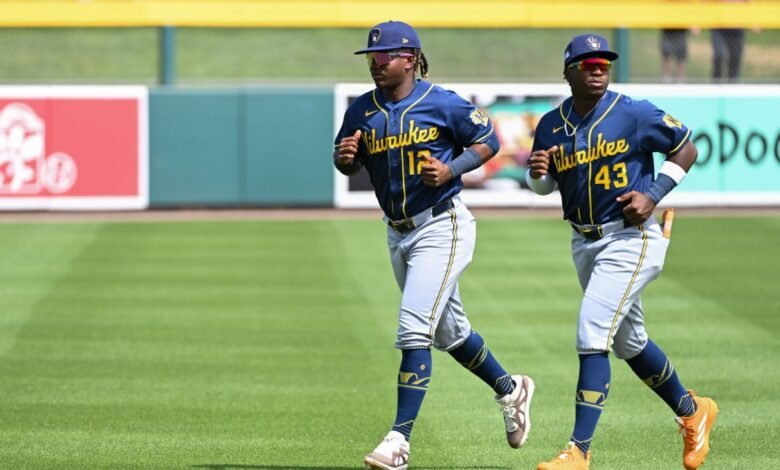
The Brewers are operating at a high level right now: they have the top prospect in the sport (Jesus Made), opened the spring with the top farm system in the sport, have the best record in the sport and despite graduating two top-50 players in the past month (Cooper Pratt and Luis Lara) and trading another top-100 prospect (Alexander Frias) at the deadline, still have the top farm system in the sport — and by a pretty solid margin.
In addition, the big league roster largely comprises homegrown players and players who got much better after Milwaukee traded for them; the scouting and development departments are working together and producing results as good or better than every other organization in baseball.
Note: I went to two decimal points to show how close these next three teams are, but called it a tie since the gap from second to fourth is less than the lowest-rated prospect on each list. In the winter when I go much deeper, these will separate a bit, and there will be trade/upgrades/downgrades from winter/fall performances.
T-2. Los Angeles Dodgers: $542.09 million
Quality depth rank: T-6
Previous rank: 4
If the Dodgers didn’t make the Tarik Skubal trade, they would have the top-ranked farm system in baseball, but since they did make the move, they fall into a near three-way tie for second.
Their outfield depth was mentioned a lot leading up to the trade, and Zyhir Hope was dealt from that surplus, but there are still eight outfielders in their top 15 prospects along with two third basemen who might end up moving to a corner outfield spot.
On the pitching side, the rise of Christian Zazueta and Zach Root make up for dealing River Ryan and seeing Jackson Ferris take a step back this season.
T-2. Baltimore Orioles: $542.05 million
Quality depth rank: 1
Previous rank: 13
The Orioles made a big move up this list over the past month-plus thanks to their return in the Adley Rutschman and Tyler Wells trades, and their July draft class.
The prospects acquired in those trades plus their top three drafted prospects — headlined by No. 7 pick Eric Booth Jr., who is already in the middle of my top 100 — total nearly $200 million in prospect value, moving the Orioles from 17th to a tie for second.
Additionally, Caden Hunter, Joseph Dzierwa and J.T. Quinn — all college pitchers selected in the 2025 draft — have taken big steps forward this year. There should be a lot of potential impact talent reaching Baltimore.
T-2. Tampa Bay Rays: $542.00 million
Quality depth rank: 2
Previous rank: 12
The Rays traded two players in the 75-150 range of the overall prospect list at the deadline (Michael Forret and Brayden Taylor) and still moved well up from their preseason ranking because of a combination of 2025 draft breakouts (including Cooper Flemming and Taitn Gray), a strong 2026 draft class headlined by the No. 2 pick (Grady Emerson), and a few more breakouts from players outside of those two draft classes. Caden Bodine was acquired from Baltimore last offseason as part of the Shane Baz deal and has been fantastic in pro ball, moving into the top half of the top 100.
5. St. Louis Cardinals: $476.4 million
Quality depth rank: 4
Previous rank: 9
I sang the praises of St. Louis’ 2026 draft — my favorite in the entire sport — and the Cardinals are also seeing solid returns from their 2025 draft class and 2026 trade deadline haul. Those three prospectr top 15 prospects were acquired last winter
The new regime is cooking on the scouting and development end of things, with Joshua Baez being the big league example while the rest of the players I’m referencing are spread across the minor leagues.
6. Detroit Tigers: $471.8 million
Quality depth rank: 5
Previous rank: 6
Kevin McGonigle is the big graduate from Detroit’s system, but Max Clark is in the big leagues early enough in the summer that he might also graduate before the season ends. Bryce Rainer has been tough to evaluate this year, with huge, worrying in-zone miss, but is a standout at everything else to the point that I still think he can dial it in to reach his big league potential.
Zyhir Hope, River Ryan, and Brady Smith were acquired in the Tarik Skubal blockbuster, and the first two are 2027 big league options in the middle of the top 100 while Smith is a premium lottery-ticket type who could join them if he continues on this trajectory.
Keep an eye on Lucas Elissalt as a riser; he’s in the conversation with Smith, 2026 first-rounder Cameron Flukey, 2026 deadline return Kash Mayfield, 2025 second-rounder Malachi Witherspoon and new big leaguer Andrew Sears for second-best pitching prospect in the organization.
7. San Francisco Giants: $467.0 million
Quality depth rank: T-6
Previous rank: 19
The system is looking up here, after adding Ramon Marquez, Joniel Hernandez and Henry Lalane at the deadline, Jackson Flora, Carson Bolemon, Kaden Waechter and Peyton Bonds in the draft, and seeing the continued rise of international signees Josuar Gonzalez, Luis Hernandez, Jhonny Level and Keyner Martinez. This group is largely at the lower minors, so they should all stay on the list next season and give this system ranking a good bit of upside.
8. Minnesota Twins: $457.5 million
Quality depth rank: T-6
Previous rank: 8
There’s a lot of upper minors talent here: Kaelen Culpepper is now in the big leagues, Walker Jenkins, Emmanuel Rodriguez, Hendry Mendez and Gabriel Gonzalez are all outfielders currently in Triple-A with three players in the top 10 in Double-A.
Vahn Lackey (No. 3 pick in 2026 draft) is behind them, but probably joins them in the upper minors at some point next season, so this wave of talent could be delivering nine of the top 11 prospects in the system to the majors at some point next season.
9. Miami Marlins: $451.4 million
Quality depth rank: T-10
Previous rank: 10
The rise of Aiva Arquette, Cam Cannarella and Karson Milbrandt along with the acquisition of Brayden Taylor and drafting of Jacob Lombard and Ethan Kleinschmit make up for injuries to Thomas White and Robby Snelling and graduations of Owen Caissie and Joe Mack, keeping this system in basically the same spot all season.
Those two injured prospects should be back at full strength next season and all but the recent draftees in the top 11 prospects in the system should start 2027 in the upper minors, so another wave is about to arrive in Miami.
10. Washington Nationals: $436.6 million
Quality depth rank: T-10
Previous rank: 14
The Nats have developed a lot of depth in the last year or so under their new regime, after the 2025 draft class has already signed. Eli Willits looks like an excellent pick and now 2024 first-rounder Seaver King also looks like a strong pick, headlining the system from the previous regime.
Travis Sykora and Jarlin Susana (recently returned from injury) have been injured this year but could show frontline potential in bulk innings again next season. Devin Fitz-Gerald (now the 100th-ranked prospect in baseball after Luis Lara’s graduation) and Gavin Fien look solid from the MacKenzie Gore return, and Coy James, Miguel Sime Jr. and Landon Harmon are intriguing from the 2025 draft haul.
I was higher than many on Chase Brunson and Luke Williams from the 2026 draft group; I’ll wait and see how Chris Hacopian (first-rounder) bounces back from injury in 2027.
11. Seattle Mariners: $394.7 million
Quality depth rank: T-19
Previous rank: 7
The M’s now have Kade Anderson in the big leagues, Michael Arroyo and Lazaro Montes in Triple-A, and Ryan Sloan, Felnin Celesten and Jonny Farmelo in Double-A. That’s six of their top seven prospects (all in the top 150 in the sport) in the upper levels, all potentially in the big leagues at some point in the next 12 months.
That’s obviously great for helping the big league team (in addition to recent graduate Colt Emerson), but also points to a potential vacuum of impact talent behind them in the farm system. Ace Reese, Nick Becker, Jake Brown and Mason Peters are the tip of that spear but aren’t at that level to compete with the aforementioned group yet.
12. Cleveland Guardians: $381.9 million
Quality depth rank: 9
Previous rank: 2
The Guardians graduated Travis Bazzana, Parker Messick and Chase DeLauter this year, with Angel Genao also now in the big leagues, and Ralphy Velazquez, Cooper Ingle, Daniel Espino, Kahlil Watson and Justin Campbell all in Triple-A among their top 15 prospects; six more of the top 15 are in Double-A.
That’s a first wave that started arriving this year and another that will reach the majors next year, possibly also in 2028, that could extend/improve the Guardians’ current window.
Note: I’m calling this a tie between the Pirates and Angels, even closer than those ties for second overall. They’ll separate more in the offseason update as I go deeper into the list and there will be trades and/or strong fall/winter performances, etc. but it’s a dead heat right now.
T-13. Pittsburgh Pirates: $367.86 million
Quality depth rank: T-13
Previous rank: 3
The Pirates graduated Konnor Griffin, Bubba Chandler, and Esmerlyn Valdez and now their top five prospects are mostly in one of the A-ball levels, aside from Murf Gray just getting to Double-A about a month ago.
That means there is probably another full year in the minors (or at least of prospect eligibility) for the top of this system, with Seth Hernandez as the headliner — and now the top pitching prospect in the sport if/when Kade Anderson graduates — so there’s some upside in this ranking over the next 12 months.
T-13. Los Angeles Angels: $367.86 million
Quality depth rank: T-10
Previous rank: 27
The Angels have finally broken out of the 23-30 range I’ve had them in for the eight previous farm rankings since the winter of 2021. It’s not a coincidence that this coincided with a more targeted draft approach, focusing on what has been working for them (making a number of medium-sized bets on high school prospects with upside) and steering away from what hasn’t been working (rushing college prospects to the big league roster and holding their breath).
Adding Arjun Nimmala, their new top prospect, in a deal with Toronto at the deadline obviously doesn’t hurt, but Dylan Jordan, Johnny Slawinski, Hayden Alvarez, Trey Gregory-Alford, Talon Haley and C.J. Gray are also all arrow-up from the high school/international markets.
15. Atlanta Braves: $359.7 million
Quality depth rank: T-13
Previous rank: 26
Since the winter of 2022, I’ve had the Braves somewhere between 26th and 30th in the farm rankings but now they have broken out well clear of that range, even after graduating two top-100 prospects this season in Didier Fuentes and JR Ritchie.
Tate Southisene, Eric Hartman and Conor Essenburg are among the three biggest arrow-up prospects in the entire minor leagues, all driven in large part because of above-average-to-plus raw power that’s showing up in games along with real-to-strong speed/defensive value.
Backfilling those graduations with a deep draft class as the fruits of a unique strategy to spread bonus money around has the Braves set up with a system that has a bit of everything: depth, upside, lottery tickets and established blue-chippers across all levels.
16. Boston Red Sox: $351.9 million
Quality depth rank: T-26
Previous rank: 11
The Red Sox graduated Payton Tolle, Connelly Early (since traded) and Jake Bennett, and then also traded Anthony Eyanson, Enddy Azocar, Kyson Witherspoon, Harold Rivas, Tyler Uberstine, and Jojo Ingrassia at the deadline. That’s a lot of talent leaving one system.
Much of that loss is made up for by the incredible rise of Franklin Arias (now the second-best prospect in the sport), along with smaller-but-notable rises from Justin Gonzales, Henry Godbout and Franklin Primera — along with a draft haul headlined by Jake Schaffner, Owen Hull, Jace Mataczynski and Martin Shelar.
Obviously, the Red Sox would be much higher without the Adley Rutschman trade (a hair under $100 million in prospect value left in that deal, so that alone would move them to roughly 10th), but this isn’t a barren system and it features a loud headliner.
17. Athletics: $348.9 million
Quality depth rank: T-19
Previous rank: 18
Gage Jump is the notable graduate from this system, but Joshua Kuroda-Grauer isn’t far behind once he returns from the IL. Leo De Vries is the clear headliner as the No. 4 prospect in baseball, while much of the rest of the system held serve, though Jamie Arnold’s strike-throwing issues moved him down a bit within the top 100.
Drew Burress (2026 first-rounder) could move quickly to join much of the rest of the top of the system (the aforementioned plus Wei-En Lin, Devin Taylor, Tommy White and Kade Morris) in the upper levels
18. Kansas City Royals: $312.7 million
Quality depth rank: T-17
Previous rank: 24
Carter Jensen is the notable graduate, and of the top 13 prospects in the system that’s Justin Lamkin, a 2025 draftee, is the only one in the upper minors. The last wave of prospects either stalled out or reached the big leagues, and now the next group is made up mostly of players from the past two drafts and international signing classes.
It’s a dead heat between Angeibel Gomez, Josh Hammond and Kendry Chourio as the biggest potential impact types from this group. Keep an eye on 2026 second-rounder Jack Slightom, a spring popup arm with midrotation upside.
19. Colorado Rockies: $308.9 million
Quality depth rank: T-19
Previous rank: 28
The new regime has steered the system out of the bottom five and back into the range they’ve been in often over the past five-plus years; just a bit below average.
Cole Carrigg is the only notable graduate and there are a number of arrow-up prospects to go with a solid incoming draft class; five players drafted this summer landed in their top 12. The most encouraging arrow-up prospect is Ethan Holliday, who had a lot hanging on his 2026 full-season debut to help explain if he’d be able to hit pro-level pitching; he played only 33 games because of a foot injury that ended his season, but the answer looks to be yes.
20. Chicago White Sox: $300.6 million
Quality depth rank: T-19
Previous rank: 20
The White Sox graduated Noah Schultz, Braden Montgomery and Sam Antonacci this year, while adding a strong draft class headlined by No. 1 pick Roch Cholowsky to backfill.
Caleb Bonemer has had a huge season (33 homers across High-A and Double-A) but there are still questions about his ultimate defensive home and bat-to-ball ability. Hagen Smith is in the big leagues but needs another notch of control to stick as a starter, and Billy Carlson needs to lift the ball more to get to his raw power in games.
Keep an eye on Joey Volchko as a potential 2027 breakout with some development tweaks, same goes for outfielder Jaden Fauske possibly breaking out with a bit more loft in his swing.
21. Cincinnati Reds: $296.6 million
Quality depth rank: 25
Previous rank: 15
Sal Stewart, Rhett Lowder and Chase Petty have all graduated this year, and Alfredo Duno has held his spot as the top prospect in the system while Aaron Watson has taken a big step forward.
Beyond that, it has been quite mixed; 2025 first-rounder Steele Hall, 2026 first-rounder Justin Lebron and 2024 second-rounder Tyson Lewis have big tools but all come with bat-to-ball questions. Hector Rodriguez is in the big leagues, but many of the best players in the system are at the lower levels.
22. Texas Rangers: $290.9 million
Quality depth rank: T-19
Previous rank: 22
Top prospect shortstop Sebastian Walcott sat out much of the season because of injury but is back on the field now and performing solidly. Yolfran Castillo picked up some of the slack in the interim, stealing 50 bases with a .383 on-base percentage as a 19-year-old shortstop in Single-A. Caden Scarborough’s velo is down a bit but his traits are still present, so he could be a 2027 breakout.
The 2026 draft approach was risk-seeking with Gio Rojas, Brody Bumila and Connor Comeau all from the high school ranks; the industry was surprised Texas took that approach.
23. Toronto Blue Jays: $278.8 million
Quality depth rank: 16
Previous rank: 16
The Jays graduated Trey Yesavage and traded Arjun Nimmala, losing their top two prospects from the preseason ranking. JoJo Parker has continued to progress, and Sean Keys, Nolan Perry and Blaine Bullard also improved their profiles. Lefties Ricky Tiedemann and Dasan Hill (acquired from Minnesota at the deadline) have big upsides and are worth monitoring, and fellow lefty Johnny King got to Double-A a couple of weeks after he turned 20.
Toronto also did well with less draft capital than usual this season, landing Will Brick and Cole Carlon.
24. New York Mets: $277.6 million
Quality depth rank: T-15
Previous rank: 5
The Mets have graduated Nolan McLean, Carson Benge, A.J. Ewing and Zac Thornton this season while Jonah Tong and Ryan Clifford both regressed and I wasn’t nuts about how they allocated their draft dollars.
On the bright side, Elian Pena has progressed, Wandy Asigen debuted and played well, and they acquired No. 39 overall prospect Jefferson Rojas at the deadline.
25. New York Yankees: $264.2 million
Quality depth rank: T-26
Previous rank: 23
Spencer Jones was the only notable graduate, though George Lombard Jr. should get there this season and Elmer Rodriguez also has had some big league time. Dax Kilby and Carlos Lagrange both dealt with injuries, and Richard Matic, Wilberson De Pena, and Yostin Pena were among those emerging at the lower levels.
The draft haul (Hunter Dietz, Sean Duncan, Brendan Borck, Paul Contreras, Bear Harrison) has plenty of upside and could help to add more depth to the system with a breakout or two next season from the group.
26. Arizona Diamondbacks: $257.8 million
Quality depth rank: T-17
Previous rank: 21
The D-backs graduated Ryan Waldschmidt, Tommy Troy and Brandyn Garcia to the big league team, then traded Daniel Eagen and Sandro Santana (plus a player to be named) for Lars Nootbaar, which represents a lot of value leaving the system this season.
There wasn’t a huge breakthrough at the top of the system this season and second baseman Demetrio Cristantes is the only top-100 prospect, so the draft additions and movement below that tier haven’t moved the system ranking up that much.
27. Chicago Cubs: $250.9 million
Quality depth rank: T-19
Previous rank: 25
The Cubs have graduated Moises Ballesteros (who was traded to the Angels at the deadline) Kevin Alcantara and Pedro Ramirez, then also traded Jefferson Rojas at the deadline along with some depth players for the system.
Jaxon Wiggins has had injury and command issues this season, but the emergence of Josiah Hartshorn, Owen Ayers, Kaleb Wing and Kane Kepley has helped balance out those losses.
28. Philadelphia Phillies: $224.0 million
Quality depth rank: 29
Previous rank: 17
The Phillies embrace risk in the draft and in trading young players for big leaguers. Right-hander Ramon Marquez was the headliner to land Luis Arraez and Marquez was a big riser, landing No. 46 on the updated top 100 last week. In the draft, the Phillies embraced hit tool and reliever risk with many of their top picks; obviously that has worked out for them at times in the past.
Shortstop Aidan Miller’s lost season to injury and the graduation of Andrew Painter and Justin Crawford hurt the ranking here, but the emergence of right-hander Gage Wood (43rd on the top 100) and outfielder Francisco Renteria (sitting at 119th right now, for those curious) has helped.
29. Houston Astros: $211.9 million
Quality depth rank: T-26
Previous rank: 29
The Astros finally had a strong group of draft picks to work with this year and their top five 2026 picks are now all in the system top 10: left fielder Logan Hughes, right-hander Jack Radel, third baseman Beau Peterson, shortstop Keon Johnson and left-hander Wes Mendes.
There’s some upside at the top, as well, with outfielder Kevin Alvarez, third baseman Xavier Neyens and shortstop Albert Fermin, so things are looking up, but all of those players were acquired in the last year-plus, so it’ll take a bit for them to show up in the upper levels and really move this ranking higher.
30. San Diego Padres: $185.4 million
Quality depth rank: 30
Previous rank: 30
The Padres continue to go for it at the deadline and are in position to grab a wild-card spot. Trading left-hander Kash Mayfield and shortstop Joniel Hernandez (among others) earlier this month will hurt as both are in the 101-150 overall range in my updated rankings.
San Diego is bullish on its top two draft picks this year (right-hander Coleman Borthwick and shortstop Elliot Lascelles), and catcher Ethan Salas is back on track, but the farm looks pretty ordinary behind that group.
Source: www.espn.com