

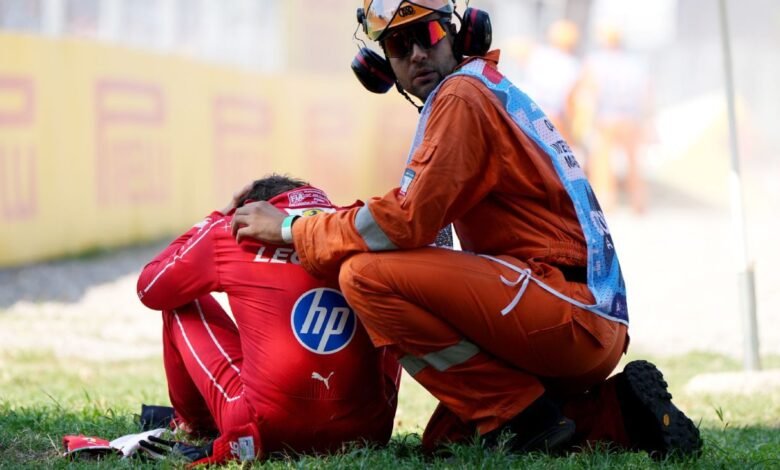
Italy — If you wanted two laps of Formula 1 racing that encapsulated the misery, frustration and perpetual humiliation of rooting for modern Ferrari, the disaster-class provided by Lewis Hamilton and Charles Leclerc at the start of Sunday’s Italian Grand Prix was a perfect example
Fittingly, Italy’s longest-running sporting disappointment opted to inflict the latest volley of misery on its tifosifanbase on the same day the nation’s new sporting icon and F1’s championship leader, Kimi Antonelli, delivered one of the most magnificent drives you’ll see: victory from 19th on the grid, the farthest back anyone has ever come from to win, for the sixth victory of his career and the first by an Italian at Monza since 1966.
While Ferrari’s wait for a first drivers’ championship since 2007 and constructors’ championship since 2008 will each roll on for another year, Italy’s wait for its first Formula 1 world champion since Alberto Ascari in 1953 will almost certainly be ended by Antonelli some time in the next four months.
Perhaps history books will mark Sept
Perhaps history books will mark Sept. 6, 2026, as the day Italy was finally able to call time on its tortured and toxic love affair with Enzo Ferrari’s historic team. Maybe it is time instead for this proud racing nation to pour its heart and soul into the Bologna prodigy Mercedes snatched from under Ferrari’s noses as a boy.
It all happened so fast.
When nine Italian Air Force planes swooshed over Monza’s grid 10 minutes before the start of the race to display the nation’s famous red, white and green Frecce Tricolori, there was still reason to believe either of Ferrari’s two cars could do something special for the home crowd.
Leclerc and Hamilton were starting on the second row of the grid: Antonelli was starting at the back, leaving George Russell vulnerable in second place, where he started next to surprise pole man Pierre Gasly with a long run down to Turn 1 to navigate. The opportunity to claw back some ground in the title fight appeared to be right there.
Less than three laps and 10 miles
Less than three laps and 10 miles of racing later, the whole thing was in tatters.
Hamilton was forced wide after a clumsy attempt to pass Leclerc at Turn 1, before Leclerc spun out at the Parabolica. Ferrari might not have had the outright pace to have challenged Mercedes or Red Bull, who claimed third with Max Verstappen, but it never even gave itself the chance to find out.
Italians have a lot of phrases to describe the kind of extreme annoyance or disappointment the red cars have regularly delivered in the modern era. “Mamma mia” is perhaps the easiest and most clichéd to reach for, but there is one more appropriate, one more synonymous with the north of Italy: “porca miseria,” which literally translates as either “pig misery” or “damned poverty.” This was misery of a uniquely Ferrari vintage, and one that could reverberate deep through the team in the coming weeks and months.
The Chosen One vs. The GOAT
The start of Ferrari’s race had all
The start of Ferrari’s race had all the hallmarks of two teammates who fundamentally do not trust one another. The two cars went side by side into Turn 1, with Hamilton waiting very late to plunge his car down the inside of his teammate. There are no codified rules of wheel-to-wheel racing in Formula 1, but it is usually the accepted logic that the car on the outside of a corner is the one who should take greater responsibility for anything that follows. It’s not an exact science, but it is usually a good rule of thumb.
Monza’s first corner is a right-left chicane, meaning Hamilton was the car on the outside at the exit. As the cars progressed through the second phase of the chicane, Hamilton was running out of space. While Leclerc then appeared to drift across to the kerb on exit — he would later admit he could have taken a tighter line out of the corner himself to free up more space — Hamilton’s initial move and then refusal to back down left him with nowhere to go as the track snaked back to the left. Hamilton’s attacking move was aggressive, and Leclerc’s defensive move was aggressive — even more so when you consider both were done against the other Ferrari.
The blame game will rumble on for days, but one fair conclusion to take is that neither man raced the other like it was their teammate, despite the fact that everyone in the team had acknowledged what a golden opportunity Sunday’s race was to do something to change the feeling of the season and recent races. And that, more than anything else, revealed everything you needed to know about the tensions that have been bubbling away (largely without being addressed by Ferrari) between Leclerc and Hamilton for the past couple of months.
We are definitely going to have
“We are definitely going to have it on after this race,” Hamilton said shortly afterward on a radio message not broadcast on the world TV feed, which seemed to be a reference to the continuing push he’s made for the team to wise up and start racing as a team.
Leclerc’s crash two laps later came as he got wide through the Parabolica, likely starved of battery and off the racing line as McLaren’s Oscar Piastri powered past him, something he later suggested was related to a power unit issue. Maybe there was also a hint of desperate or angry driving, perhaps, but a mistake that made the incident on Turn 1 all the more painful. Just like that, one Ferrari’s race had been totally compromised, the other’s race was totally over. Even with a restart and a mid-race Virtual Safety Car, Hamilton faded and finished sixth on what had promised to be a much better afternoon.
Given all that, it was quite audacious when Leclerc arrived in the media pen shortly after his crash and seemed affronted by the mere suggestion that all is not well between him and his seven-time world champion teammate.
I don’t really know who is forcing
“I don’t really know who is forcing that narrative that we are one against the other,” he said to a question about the Turn 1 incident. “At Zandvoort there were way too many talks already.”
There was some of George Orwell’s “1984” about it all: The party told you to reject the evidence of your eyes and ears.It was their final, most essential command.
Zandvoort’s Dutch Grand Prix had, in fact, appeared to offer obvious evidence that something is fundamentally flawed deep inside F1’s most decorated team. At a crucial point in the race, Leclerc had appeared to refuse Ferrari’s request to move over for Hamilton when the seven-time world champion was on a far superior strategy at that moment in time. Ferrari had then dithered instead of forcing the issue. It was baffling in the moment and even more so in hindsight, likely costing the team a podium finish — if not more.
Hamilton was irate, especially when he saw old
Hamilton was irate, especially when he saw old team Mercedes deliver a clinical team order of its own to ensure one of the team’s two drivers won the race: whether fair or not on Russell was a different argument, the team did it and, after mild protests, Russell obeyed. It spoke a lot about how Mercedes’ operation — one Hamilton knows all too well — is run.
Hamilton’s frustration had come out in the form of a series of curt and sarcastic radio messages. “Great way of wasting time, guys. Good job,” the Englishman had said at one point. Curiously, that evening he had posted an extensive apology to Instagram: “That wasn’t the best version of me. I take responsibility for that, and I’ll be better.”
It felt slightly odd, given that Hamilton’s complaints in the race had been justified. But an omertà has always existed at Ferrari. Alain Prost was infamously sacked on the spot in 1991 when he suggested his Ferrari was like a truck. Some more conspiracy-minded folk in the paddock might have been forgiven for thinking larger forces could be behind Hamilton’s groveling row-back after Zandvoort. After all, who can forget Ferrari chairman John Elkann effectively telling his drivers to shut up and drive after the Brazilian Grand Prix last year.
Ferrari academy graduate Leclerc, who has always been
Ferrari academy graduate Leclerc, who has always been the good soldier for the team and who several months ago was handed a contract extension stretching into the 2030s, did what he has always done so well: he took on some of the blame himself, but also managed to de-escalate when others might have chosen to escalate the situation.
“Here it’s true, though, that we went too far, I think, [with] Lewis in Turn 1,” Leclerc later said. “Then in Turn 2 I tried to do the tightest corner possible, but that was just not enough, and doing it here is not good.”
As if to prove the disconnect there appears to be on either side of the Ferrari garage, Hamilton, who has a contract for next year and then nothing beyond that as it stands, disagreed with that assessment completely when Leclerc’s viewpoint was put to him.
I was ahead in Turn 2,
“I was ahead in Turn 2, by the apex, I was ahead. There was no ‘we’ in it,” Hamilton said on Sunday afternoon. “Afterwards we will take it offline and talk about it.”
He came into the weekend 59 points behind Antonelli in the championship, but 33 points ahead of Leclerc. Part of his desperate pleas for some help on strategy in Zandvoort were rooted in the feeling that, while both Ferrari drivers came into the Italian Grand Prix with slimming title chances, his were at least slightly better and more realistic than Leclerc’s. Qualifying at Monza had left him exasperated for the same reasons. A late call to leave the pits saw him barely scrape through to Q3, before a messy Q3 saw him end up behind Leclerc.
“The team was solely focused on trying to get an equal tow for each driver and we just stumbled,” Hamilton said on Saturday. On the team’s title chances, he’d added, “There’s light at the end of the tunnel, but it’s getting dimmer the further we get through.”
Hamilton’s qualifying media comments were as close
Hamilton’s qualifying media comments were as close as a driver could come to saying he needed to be prioritized in terms of strategy without actually saying it in those exact words. Given how Sunday unfolded, he could be forgiven for feeling exasperated again: that sliver of light at the end of the tunnel he referenced appeared to have vanished, and it was all Ferrari’s fault.
Even if Hamilton and the team now have those discussions “offline,” as Hamilton put it, doing so after the golden opportunity of Monza perfectly summed up what the problem is.
“I think from today, we’ve just lost so much ground to them on points. It’s far too late for those decisions to come,” he said on Sunday. “It’s many, many weeks too late. All I can do is just try and turn up. I’ll get up tomorrow morning and I’ll give it my best.”
It’s important to note here: Hamilton has not
It’s important to note here: Hamilton has not been demanding that Leclerc always move out of his way, or that Ferrari suddenly adopt a No. 1 and No. 2 driver. It’s more generalized than that. At Mercedes, he and teammate Nico Rosberg infamously ended up with rules of engagement after they collided while fighting for the lead of the 2016 Spanish Grand Prix — “there are no rules [of engagement] here,” Hamilton added on Sunday — when Toto Wolff felt his two battling drivers had overstepped the mark one too many times. He felt his drivers had breached the two-way trust that had existed: Wolff knew his drivers would put the team first, and his drivers would accept (sometimes reluctantly) that decisions made on the pit wall were for the good of wider team picture. That does not seem to be the case for his new team. Hamilton revealed that even in strategy meetings, it is rare for Ferrari to discuss awkward or tricky situations where one driver might simply need to be given the better call, as he had felt was the case at the Dutch Grand Prix.
Those decisions rest above Hamilton’s head.
“Ultimately it comes from the top,” he said. “It trickles down decisions. It starts with Fred [Vasseur]. There’s only so much you can say, so much you can push and shove and mount the top. Yesterday I said we’ve got to look at how we communicate. If we continue to travel the same path, we get the same result. We keep getting the same result. We’ve got to change things because it’s not helping us move forward.”
The reference to Vasseur was curious. After his memorable first Ferrari win in Barcelona earlier this year, Hamilton had lauded Ferrari’s team boss for listening to his demands on things that needed changing internally. Hamilton had begged his team to trust his experience and title-winning pedigree and had started to see progress: he had changed brake material earlier in the year, something that immediately appeared to come with an uptick in results.
Yet for some reason, several months on, Hamilton’s
Yet for some reason, several months on, Hamilton’s push for change in other areas appears to be going nowhere. Even more curious than the reference to Vasseur, and perhaps because by this point Hamilton had already said too much about F1’s most delicate team, he immediately changed his tune when asked exactly why his demands were being listened to a few months ago, but seemingly not now.
“I know what you guys are trying to do,” Hamilton replied. “I don’t want to get into arguing and fighting about my team.”
Unfortunately for Hamilton, Leclerc and Vasseur, that ship seems to have sailed.
Source: www.espn.com